

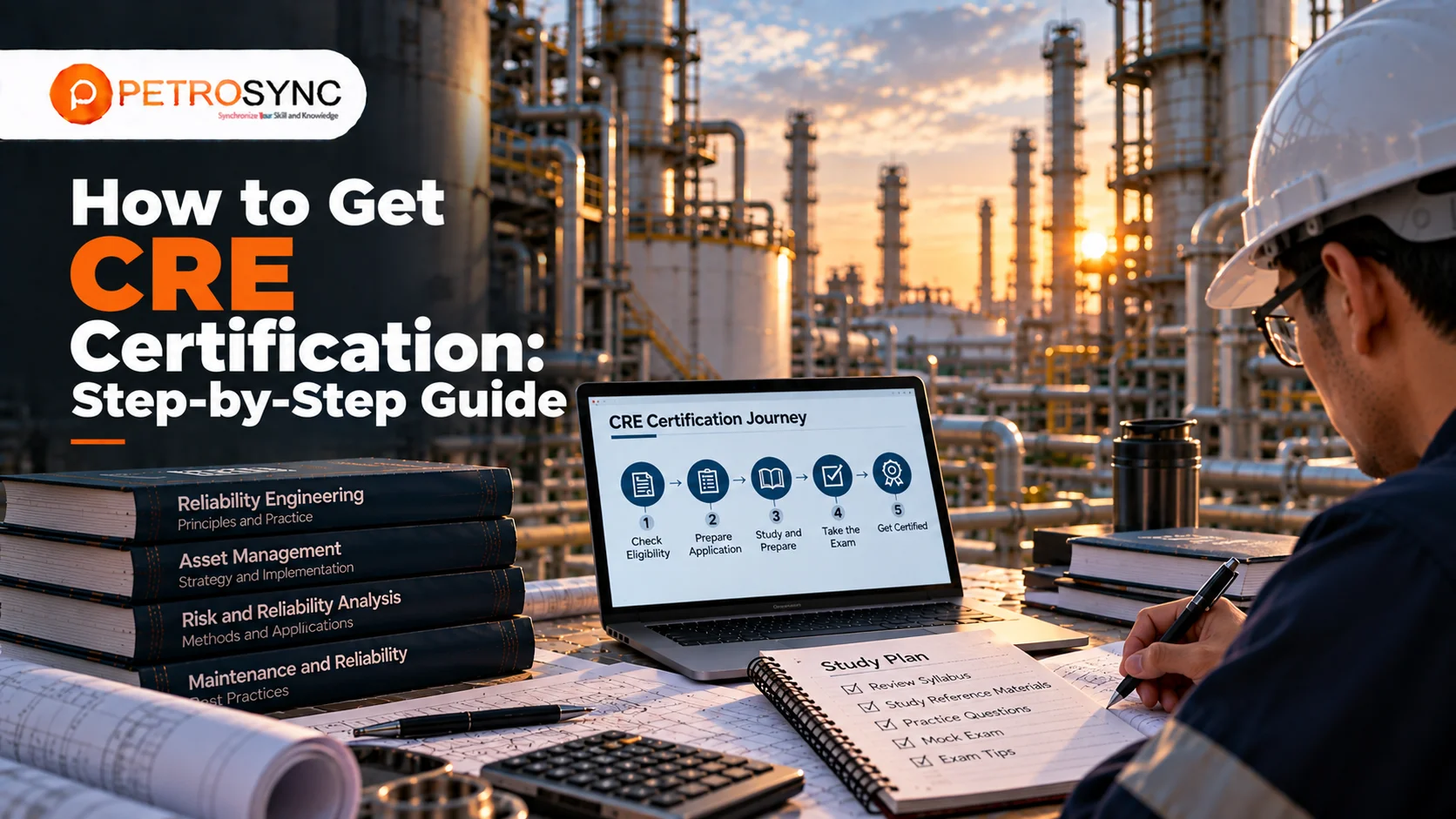
- Getting ASQ CRE certified is a process: verify eligibility, prepare, apply, pass ASQ review, schedule, take and pass the exam, claim the credential, and maintain it.
- ASQ—not PetroSync—sets CRE eligibility, reviews applications, administers certification policy, and issues the professional credential.
- CRE preparation is optional; candidates can self-study, use structured training, or combine both, but training does not create eligibility.
- Approved computer-based testing candidates currently schedule through Prometric after ASQ approval, while paper-based or translated exam routes follow different instructions.
- After certification, CRE must currently be maintained every three years through 18 recertification units or the exam route.
The Certified Reliability Engineer (CRE) discussed here is the professional credential administered by the American Society for Quality (ASQ). Getting certified involves more than enrolling in a course and taking an exam. Candidates first need to meet ASQ eligibility requirements, prepare against the CRE Body of Knowledge, submit an application, complete ASQ review, schedule and pass the exam, claim the digital credential, and then maintain it through recertification. This guide focuses on that end-to-end process rather than deep eligibility rules, study strategy, or test-day tactics.
How Do You Get ASQ CRE Certification?
To get ASQ CRE certification, first confirm that you meet the current eligibility rules. Then review the CRE Body of Knowledge and prepare, submit your application to ASQ, complete the eligibility review, schedule the approved exam, take and pass it, receive the result and digital credential, and maintain the certification through the current recertification process.
|
Step |
What You Need to Do |
Who Controls It |
|
Eligibility Check |
Verify experience and any education waiver |
ASQ |
|
Preparation |
Review the BOK and build a study plan |
Candidate / optional preparation provider |
|
Application |
Submit CRE application and applicable fee |
ASQ |
|
Review |
Respond to approval or hold |
ASQ |
|
Scheduling |
Book an approved exam appointment |
ASQ / Prometric |
|
Exam |
Take and pass the CRE exam |
ASQ |
|
Credential |
Receive result and claim digital credential |
ASQ / Accredible |
|
Recertification |
Maintain the credential every 3 years |
ASQ |

Step 1: Check Whether You Meet CRE Eligibility
Before preparing or paying for an application, confirm that you satisfy the current ASQ eligibility requirements. ASQ currently requires 8 years of relevant on-the-job experience, including 3 years in a decision-making position, from a full-time paid role. Qualifying education can reduce the total experience requirement through one education waiver.
1. Check Your Relevant Work Experience
Your experience should relate to one or more areas covered by the CRE Body of Knowledge. Relevant work can involve reliability management, statistics, design and development, reliability modeling, testing, maintainability, availability, or failure and reliability data analysis.
A job title alone does not determine eligibility. A reliability engineer, maintenance specialist, quality engineer, asset-management professional, or technical lead may perform qualifying work depending on actual responsibilities. Candidates should compare the substance of their experience with current ASQ requirements rather than assuming every technical year automatically counts.
2. Check the Decision-Making Requirement
Within the overall experience requirement, ASQ currently requires 3 years in a decision-making position. The role does not need to carry a formal management or supervisory title.
What matters is whether the candidate had authority to define, execute, or control projects or processes and responsibility for the outcome. This can exist in technical roles as well as management roles. Candidates should assess actual authority and accountability instead of relying only on seniority or job title.
3. Apply an Education Waiver if Relevant
Qualifying education can reduce the total 8-year experience requirement. Current ASQ rules provide different waivers for technical or trade school credentials, associate degrees, bachelor’s degrees, and graduate degrees, with only one waiver applied.
The waiver reduces total required experience; it should not be treated as a substitute for the separate decision-making requirement. Candidates who need the full waiver detail should use current ASQ information before calculating their eligibility.
Step 2: Review the CRE Body of Knowledge and Prepare
Once eligibility is clear, review the current CRE Body of Knowledge and build a preparation plan around your strengths and gaps. Preparation is not an eligibility requirement, but candidates still need enough familiarity with the reliability-engineering domains, references, calculations, and problem-solving approaches covered by the certification.
1. Review the Current CRE Body of Knowledge
The CRE Body of Knowledge spans reliability management, probability and statistics, design and development, modeling and prediction, reliability testing, maintainability, availability, and the use of reliability and failure data.
For this certification-process guide, those domains are only a preparation checkpoint. Candidates who need deeper topic coverage should review a dedicated Body of Knowledge guide rather than trying to turn the certification journey into a full syllabus.
Read Also: CRE Body of Knowledge: Essential Guide for Experts
2. Use Current ASQ Preparation Resources
ASQ currently directs CRE candidates to the official Body of Knowledge, references used as the basis for exam questions, the CRE Question Bank, and the ASQ CRE Handbook. The Question Bank supports sample-question practice, timed simulation, and review modes.
Because the CRE exam is currently open book, preparation should include familiarity with the references candidates intend to use, not only memorization. Resource availability and exam rules can change, so official ASQ information should remain the authority.
3. Choose Self-Study, Structured Training, or a Hybrid
Candidates can prepare independently, join structured training, or combine both approaches. Self-study may suit professionals who already know the BOK well and can manage their own study schedule, while structured training can help organize complex domains and provide guided practice.
Neither route creates ASQ eligibility. Training should be treated as optional preparation support, while the official application and certification decision remain with ASQ.
Step 3: Submit Your ASQ CRE Application
After confirming eligibility and deciding how to prepare, submit the CRE application through ASQ. Candidates should use the current ASQ application process and confirm applicable fees before payment. Exam windows and application deadlines change, so this evergreen guide does not reproduce specific current testing dates.
1. Complete the ASQ CRE Application
The official application is submitted through the current ASQ certification process. Candidates should provide the information requested by ASQ and make sure the application accurately reflects their eligibility.
This guide does not assume that the same supporting documents are required for every candidate. If ASQ asks for additional information during review, respond to the specific hold request rather than relying on a generic checklist from an older article or third-party training provider.
2. Confirm the Current Application and Exam Fee
As verified on Sep 29, 2026, ASQ lists USD 550 for the initial CRE exam, USD 450 for ASQ members, and USD 350 for a retake. These amounts are current at the verification date, not permanent prices.
Candidates should check the official CRE page immediately before payment because certification fees can change. PetroSync training fees are separate from ASQ certification fees and do not replace the official application or exam payment.
3. Select the Applicable Testing Window
ASQ publishes testing windows and application deadlines for CRE. Candidates should choose a window that fits their preparation timeline and complete the application before the applicable deadline.
Because those windows change throughout the year, this guide intentionally avoids locking current dates into evergreen copy. The relevant window should be confirmed directly on the ASQ CRE page when the candidate is ready to apply.
Step 4: Wait for ASQ Application Review
ASQ reviews the application to determine whether the candidate meets CRE exam requirements. Current guidance states that online applications are typically reviewed within 1–2 business days and hardcopy applications within 3–5 business days. After review, the candidate receives approval or a hold asking for more information.
1. Receive Approval or a Hold
An approved application allows the candidate to move to the exam-scheduling stage. A hold means ASQ needs additional information before it can complete the eligibility decision.
Candidates should respond to the actual request in the hold notice rather than assuming which document is missing. The review step is important because a training provider cannot pre-approve ASQ eligibility or override the certification body’s decision.
2. If ASQ Determines You Are Not Eligible
Current ASQ guidance states that when a candidate does not meet the exam requirements, a refund is issued minus a USD 130 processing fee.
This is an administrative policy and can change, so applicants should verify the current rule before applying. The important process point is that eligibility is formally reviewed by ASQ; paying for preparation or submitting an application does not guarantee approval.
Step 5: Schedule Your CRE Exam
After ASQ approves eligibility, candidates follow the scheduling instructions for their exam route. For computer-based testing, current ASQ guidance says an eligibility email is sent after approval with instructions to schedule through Prometric. Paper-based or translated exam candidates follow a separate seating-letter process.
1. Schedule Computer-Based Testing Through Prometric
Current ASQ guidance says CBT candidates receive an eligibility email about 1–2 business days after approval. The email contains instructions for scheduling the exam with Prometric within the approved testing window.
Candidates should follow the current instructions in that email rather than relying on screenshots or older third-party guides. This article does not reproduce rescheduling, cancellation, or test-center policies because those operational rules can change.
2. Follow the Instructions for Paper-Based or Translated Exams
Candidates using paper-based or translated exam routes do not follow the same CBT scheduling email flow. Current ASQ guidance says a seating letter containing the exam date, time, and location is sent approximately two weeks before the exam.
Availability can depend on location and exam administration. Candidates should therefore follow the instructions attached to the exam route approved for them.
Step 6: Take and Pass the CRE Exam
Passing the CRE exam is the assessment step in the certification process. ASQ currently offers computer-delivered and paper-and-pencil formats, and CRE exams are currently open book. Detailed test-day rules, calculator policies, permitted references, and exam strategy should be checked through current ASQ instructions rather than copied into a general certification-process guide.
1. Know the Exam Format at a High Level
Current ASQ information lists 165 questions for the computer-delivered CRE exam, with 150 scored and 15 unscored questions. The stated exam time is 4 hours 18 minutes within a 4.5-hour appointment.
The paper-and-pencil format currently contains 150 questions with a 4-hour exam time. These numbers provide process context only; candidates should confirm the current official format before the exam.
2. Use Official ASQ Rules for Test-Day Details
Exam-day requirements can include identity rules, permitted reference materials, calculator guidance, arrival instructions, and scheduling procedures. Those details are operational and can change.
For that reason, candidates should use current ASQ and testing-provider instructions before the appointment. This keeps the certification-process article focused on the journey rather than duplicating a separate exam guide that may become stale.
Step 7: Receive Your Result, Certificate, and Digital Badge
For the normal computer-based testing flow, current ASQ guidance provides an exam result after submission, followed by a confirmation email and separate instructions to claim the digital certificate and badge. Some pilot exams tied to an updated or new Body of Knowledge may use a different result timeline.
1. Review Your Exam Result
For standard CBT exams, candidates currently receive a result immediately after submitting the exam. This gives the candidate quick feedback on whether the assessment was passed.
Not every exam administration follows the same timing. ASQ notes that pilot exams associated with a revised or new Body of Knowledge can have results communicated later, and paper-based results may also follow a different timeline.
2. Wait for ASQ Confirmation
Current ASQ guidance says the normal CBT result-confirmation email follows within 3–5 business days. Candidates should keep that confirmation as part of their certification record and follow any instructions provided.
The immediate on-screen result and later confirmation are separate parts of the process. If timing differs for a particular administration, the official ASQ communication should take precedence.
3. Claim the Digital Certificate and Badge
After certification is confirmed, ASQ currently sends a separate email with instructions to claim the digital certificate and badge through Accredible.
This distinction is important for role clarity. The professional CRE credential is issued through the ASQ certification process. A PetroSync training certificate, if provided for course participation, is not the same as the ASQ Certified Reliability Engineer credential.
What Happens If You Do Not Pass the CRE Exam?
Not passing the exam does not end the process. Candidates can review their performance, strengthen weak knowledge areas, and apply for another attempt under the current ASQ retake process. Retake fees and administrative rules should always be confirmed directly because they can change.
1. Check the Current Retake Fee and Process
The current ASQ CRE page lists a USD 350 retake fee. ASQ also currently states that candidates are eligible for the reduced retake rate for two years after their previous attempt.
This guide does not invent a fixed waiting period or lifetime attempt limit. Candidates should use the latest ASQ application instructions when they are ready to retake the exam.
2. Review Weak Areas Before the Next Attempt
For unsuccessful CBT attempts, current ASQ guidance states that a performance summary is provided within 3–5 business days. Candidates can use that feedback, along with their own preparation notes, to identify domains that need more work.
The next preparation cycle should focus on understanding and practice rather than simply repeating the same study routine. No preparation method can guarantee a passing result.
What Happens After You Become CRE Certified?
CRE certification has an ongoing maintenance requirement after the credential is earned. Current ASQ rules require Reliability Engineer certification to be recertified every 3 years through either 18 recertification units or the exam route. These requirements are separate from the steps needed to become certified for the first time.
1. Track the Three-Year Recertification Cycle
Once certified, the professional should begin tracking the activities or exam route that will support recertification. The current certification cycle is 3 years.
Waiting until the end of the cycle can make documentation more difficult. Credential holders should use current ASQ recertification guidance throughout the cycle because qualifying activities and administrative rules can change.
2. Use the RU or Exam Route
Current ASQ rules allow recertification through 18 recertification units or by retaking the certification exam. The journal-based route currently also includes a 60-day grace period.
ASQ’s current recertification page contains conflicting wording about the exact post-grace exam deadline, so this guide does not state a specific number of months. Credential holders should verify the current rule directly before their certification date approaches.
How Can PetroSync Support Your CRE Journey?
PetroSync can support the preparation stage of the CRE journey through structured training aligned with the ASQ CRE Body of Knowledge. It does not determine eligibility, review the ASQ application, administer the professional credential, or guarantee exam success. Candidates remain responsible for following the current ASQ certification process.
1. Structured Review Across CRE Knowledge Areas
PetroSync’s CRE course covers reliability management, probability and statistics, reliability design and development, modeling and prediction, reliability testing, maintainability, availability, and the use of reliability data.
A structured course can help candidates organize a broad certification syllabus and review the knowledge areas in a deliberate sequence. Official ASQ sources should still control eligibility, application, fee, exam, and credentialing questions.
2. Practice Reliability Engineering Applications
PetroSync training materials include practical reliability-engineering applications such as FMEA, root cause analysis, Markov and Monte Carlo methods, and reliability or degradation exercises.
These activities can help candidates connect theory with engineering decisions and build familiarity with analytical methods. They are preparation tools, not evidence that a candidate will pass the exam or automatically qualify for the ASQ credential.
3. Public and Company Training Options
PetroSync currently offers public classroom CRE preparation when relevant batches are scheduled and can discuss structured training needs with companies supporting reliability teams.
Current locations, dates, and commercial pricing change, so this evergreen article does not lock them into the main body. Candidates and organizations should confirm the current offering before registering and then handle the ASQ certification process separately.
Review reliability engineering concepts, statistics, design, modeling, testing, and failure analysis with guided preparation.
Button: Explore CRE Training
Start Your CRE Certification Journey with the Right Next Step
Start with the part of the process ASQ controls: confirm that your experience and any education waiver satisfy current eligibility requirements, then review the latest application and exam instructions. From there, choose a preparation approach that fits your knowledge gaps and schedule. PetroSync can support structured CRE preparation, while ASQ remains the authority for application approval, examination, credential issuance, and recertification.
Frequently Asked Questions (FAQ)
Start by checking current ASQ eligibility, including relevant work experience, decision-making experience, full-time paid work, and any applicable education waiver. Preparation or course enrollment should come after that eligibility check because training does not replace ASQ certification requirements. Confirm the latest rule directly with ASQ before applying.
No mandatory training requirement is currently listed by ASQ for CRE eligibility. Candidates may self-study, use structured training, or combine both. PetroSync training can support preparation, but it does not make a candidate eligible or issue the ASQ credential. The official application decision remains with ASQ.
Current ASQ guidance states that online applications are typically reviewed within 1–2 business days and hardcopy applications within 3–5 business days. These are current administrative timelines, so candidates should check the official CRE page before applying and allow extra time if ASQ places the application on hold.
For normal CBT exams, current ASQ guidance provides an immediate result after submission, followed by confirmation and separate instructions to claim the digital certificate and badge. Pilot exams tied to an updated or new Body of Knowledge may use a different result timeline.
Yes. Current ASQ rules require Reliability Engineer certification to be recertified every 3 years. Credential holders currently maintain it through 18 recertification units or the exam route, while detailed timing should be confirmed from the current recertification page. Tracking qualifying activities throughout the cycle can make renewal easier.

Results-oriented and thorough SEO specialist with extensive experience in conducting keyword research, developing and implementing digital website promotion strategies and plans, managing campaigns to develop company websites in the digital world, excellent knowledge of marketing techniques and principles, and attentive strong attention to detail.

Business Development Manager at PetroSync with 12+ years of experience in professional training and business development across the energy and industrial sectors.