



⦁ Carbonate reservoirs are complex systems with strong heterogeneity and diagenetic effects that can heavily influence recovery, forecasts, and field development outcomes.
⦁ Specialized training improves reservoir characterization, helping teams avoid misinterpretation that can cut recovery efficiency by 20–30%.
⦁ Engineers gain tools to model dual porosity, fractures, and non-linear flow, leading to more reliable well placement and production planning.
⦁ Targeted carbonate expertise reduces operational risks like unexpected water breakthrough and compartmentalization in high-value assets.
⦁ Continuous learning strengthens forecasting accuracy, decision quality, and leadership impact in managing critical carbonate fields.
A Carbonate Reservoirs Course provides a focused and highly technical learning experience for professionals who want to master the complexities of carbonate formations—reservoir systems that account for more than half of the world’s hydrocarbon reserves. Their global significance is undeniable, yet carbonate reservoirs remain some of the most challenging environments to interpret and manage.
Their geological heterogeneity, diagenetic overprinting, and irregular pore structures create uncertainties that can directly impact production forecasts, well placement strategies, and long-term recovery. For senior engineers, managers, and decision-makers, structured and advanced learning becomes essential to guide high-stakes development activities.
Before exploring the deeper technical aspects of these formations, it helps to understand why carbonate reservoirs deserve dedicated study and why specialized training makes such a significant difference.
What is a Carbonate Reservoir and Why Study It? – Introduction to Carbonate Reservoirs Course
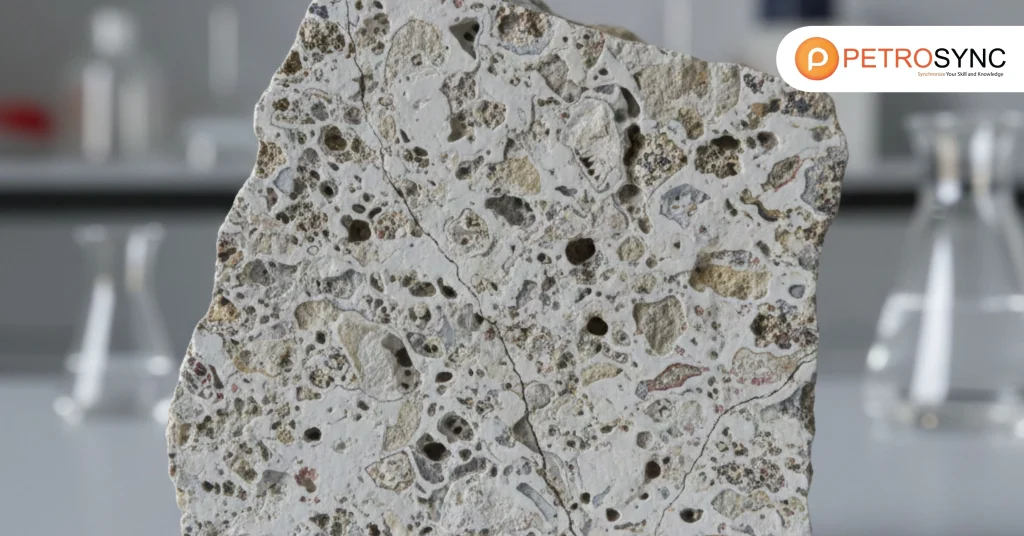
Carbonate reservoirs are sedimentary systems primarily composed of limestone and dolomite, formed through biological and chemical processes rather than mechanical deposition. This origin makes them fundamentally different from clastic reservoirs. Their structure is shaped by organisms, reefs, shells, and complex diagenetic changes that transform original pore systems over millions of years.
As a result, carbonate reservoirs typically exhibit high heterogeneity, unpredictable fracture networks, dual-porosity systems, and strong capillary effects. Understanding these characteristics matters because reservoir performance is directly tied to the architecture of these rocks. Studies published in the AAPG Bulletin and Marine and Petroleum Geology highlight that improper understanding of carbonate heterogeneity can reduce recovery efficiency by as much as 20–30%.
This reality underscores why a specialized Carbonate Reservoirs Course is critical. Professionals who work with carbonate assets need a deep foundation in depositional models, geological evolution, pore types, and diagenetic transformation to reduce uncertainty and increase production reliability.
Why Carbonate Reservoirs Are Critical for Petroleum and Reservoir Engineers – Insights from Carbonate Reservoirs Course
For petroleum and reservoir engineers, mastering carbonate reservoirs is more than just academic knowledge. Carbonates dominate numerous high-profile oil and gas basins in the Middle East, Southeast Asia, and parts of Europe. Many of these assets contribute significantly to national energy supply, corporate profitability, and long-term development plans.
However, their complexities often cause production unpredictability. Engineers who apply clastic-based assumptions to carbonate environments may misinterpret permeability pathways, fracture connectivity, or saturation distributions. Research from the Journal of Petroleum Science and Engineering indicates that mischaracterizing carbonate pore systems can impact initial production predictions by up to 40%.
This gap between expectation and reality reinforces the value of targeted learning. A Carbonate Reservoirs Course trains engineers to recognize patterns unique to carbonates, refine analytical techniques, and apply more accurate models to mitigate risks and enhance recovery.

Key Benefits of Taking a Carbonate Reservoirs Course
The benefits of specialized carbonate training extend well beyond academic understanding. They have a measurable impact on reservoir performance, operational decisions, and long-term asset value.
One of the most significant advantages is the improvement of reservoir characterization accuracy. Carbonates rarely present uniform structures, and their multi-scale heterogeneity requires a more refined approach. With proper training, engineers can interpret geological indicators more confidently and identify subtle variations that influence fluid flow.
Another important benefit is the ability to optimize production and maximize recovery in carbonate fields. Enhanced characterization leads to more precise well placement, improved stimulation strategies, and more reliable forecasting. Industry analyses published in Energy Reports have shown that improved carbonate characterization can boost recovery factors by 8–15% depending on reservoir conditions.
Training also helps professionals reduce operational and development risks. Carbonates often surprise teams with unexpected water production, compartmentalization, or fracture dominance. A structured Carbonate Reservoirs Course teaches participants how to anticipate these challenges and integrate multidisciplinary data for more informed decisions.
By understanding how geological processes influence reservoir behavior, teams can better align investment decisions with realistic subsurface expectations.
Core Technical Skills Covered in a Carbonate Reservoirs Course
A strong Carbonate Reservoirs Course provides a comprehensive technical foundation, ensuring that each participant develops practical, applicable skills for real-world reservoir management. Participants learn advanced petrophysical evaluation techniques to distinguish pore types, analyze saturation trends, and interpret log signatures unique to carbonates.
Because carbonate pore structures include vugs, molds, intercrystalline spaces, and fractures, this step is essential for accurate modeling. The course also sharpens expertise in subsurface imaging and seismic interpretation. Carbonates often produce ambiguous seismic responses due to velocity variations and facies complexity.
With proper training, professionals gain the ability to interpret seismic data more reliably, improving structural mapping and depositional model reconstruction. Another crucial area is reservoir modeling and simulation. Heterogeneous carbonates require tailored simulation approaches that incorporate dual porosity, multi-scale fractures, and non-linear flow behavior.
Training helps participants build more realistic models that support optimized development plans and more accurate production forecasts.
How a Carbonate Reservoirs Course Supports Field Development and Integrated Management
Effective carbonate reservoir management requires collaboration across geology, reservoir engineering, drilling, production, and surface facility teams. A Carbonate Reservoirs Course equips participants with knowledge that facilitates coordinated planning from reservoir to surface.
Professionals learn how to contribute meaningfully to integrated development workflows, ensuring that subsurface uncertainties are clearly accounted for before finalizing well placement or production strategies. This alignment strengthens asset management and improves decision quality at every stage of the development cycle.
Many courses also include real-world case studies, allowing participants to analyze project successes and failures from major carbonate-producing regions. These lessons provide invaluable insight that can be applied directly to ongoing field operations.
Why Continuous Learning Through a Carbonate Reservoirs Course Is Essential for Professionals
Carbonate reservoirs evolve over time, just like the technology and methodologies used to evaluate them. Professionals who engage in continuous learning remain ahead of industry standards and maintain a competitive edge.
Advanced training exposes participants to updated analytical techniques, improved imaging technologies, and more sophisticated reservoir modeling tools. It also prepares them to handle new industry challenges such as unconventional carbonate plays, enhanced recovery methods, and increasingly complex development environments.
The ability to apply structured knowledge consistently leads to better decision-making. Studies from the SPE Reservoir Evaluation & Engineering Journal show that teams with continuous technical training achieve up to 25% better forecasting accuracy compared to teams without ongoing learning programs.
Boost Your Technical Expertise with PetroSync Carbonate Reservoirs Course
For professionals who want to deepen their reservoir expertise and strengthen their leadership influence, PetroSync’s Carbonate Reservoirs Course offers a comprehensive and industry-aligned learning experience. The curriculum is built for geoscientists, reservoir engineers, and managers who handle high-value carbonate assets and need actionable insights rather than theoretical overviews.
Through hands-on exercises, practical workflows, and real case discussions, participants gain the confidence to tackle complex carbonate challenges and improve reservoir performance in ways that benefit their teams and organizations directly. The course is designed to help technical professionals step into higher-impact roles, make stronger recommendations, and guide strategic decisions backed by solid subsurface understanding.
If you are ready to enhance your technical capability, reduce uncertainty in your reservoir evaluations, and elevate your career with deeper carbonate knowledge, this is the right time to enroll. PetroSync provides the structured expertise and professional guidance needed to bring your reservoir insights to the next level.
Frequently Asked Questions (FAQ)
A carbonate reservoir is a sedimentary system mainly composed of limestone and dolomite, formed through biological and chemical processes rather than mechanical deposition. Unlike clastic reservoirs, carbonates exhibit complex pore systems, strong heterogeneity, and significant diagenetic overprinting, making their reservoir behavior more difficult to predict.
Carbonate reservoirs are challenging due to their irregular pore structures, fracture networks, and multi-scale heterogeneity. Diagenetic processes further alter porosity and permeability, creating uncertainties that can affect production forecasts, well placement, and long-term recovery strategies.
A specialized Carbonate Reservoirs Course equips professionals with targeted knowledge to correctly interpret carbonate-specific geological and petrophysical features. This training helps reduce uncertainty, improve reservoir characterization, and support high-stakes development decisions that cannot rely on clastic-based assumptions.
A Carbonate Reservoirs Course typically covers advanced petrophysical evaluation, pore-type identification, seismic interpretation in carbonate settings, and reservoir modeling techniques that account for dual porosity, fractures, and non-linear flow behavior.
By improving reservoir characterization accuracy and integrating multidisciplinary data, a Carbonate Reservoirs Course helps professionals optimize well placement, enhance production strategies, and reduce operational risks. This leads to more reliable forecasts, higher recovery factors, and stronger long-term asset performance.

Results-oriented and thorough SEO specialist with extensive experience in conducting keyword research, developing and implementing digital website promotion strategies and plans, managing campaigns to develop company websites in the digital world, excellent knowledge of marketing techniques and principles, and attentive strong attention to detail.