

⦁ ISO 55000 courses are a practical bridge from asset management theory to real, value-driven decisions across cost, risk, and performance.
⦁ The training helps leaders move beyond maintenance thinking into lifecycle-based planning that protects long-term asset value.
⦁ Structured frameworks improve consistency, align operations with strategy, and strengthen governance in asset-intensive industries.
⦁ Risk-based prioritization reduces unplanned failures, lowers lifecycle costs, and boosts reliability where it matters most.
⦁ Hands-on tools and common language enable stronger cross-functional collaboration and data-driven performance improvement.
ISO 55000 Courses have become increasingly essential for organizations that rely on complex asset portfolios—especially in asset-intensive sectors like oil and gas, utilities, energy, and large-scale infrastructure. As asset management evolves from a technical function into a strategic discipline, senior leaders face growing pressure to make decisions that balance cost, risk, performance, and long-term value.
Modern businesses are evaluated not only on operational efficiency but also on their ability to optimize resources, manage asset-related risks, and extract sustainable value across the full lifecycle of their assets.
This shift has elevated the importance of structured asset governance. To navigate these challenges with clarity, many executives turn to ISO 55000 as a guiding framework for disciplined, value-driven asset decisions. However, understanding the principles is only the first step—translating them into practical, organization-wide improvements requires deeper capability.
This is where ISO 55000 courses play a pivotal role, equipping leaders with the knowledge, tools, and confidence to implement asset management practices that support both operational excellence and strategic growth.
What are ISO 55000 Courses?

ISO 55000 courses are specialized training programs designed to help professionals understand and apply the ISO 55000 family of asset management standards. These standards introduce a structured approach to planning, managing, and optimizing assets so they deliver maximum value throughout their lifecycle.
The ISO 55000 series consists of three main components:
- ISO 55000 (concepts, principles, and terminology),
- ISO 55001 (requirements for an Asset Management System),
- ISO 55002 (guidance for application).
Through these courses, participants learn how to translate these principles into concrete strategies—whether the goal is improving reliability, strengthening governance, reducing risk exposure, or preparing for certification.
Why ISO 55000 Courses Critical for Asset Management?
Effective asset management is no longer about maintenance alone. It affects financial performance, operational stability, safety risks, and even customer outcomes. ISO 55000 courses are critical because they help organizations adopt a framework that connects asset decisions to broader business objectives.
Independent assessments of organizations that implemented ISO-based asset management practices have reported several measurable improvements, such as:
- More consistent decision-making, thanks to shared terminology and structured processes.
- Enhanced alignment between operational activities and long-term strategy.
- Reduced lifecycle costs, through smarter investment and maintenance planning.
- Higher reliability and performance, due to risk-based prioritization.
- Increased stakeholder confidence, especially in high-risk industries.
One well-documented analysis of asset-intensive companies found that those adopting structured asset management frameworks showed significant improvements in financial performance and operational reliability. These findings reinforce how ISO 55000 training helps organizations build systems that deliver value, not just compliance.
What is the ISO 55000 Courses Objective?
This course will objectives as follows:
- Attendees will learn how to develop and implement a strategic asset management plan successfully
- Understand the tools involved in industrial asset management
- Develop the necessary skills to successfully analyze and determine specific asset requirements in light of business goals
- Understand and learn about the international standard ISO 55000:2014 and its practical implementation
- Integrating Asset Integrity Management tools (RCM, RBI, CMS, MoC, Culture change, RCA, CSMMS, IPF, Action tracking, and KPIs) into the SAMP
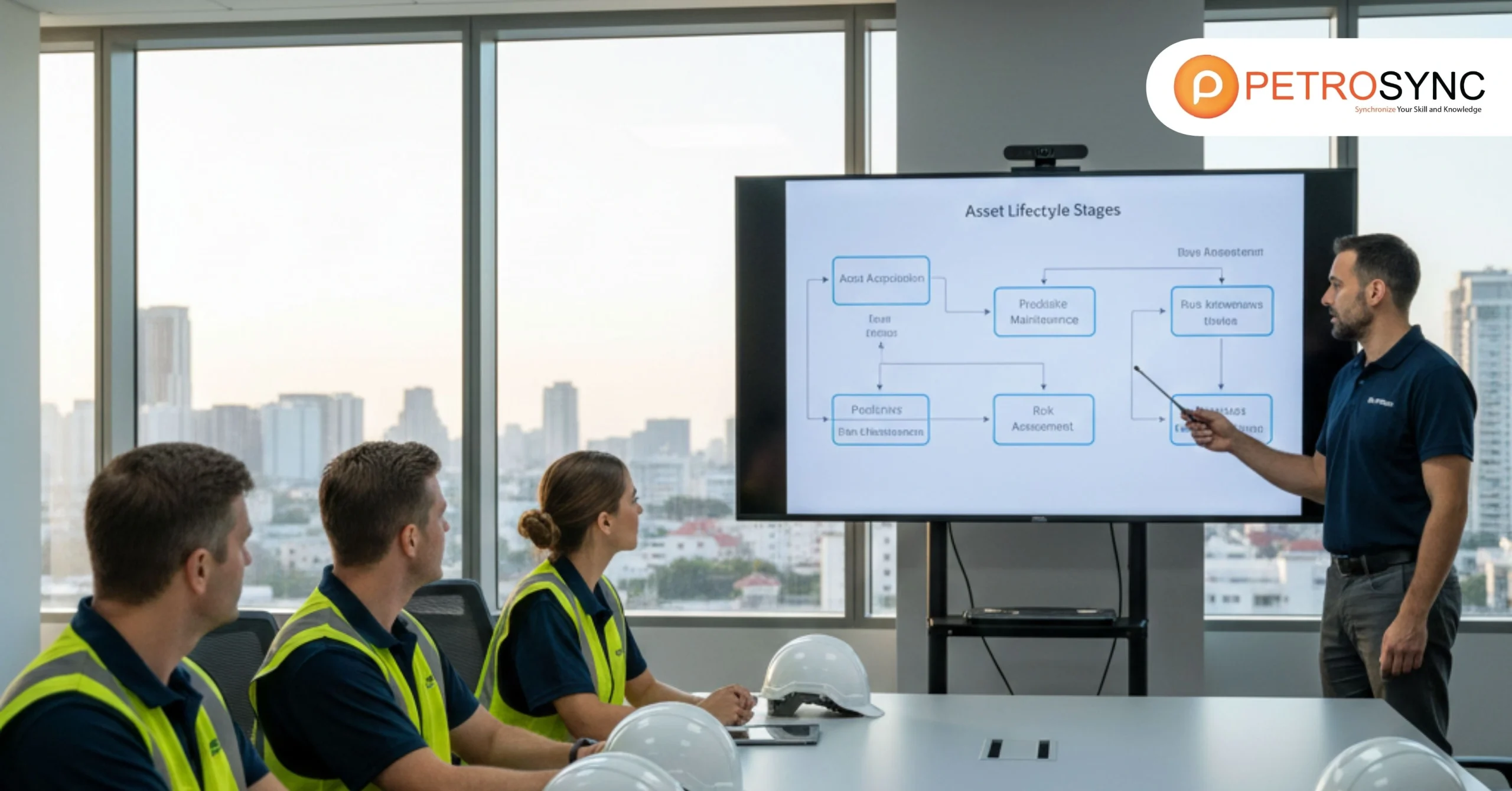
What are ISO 55000 Courses Outlines?
DAY 1
- Introduction
- Definition of assets, asset management, and asset management systems (ISO 55000:2014)
- Tools used in asset management and the relation with asset integrity management
– RCM
– RBI
– CMS
– MoC
– Culture change
– RCA
– CSMMS
– IPF
– Action - Understanding the Strategic asset management plan (SAMP)
- Case Study – Understanding your assets and asset portfolio and determining the risk associated with the operation
DAY 2
- Understanding the use of asset management and asset integrity management tools
– Criticality and Risk
– Risks Associated with Production
– The risk associated with maintenance or lack thereof
– Risks associated with health safety and the environment
– Developing a risk matrix (Probability, Consequence, and Detectability) - Developing a successful strategic asset management plan based on identified risks and needs of individual
– Identifying business goals and aligning activities
– Lifecycle cost
– Maintenance Strategy tools
– Balancing activities, needs, and cost
– Operation demand and maintenance requirements – finding the balance
– People skills and skill management programs - Case Study – Develop a Strategic Asset Management Plan (SAMP) to manage your asset portfolio risk
DAY 3
- Successful implementation of strategic asset management plans
– Task Development
– Detailed task writing
– Developing your CMMS system
– Inspection programs and operator-driven reliability - Pitfalls that should be avoided
– Overdoing it with tasks
– KPIs that make sense
– Balanced score cards
– Updating studies and continuous improvement - Final notes on techniques and technologies
– Tools and techniques to simplify inspection
– Tools and techniques to build a visual inspection program
– Skills matrices and successful implementation and integration - Case study – Implementing your SAMP successfully and following up on your implementation
Who Should Attend ISO 55000 Courses?
This course is specially designed for the following disciplines:
- Maintenance and Operations Managers
- Engineering Managers
- Maintenance Planning Managers
- Asset Management Professionals
Each attendee must bring a Laptop Computer with Microsoft Operating System and Scientific Calculator
How ISO 55000 Courses Help Apply Smarter Asset Decisions
ISO 55000 courses empower leaders with structured methodologies to improve how they analyze, prioritize, and manage assets. The training encourages a shift from intuition-based decisions to evidence-based strategies.
1. Enabling Lifecycle-Based Planning
Leaders learn how to balance short-term demands with long-term asset value. This results in reduced total cost of ownership and more effective capital allocation.
2. Strengthening Risk-Based Decision-Making
By applying risk tools and criticality analysis, organizations can prioritize efforts where they matter most. Many companies adopting ISO frameworks experience fewer unplanned failures and improved reliability.
3. Enhancing Cross-Functional Collaboration
ISO 55000 provides a common language that helps finance, engineering, operations, and leadership work together more effectively.
4. Driving Data-Driven Performance Improvement
Participants learn how to define performance indicators that reflect strategic goals, enabling objective evaluation and continuous improvement.
5. Building Long-Term Business Value
Research shows that organizations applying structured asset management practices often see improvements in cost efficiency, operational stability, and customer trust over time.
Combined, these outcomes lead to smarter asset decisions—decisions that protect organizational resilience and enhance long-term value.
Boost Your Asset Management with PetroSync ISO 55000 Courses
For leaders who want to translate asset management standards into real business impact, PetroSync’s ISO 55000 Courses offer a powerful advantage. The training is designed specifically for professionals in asset-intensive environments, combining strategic insight with hands-on methodologies.
PetroSync helps participants understand not just the theory behind ISO 55000, but how to apply it meaningfully in their day-to-day roles—aligning asset strategies with business goals, improving cross-functional communication, and strengthening overall governance.
If your organization aims to enhance decision-making, optimize asset value, and develop a mature asset management system, PetroSync provides the expertise, framework, and guidance needed to accelerate that journey. Their ISO 55000 courses give leaders the capability to make smarter, more confident, and more strategic asset decisions that support sustainable growth.
Frequently Asked Questions (FAQ)
ISO 55000 courses are professional training programs designed to help organizations understand and apply the ISO 55000 family of asset management standards. They focus on lifecycle-based asset planning, governance, risk management, and aligning asset decisions with business objectives.
ISO 55000 courses are critical for asset-intensive industries because they provide a structured framework to balance cost, risk, performance, and long-term value. They help organizations improve reliability, reduce lifecycle costs, strengthen governance, and support strategic decision-making.
The main objectives of ISO 55000 courses include developing and implementing a Strategic Asset Management Plan (SAMP), understanding industrial asset management tools, aligning asset requirements with business goals, applying ISO 55000 standards in practice, and integrating asset integrity management tools into asset strategies.
ISO 55000 courses are designed for Maintenance and Operations Managers, Engineering Managers, Maintenance Planning Managers, and Asset Management Professionals who are responsible for managing complex asset portfolios and improving organizational performance.
ISO 55000 courses help leaders make smarter asset decisions by promoting lifecycle-based planning, risk-based prioritization, data-driven performance measurement, and cross-functional collaboration. This approach leads to improved reliability, optimized costs, and sustainable long-term business value.

Results-oriented and thorough SEO specialist with extensive experience in conducting keyword research, developing and implementing digital website promotion strategies and plans, managing campaigns to develop company websites in the digital world, excellent knowledge of marketing techniques and principles, and attentive strong attention to detail.