

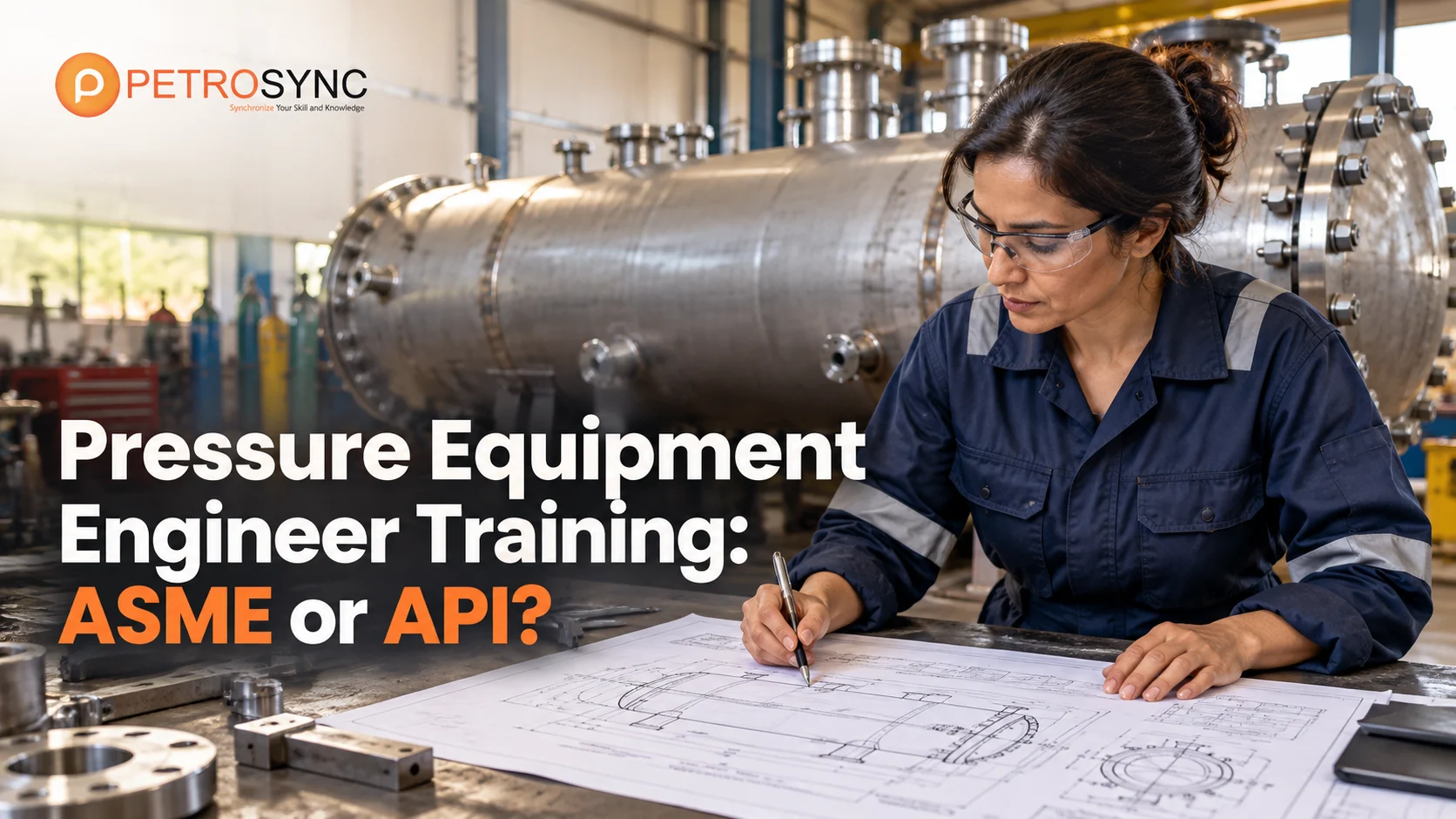
- Choose ASME Section VIII for pressure-vessel design responsibilities and API 510 for in-service inspection responsibilities.
- Design courses develop code-based design decisions, while inspection courses focus on evaluating equipment already in service.
- Useful training strengthens condition assessment, document interpretation and code-based judgement.
- Course level, relevant exercises and the distinction between learning and certification determine practical fit.
- PetroSync offers distinct ASME Section VIII and API 510 programmes for these different responsibilities.
- A training budget should separate the selected public-course fee, optional exam arrangements and any custom in-house scope.
A pressure equipment engineer may review a new vessel design one week and support an inspection review the next. Those assignments draw on related knowledge, but they create different training needs. Choosing a course becomes easier when you start with the decision you need to make at work.
This guide compares pressure equipment engineer training for design and in-service inspection. It explains the skills to prioritise, the exercises worth looking for, and how PetroSync’s ASME and API programmes connect with individual development and team training plans.
Should Pressure Equipment Engineers Choose ASME or API?
Choose ASME Section VIII learning when your responsibilities centre on pressure-vessel design, and API 510 learning when they centre on in-service inspection. The useful distinction is the engineering task: evaluating a design proposal calls for a different emphasis from reviewing equipment already in service.
For engineers working with pressure equipment, a job title alone rarely settles that choice. Your immediate assignment may involve a calculation package, inspection findings, or questions about an existing vessel’s condition. Identify which decisions you must explain and which information you need to interpret.
Some roles span both areas. In that case, prioritise the course that addresses your current knowledge gap, then plan complementary learning. Shared terminology can help you connect the subjects, while each course still has its own purpose and depth.
How Do Design and Inspection Courses Compare?
Design courses focus on applying requirements to vessel design, fabrication and testing. Inspection courses place greater emphasis on evaluating in-service equipment, using inspection information and understanding the relevant inspection requirements. Comparing those learning priorities helps you choose beyond a course title.
|
Training Focus |
Relevant Responsibilities |
Learning Priorities |
|
Pressure-vessel design |
Design and fabrication review |
Design rules and calculations |
|
In-service inspection |
Condition and inspection review |
Inspection requirements and records |
Consider an engineer who reviews design calculations but occasionally joins an inspection discussion. Design learning may address the immediate responsibility, while inspection training could become a later development step. An engineer who primarily reviews inspection findings may choose the opposite order.
The comparison also helps a manager avoid assigning identical training to everyone with the same job title. Discuss the work each person handles and the judgement they need to develop. A learning route should support those responsibilities; attending the course does not itself establish professional certification or approval authority.
Read Also: Pressure Vessel Inspector Training: Invest in Your Expertise
Skills That Support Pressure Equipment Decisions
Useful pressure-equipment training develops condition awareness, document interpretation and code-based judgement. These skills help you explain why an issue needs further evaluation and how the available information supports a decision, so look for exercises that practise the following capabilities rather than simply presenting terminology:
1. Recognise Equipment Condition and Repair Needs
Recognising equipment concerns helps you identify the evaluation or repair expertise a situation needs. The learning goal is to distinguish an observation from an engineering assessment and from the authority to approve a response. That distinction keeps the discussion focused on your actual responsibility.
For example, a classroom inspection record might describe wall loss without enough context to support a conclusion. A useful exercise asks what information is missing and who should review it. Repair-focused learning can then complement the main design or inspection route when your role requires that depth.
Read Also: ASME PCC-2 Training: Pressure Equipment Repair Methods
2. Interpret Design and Inspection Documentation
Design and inspection documents answer different engineering questions, even when they describe the same vessel. A design basis explains the assumptions behind a proposal, while an inspection history provides context for understanding equipment condition. Training should help you identify which record supports the decision in front of you.
In a hypothetical exercise, a design reviewer and an inspector could read the same equipment file for different reasons. Explaining those reasons is more useful than memorising a document list. It also reveals gaps in the information you need to interpret confidently.
3. Apply Code-Based Engineering Judgement
Code-based judgement connects a requirement with the facts and assumptions of a particular case. A useful learning exercise asks you to identify the relevant question, explain the basis of your reasoning and recognise where further review is necessary. Finding a provision is only part of that task.
For instance, participants might discuss which code issue a case raises before attempting a calculation. Comparing their reasoning can expose different assumptions and improve the clarity of the explanation. The objective is disciplined engineering thinking within your role, with authorisation remaining a separate matter.
Explore the API 510 training course.
What Should You Check Before Choosing a Course?
Choose a course whose level and exercises match your engineering experience, equipment scope and intended learning outcome. A technically detailed syllabus is useful when you can connect it to work you already understand or are preparing to undertake. The practical selection criteria are:
- Match the course level to your engineering experience.
- Check whether exercises reflect your equipment and responsibilities.
- Separate learning outcomes from certification requirements.
A worked example should show how the instructor reaches a conclusion, including the assumptions that affect it. That gives you a basis for judging whether the teaching will develop the reasoning you need.
If your aim includes becoming an API 510 inspector, distinguish course preparation from the certification process. Course attendance and exam eligibility are different questions. For a design-focused role, assess the relevance of design cases first, rather than choosing an inspection programme because its certification name is familiar.
Pressure Equipment Training Options with PetroSync

PetroSync offers separate programmes for pressure-vessel design and in-service inspection learning. ASME Section VIII and API 510 therefore provide different starting points, depending on the responsibility you want to develop; the following options connect each learning need with its relevant course scope:
1. ASME Section VIII for Pressure Vessel Design
ASME Section VIII training supports engineers who need to understand pressure-vessel design requirements and their application. PetroSync’s Division 1 and 2 programme covers design-code use, fabrication and testing, with case studies that connect the requirements to engineering questions. This makes the design path relevant when you review a vessel proposal.
Use that scope to identify the decisions you want to discuss during training. For example, a design reviewer may want a clearer explanation of how assumptions affect a calculation. The course provides a learning setting for that discussion, without replacing the responsibilities attached to your engineering role.
2. API 510 for In-Service Vessel Inspection
PetroSync’s API 510 programme focuses on in-service vessel inspection and certification-exam preparation. Its scope connects code use and calculations with inspection evaluation, giving the inspection path a different emphasis from the design course. It suits a discussion about the knowledge needed for your inspection responsibilities.
An individual can start by matching that scope to current assignments. A manager can use the same distinction when planning development for several engineers. This keeps the course choice tied to the work, while provider reputation adds another useful consideration once the technical fit is clear.
Rated 4.9/5 on Google from 1,000+ reviews.
Source: Google Business Profile, PetroSync Jakarta — snapshot dated 6 September 2026.
That dated review feedback gives you another reason to include PetroSync in your training shortlist alongside the programme’s relevance to your work.
What Should Your PetroSync Training Quote Cover?
Your training quote should identify the selected programme, delivery format, participants and requested services. As checked on 27 October 2026, PetroSync listed public-session fees of USD 3,450 for ASME Section VIII and USD 3,450 for API 510. These are separate course references, not a combined package price.
- Ask for the course fee and a clear list of inclusions.
- Confirm any optional examination arrangements separately.
- Discuss team scope and delivery requirements for an in-house quote.
The PetroSync FAQ explains that standard API course tuition covers preparation, with an optional training-plus-certification-exam package and registration assistance available. Discuss the package price separately if you want that arrangement; do not treat it as part of every training fee.
For a company group, the useful starting point is a defined design or inspection learning need. In-house delivery requires its own quotation, including the agreed scope and participant arrangements. PetroSync can clarify the applicable minimum group size. Travel, accommodation, taxes and other inclusions also belong in the budget discussion rather than assumptions based on the public fee.
Discuss Pressure Equipment Training with PetroSync
Discuss the pressure-equipment decisions you want to handle more confidently with PetroSync, and explore the course that fits your design or inspection responsibilities. A focused conversation can help you connect the programme’s learning scope with your next development step.
For a company group, discuss in-house training around your team’s equipment, experience and learning priorities. Request a tailored quotation so the proposed programme and delivery arrangements support a clear training objective.
Frequently Asked Questions (FAQ)
Both training paths can support a role that covers design and in-service inspection. Start with the course that addresses your immediate responsibilities, then consider complementary learning as your work develops; the programmes have distinct scopes, and a combined package or compulsory sequence should not be assumed.
Suitability depends on your relevant engineering and inspection background. PetroSync's API 510 page describes experienced technical personnel, so discuss your current knowledge if you are new to inspection; that course-fit conversation is separate from determining whether you meet the requirements for the certification exam.
Use the edition specified for your selected course and, if you plan to take an API exam, its applicable references. A design class and an examination can follow different reference requirements, so obtain the relevant instructions before buying study materials or assuming the newest edition applies.
Standard API training tuition does not automatically include exam registration. PetroSync offers an optional training-plus-exam arrangement with registration assistance, so discuss the package price when booking; this API option should not be interpreted as an ASME professional-certification package or a promise of an immediate exam date.
Employer sponsorship depends on your organisation's training policy and approval process. Present the named course, its relevance to your responsibilities and the quotation as part of your request; if several colleagues share a learning need, the company can also discuss a separate in-house training arrangement.

Results-oriented and thorough SEO specialist with extensive experience in conducting keyword research, developing and implementing digital website promotion strategies and plans, managing campaigns to develop company websites in the digital world, excellent knowledge of marketing techniques and principles, and attentive strong attention to detail.