


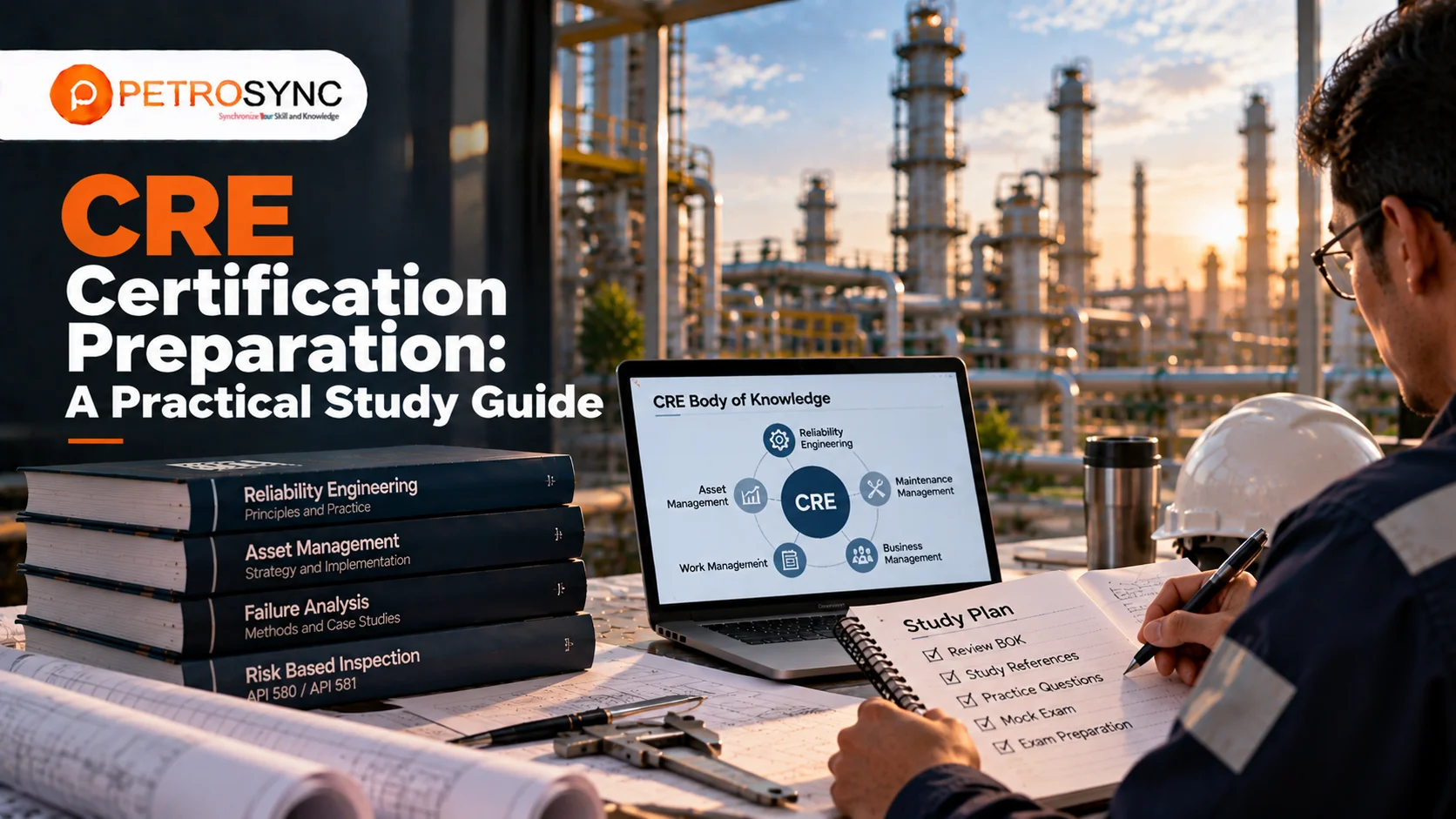
- Start CRE preparation from the current ASQ Body of Knowledge, then identify which domains and problem types need the most work.
- Because the CRE exam is open-book, preparation should include reference organization and retrieval practice, not memorization alone.
- Use worked problems, timed practice, and an error log to turn weak topics into a focused study plan.
- Choose self-study, structured training, or a hybrid approach based on current knowledge, discipline, time, and need for instructor feedback.
- PetroSync can provide optional structured CRE preparation, while ASQ/ASQE remains the certification authority and training does not guarantee certification.
How Should You Prepare for CRE Certification?
A practical CRE preparation process is to confirm the current Body of Knowledge and exam rules, assess your strongest and weakest areas, organize a reliable open-book reference set, work through technical problems, practice under time pressure, record recurring errors, and retest weak topics. The goal is not to study everything equally, but to build a repeatable loop that concentrates effort where it has the greatest value.
|
Step |
Main Focus |
Practical Output |
|
1. Confirm Scope |
Current CRE BOK and exam rules |
Current preparation boundary |
|
2. Diagnose Gaps |
Strengths/weaknesses by BOK domain |
Priority study list |
|
3. Build Reference Set |
Current allowed references/handbook |
Organized open-book materials |
|
4. Practice Retrieval |
Find formulas/tables quickly |
Faster reference use |
|
5. Work Problems |
Statistics, modeling, testing, reliability calculations |
Applied problem-solving practice |
|
6. Practice Under Time |
Timed/review questions |
Time-management evidence |
|
7. Review Errors |
Categorize misses and weak concepts |
Error log and remediation list |
|
8. Retest and Final Check |
Revisit weak areas and logistics |
Final readiness picture |
This workflow separates different problems. A topic you do not understand requires concept review; a topic you understand but solve too slowly needs more practice. If you know the concept but cannot find the supporting formula quickly, the problem is reference organization. Candidates who need a broader credential overview can review PetroSync’s CRE certification guide, while this article stays focused on preparation.
What Should You Study for the CRE Exam?
Use the current ASQ CRE Body of Knowledge as your preparation map. The current ASQ Certified Reliability Engineer Handbook, Fourth Edition, is organized according to the 2025 CRE Body of Knowledge, so candidates should compare study resources against that scope before treating them as primary preparation material. The objective is to identify what you know, where you are weak, and which problem types require repeated practice.
1. Start With the Current CRE Body of Knowledge
The Body of Knowledge should define the boundary of your study plan. Before relying on a book, course, or question set, confirm that it supports the current CRE scope. Then use the BOK as a checklist: mark areas where you have strong professional experience, areas you understand conceptually but rarely calculate, and areas you have not used recently. For a deeper domain breakdown, use PetroSync’s CRE Body of Knowledge guide rather than duplicating the full syllabus here.
2. Identify Your Highest-Gap Domains
A useful gap analysis distinguishes four situations: topics you know well, concepts you understand but calculate slowly, topics rarely used in your job, and subjects where reference retrieval is inefficient. Turn those differences into a priority list. The highest-priority area is not automatically the longest chapter; it is the topic where your present ability is furthest from the level of understanding and application expected by the current BOK.
3. Build Practice Around Problem-Solving Topics
CRE preparation should include active problem solving. Build practice around current-BOK areas such as probability and statistics, design and development, reliability modeling and predictions, testing, maintainability and availability, and data collection and use. Move from concept review to worked examples, then solve similar problems independently. When you get stuck, identify whether the issue is calculation, method selection, interpretation, or reference retrieval, because each problem requires a different fix.
How Should You Prepare for an Open-Book CRE Exam?
The CRE exam is currently open-book, but that does not make it a simple lookup exercise. ASQ requires reference materials and notes to be bound and remain bound during the exam. Preparation should therefore combine technical understanding with fast reference retrieval. Know what each reference contains, where key formulas and tables are located, and when looking something up is more efficient than solving from memory.
1. Choose References That Match the Current BOK
Start with the current BOK and select references that support the areas you need to study. ASQ provides references used as a basis for exam questions, but its certification guidance also states that no single source covers everything and that the ASQE Certification Council does not endorse one particular reference. A smaller, well-understood set can therefore be more useful than a large stack of books you have not practiced using. See the official ASQ CRE certification page for current rules and PetroSync’s CRE exam guide for detailed exam context.
2. Organize Your Bound References for Fast Retrieval
ASQ’s current policy requires reference materials and notes to be bound and remain bound. Permanently bound books and materials secured with ring binders, spiral binders, plastic snap binders, brads, or screw posts are permitted, while unsecured hand-stapled material is not. Post-It notes may be used as book tabs when attached before entering the test center. Organize formulas, tables, and examples around those rules, and practice with the same reference system you intend to use on exam day.
3. Practice Finding Information Under Time Pressure
Reference retrieval should become part of your practice routine. During mixed question sets, intentionally look up selected formulas, tables, or examples and observe whether the reference helps or slows you down. If you repeatedly search the same section, improve the tab or index. This teaches an important open-book decision: when should you recall the method directly, and when is it worth verifying a formula or condition?
Which CRE Preparation Resources Should You Use?
Prioritize resources that reflect the current CRE scope, then add practice tools that help diagnose and correct weaknesses. Start with the current Body of Knowledge, current CRE Handbook and ASQ reference list, then supplement them with worked problems, your own error log, and carefully selected practice resources. The ASQ CRE Question Bank can support practice, but its current product page states that it was written to the 2009 CRE Body of Knowledge.
1. Use the Current CRE Handbook and Reference List
The ASQ Certified Reliability Engineer Handbook, Fourth Edition, was published in 2025 and is organized according to the 2025 CRE Body of Knowledge. That makes it a relevant current study companion. Still, treat it as a strong reference rather than the only source you may need. Your gap analysis should determine where additional references or problem sets are useful, especially when a domain is outside your daily work.
2. Use the CRE Question Bank Carefully
The ASQ CRE Question Bank provides timed simulation and review modes, repeated attempts during its access period, and explanations that can help identify strengths and weaknesses. However, the current ASQ CRE Question Bank page explicitly states that it was written to the 2009 CRE Body of Knowledge. Use it for practice mechanics and diagnostic feedback, but compare coverage against the current BOK before assuming it represents the complete current exam scope.
3. Add Your Own Worked-Problem and Error-Review System
A simple error log can turn practice into a study plan. For each missed or slow problem, record the domain, problem type, why the answer went wrong, the formula or reference needed, the corrective action, and the result when you retested. This distinguishes calculation errors from concept gaps, method-selection mistakes, and slow reference retrieval. Review the log regularly so recurring weaknesses become visible and receive targeted practice.
Is Self-Study or Training Better for CRE Preparation?
Neither self-study nor training is universally better for CRE preparation. Self-study works well for candidates who can build their own BOK-based plan, organize references, and practice consistently. Structured training can help candidates who want guided sequencing, instructor explanations, worked examples, exercises, and feedback. A hybrid approach combines both, using training for structure and self-study to focus on individual weaknesses before and after the course.
|
Approach |
Best Fit |
Main Strength |
Main Watchout |
|
Self-Study |
Independent candidates with strong discipline |
Flexible pace and reference choice |
Requires self-diagnosis and planning |
|
Structured Training |
Candidates wanting guided explanation and practice |
Defined sequence, instructor feedback, exercises |
Requires time/budget; no pass guarantee |
|
Hybrid |
Candidates with uneven gaps |
Combines structure with targeted individual review |
Needs coordination to avoid duplicated study |
1. Choose Self-Study When You Can Structure Your Own Preparation
Self-study is a strong option when you can maintain a schedule without external accountability and diagnose your own technical gaps. You should be comfortable mapping resources to the current BOK, solving reliability problems independently, and reviewing errors systematically. Its main risk is false confidence: familiar reading can feel productive without testing application. Make sure every week includes problem solving, reference retrieval, and review of mistakes.
2. Choose Structured Training When You Need Guided Practice
Structured training can be useful when you want a defined sequence across the CRE Body of Knowledge, explanations of difficult topics, worked examples, practical exercises, and opportunities to ask questions. Training should still be treated as preparation support rather than a substitute for individual work. You will benefit more if you arrive knowing your weak areas and continue practicing afterward. Completing training does not guarantee the ASQ CRE credential.
3. Use a Hybrid Approach for Uneven Knowledge Gaps
A hybrid approach works well when your knowledge is uneven. Training can provide organized coverage and instructor support, while self-study gives you additional time for personally difficult topics. Complete a baseline review before training, mark unresolved areas during the course, and return to worked problems and your error log afterward. The value comes from connecting guided learning with targeted individual practice, not simply adding more study hours.
Work through the CRE Body of Knowledge with guided learning, worked examples, and focused practice.
How Do You Build a Realistic CRE Study Plan?
Build your CRE study plan backward from the exam window you intend to target, but avoid assuming every candidate needs the same number of weeks or hours. Rotate current-BOK review with worked problems, reference retrieval, timed practice, and error analysis. A realistic plan protects recurring study time and keeps returning to weak areas until your performance becomes more consistent.
1. Set a Target Exam Window
An intended exam window gives your preparation a finish line. You do not need to build the plan around exact dates, but you should know roughly when you want to be ready. That allows you to divide the remaining time between coverage, practice, correction, and final review. Keep application logistics separate from preparation planning; the purpose here is simply to prevent an open-ended study schedule.
2. Build a Weekly Study Cadence
Use a repeatable cycle: review a concept, work problems, practice reference retrieval, complete a small timed set, and review errors. Do not allocate time equally by default. If a domain is already strong, reduce passive review and redirect time toward weaker problem-solving areas. The best cadence is one you can maintain consistently while still adapting to what your practice results show.
3. Use an Error Log and Retest Loop
Group errors by cause: knowledge gap, incorrect method selection, calculation mistake, misread question, slow reference retrieval, or time pressure. Each category suggests a different corrective action. After correcting the issue, retest with a different problem of the same type. This makes preparation more evidence-based because you judge progress by whether previously weak problem types improve, not by how many pages you have read.
4. Finish With a Readiness Check
Confirm that your weakest BOK areas have improved, your references are organized, you can find common formulas and tables efficiently, and you can maintain workable pacing across mixed technical questions. Also confirm that any calculator you plan to use complies with current ASQ rules. Avoid major last-minute changes to a reference system you already know. For broader professional context, PetroSync’s reliability engineering guide connects these study topics with real engineering practice.
How Can PetroSync Support CRE Preparation?
PetroSync can support candidates who want structured CRE preparation rather than building the entire study path alone. Its five-day, intermediate, face-to-face Certified Reliability Engineer course follows the ASQ CRE Body of Knowledge and covers reliability management, probability and statistics, design and development, modeling and predictions, testing, maintainability and availability, and data use, supported by practical exercises and case applications.
1. Work Through the CRE BOK in a Structured Sequence
A structured course can organize a large technical scope into a sequence that is easier to follow. That can help professionals whose daily work is concentrated in only a few reliability areas. The course does not replace the official BOK; ASQ remains the authority for certification scope. PetroSync’s role is guided preparation, explanation, and practice around topics aligned with the CRE Body of Knowledge.
2. Practice Reliability Problems and Case Applications
PetroSync’s CRE preparation includes practical work around FMEA and RCA, Markov and Monte Carlo methods, reliability calculations, modeling, testing, and maintenance strategy applications. Use these exercises diagnostically. If a case exposes weak statistics, add probability practice afterward. If modeling is difficult, identify whether the issue is the equation, assumptions, or interpretation. Training is most useful when it improves your individual study plan.
3. Combine Training With Individual Review
Before the course, identify your weakest BOK areas and organize your references. During training, note unresolved questions and problem types that still require work. After training, return to your error log, solve additional problems, and retest difficult topics. PetroSync’s Certified Reliability Engineer training page provides more detail about the training format and audience, while the course remains optional preparation support rather than a certification requirement.
According to PetroSync’s internal exam records, 12 participants successfully passed the CRE certification exam through PetroSync across the available 2022–2026 records. This is first-party internal experience data, not an independent industry benchmark or a pass rate, and it should not be interpreted as a guarantee of future results.
Discuss Your CRE Preparation Plan
A useful CRE preparation plan should reflect your actual BOK gaps, problem-solving ability, open-book reference strategy, and available study time. If you want more structure, PetroSync can help you evaluate whether guided CRE preparation fits the areas where you need the most support. Individual candidates can use that discussion to clarify study priorities, while company groups can also explore structured or in-house preparation for teams. Training is optional, and the ASQ/ASQE certification process remains separate from PetroSync’s preparation support.
Frequently Asked Questions (FAQ)
Yes. Under current ASQ guidance, ASQ certification exams are open-book, and reference materials and notes must be bound and remain bound during the exam. Open-book does not remove the need for technical understanding; effective preparation should include both subject mastery and the ability to retrieve formulas, tables, and examples efficiently.
Start with the current 2025 ASQ CRE Body of Knowledge, then identify which domains and problem types are weakest for you. Use those gaps to choose references, worked examples, and practice material instead of studying every topic with the same intensity. Your first objective is a prioritized study map, not a large reading list.
No. The ASQ CRE Question Bank can support practice, timed simulation, review, and weakness diagnosis, but its current product page says it was written to the 2009 CRE Body of Knowledge. Use the current BOK and current references as the authority for exam scope, and treat the Question Bank as a supplementary practice tool.
There is no universal preparation duration. The time you need depends on your current reliability knowledge, BOK gaps, calculation and problem-solving ability, reference-retrieval speed, weekly study availability, and intended exam window. Build a repeatable study cadence and adjust it based on your error log and retest results rather than following a fixed number of weeks.
No. PetroSync training is optional preparation support and should not be presented as an ASQ prerequisite. Candidates can prepare through self-study, structured training, or a hybrid approach. ASQ/ASQE controls the certification requirements and professional credential, while training can provide guided coverage, explanations, exercises, and feedback.

Results-oriented and thorough SEO specialist with extensive experience in conducting keyword research, developing and implementing digital website promotion strategies and plans, managing campaigns to develop company websites in the digital world, excellent knowledge of marketing techniques and principles, and attentive strong attention to detail.

Business Development Manager at PetroSync with 12+ years of experience in professional training and business development across the energy and industrial sectors.