

- Match the course to your equipment and lifecycle responsibilities.
- ASME Section VIII and API 579 address different engineering questions.
- Prepare the equipment context and technical foundations before enrolling.
- Use learning to examine assumptions, condition information and recommendations.
- Compare syllabus depth and confirmed exercises against your work.
- PetroSync offers separate design and fitness-for-service learning options.
- Confirm course inclusions and distinguish public fees from an in-house quotation.
- Build a team plan around priority tasks and internal follow-up.
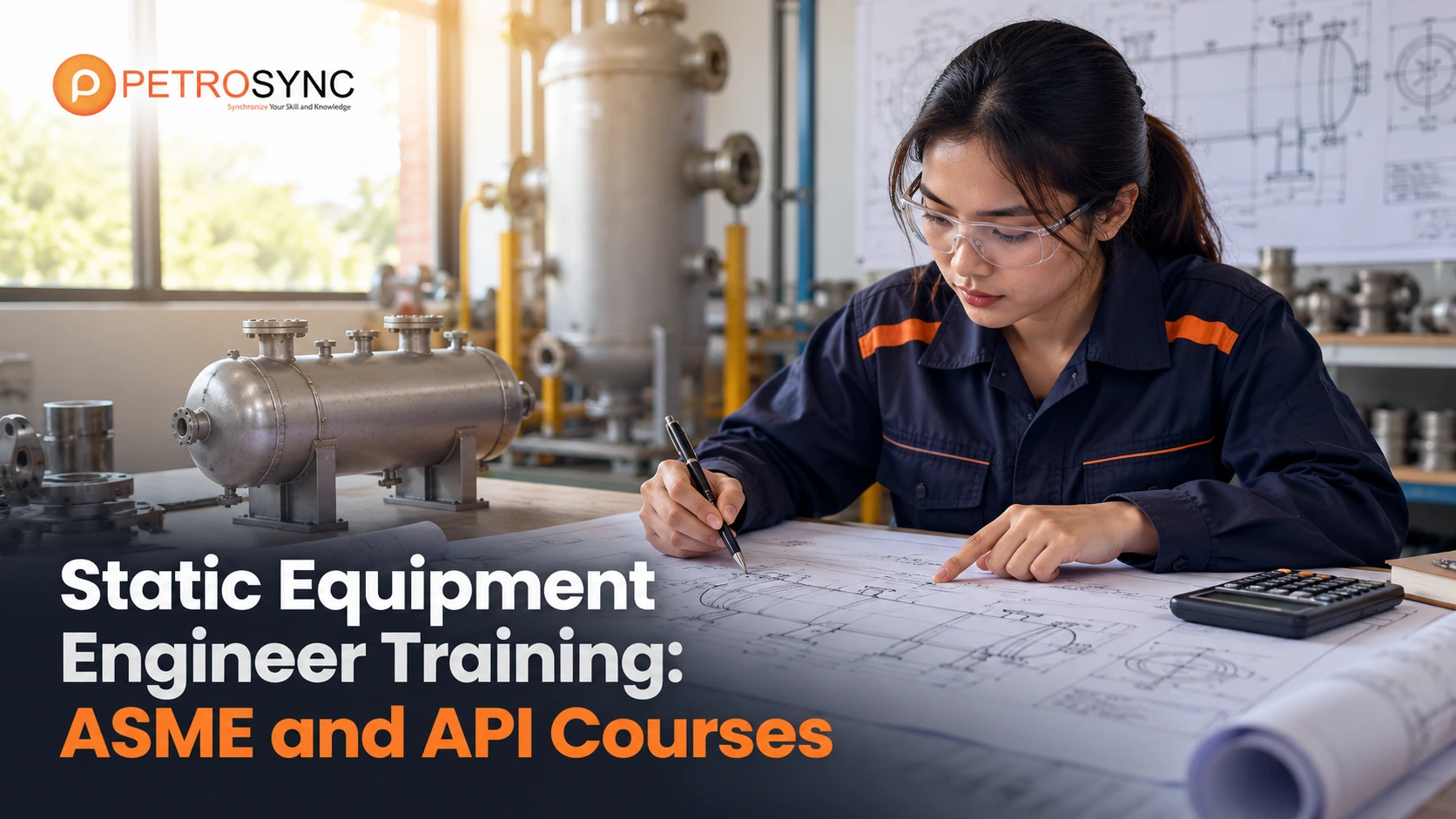
Static equipment engineer training should connect the equipment you work with to the decisions you need to understand. Reviewing a pressure-vessel design involves different questions from assessing damage in equipment already in service, even when the same engineering team handles both.
Choosing a course therefore starts with your responsibilities, existing knowledge and learning priorities. This guide compares relevant ASME and API options, explains how to assess course suitability, and outlines what to prepare when planning training for yourself or your team.
Training Priorities Across the Static Equipment Lifecycle
Choose training around your principal equipment and its lifecycle stage. Design work, condition assessment and maintenance support require related knowledge, but they do not create identical learning needs. A useful starting point is the technical question you most often need to resolve or discuss.
For example, a design review may require closer attention to the basis of a vessel calculation. An in-service review may instead raise questions about damage information and further assessment. Listing these responsibilities makes the choice more specific than selecting a course simply because it mentions static equipment.
Keep the equipment boundary clear. Pressure vessels, heat exchangers, tanks and piping may all fall within your responsibilities, yet one course will not necessarily address each in equal depth. Identify the equipment that matters most now, then compare the relevant syllabus against that need.
Read Also: Pressure Vessel Design Process from Concept to Construction
Which ASME and API Courses Match Your Work?
Choose ASME Section VIII when your priority is pressure-vessel design learning, and API 579 when you need to understand fitness-for-service assessment. Both involve engineering judgement, but the work question behind your choice matters more than treating either course as a general qualification for all static equipment.
1. ASME Section VIII for Pressure Vessel Design
ASME Section VIII learning focuses on pressure-vessel code application and the reasoning behind design calculations. PetroSync’s ASME Section VIII training covers Divisions 1 and 2, providing a relevant starting point when your work involves reviewing vessel-design requirements and understanding the assumptions behind a calculation.
When comparing the syllabus with your responsibilities, identify the design questions that cause difficulty. You might need to understand which inputs require clarification before reviewing a calculation. Use that question to assess course relevance; completing the course does not itself confer authority to approve or stamp a vessel design.
2. API 579 for In-Service Equipment Assessment
API 579 addresses fitness-for-service, or FFS, questions about equipment already in service. The learning focus concerns condition information and the engineering assessment needed when damage or flaws require evaluation. This differs from choosing a course primarily to understand new-equipment design.
An illustrative review question is whether the available condition information is sufficient for the proposed assessment. Learning to recognize missing inputs can help you participate more effectively in that discussion. The course should support understanding of the assessment basis, rather than encourage conclusions about actual equipment from an incomplete example.
|
Work Responsibility |
Learning Focus |
Relevant Course |
Scope Boundary |
|
Pressure-vessel design review |
Code application and design assumptions |
ASME Section VIII Divisions 1 & 2 |
Not a universal course for every static equipment code |
|
In-service equipment assessment |
Damage information and FFS reasoning |
API 579 / ASME FFS-1 |
Not a substitute for new-equipment design or engineering authorization |
What Knowledge Should You Build Before Training?
Prepare the equipment context and technical foundations that will help you connect course material to your work. Familiarity with drawings, material identification and operating conditions can make examples easier to follow. Treat this preparation as a learning aid rather than an invented formal admission requirement.
Start with the equipment you handle most often. Review its drawing terminology and note any unfamiliar code references. For in-service work, build awareness of relevant corrosion mechanisms and distinguish an observed condition from an explanation that still needs investigation. Record questions that you want the course to help you frame.
Finally, compare your background with the chosen course’s published audience guidance. A participant who lacks experience in one topic may still have useful knowledge from maintenance, inspection or another engineering function. Discuss the specific gap with the provider instead of assuming that every course needs the same prior certification.
Read Also: ASME Section VIII Pressure Vessel Code Explained
How Can Training Support Engineering Decisions?
Training can help you examine assumptions, understand the limits of condition information and explain a technical recommendation more clearly. Apply that learning within your company’s engineering review process, using the following decision areas to identify what you want to practise and where further review remains necessary.
1. Reviewing Design Assumptions and Calculations
Start a calculation review by identifying the inputs and assumptions on which it depends. A course can help you understand how code requirements relate to a design question, making it easier to ask for clarification when the calculation basis is unclear or incomplete.
For example, you could ask whether the design conditions and material basis have been explained before discussing a result. This is a review question, not a substitute for checking the applicable requirements. Your aim is to recognize what needs examination and communicate it to the responsible engineering reviewer.
2. Interpreting Equipment Condition and Assessment Needs
Condition information needs context before it can support an assessment discussion. Training can help you recognize the difference between a reported observation, an interpretation and an assumption. That distinction is useful when deciding what additional information a responsible assessor may need.
Consider a summary of wall thickness measurement that lacks a clear explanation of where measurements were taken. The useful learning question is how that missing context affects confidence in the information. Identifying such gaps supports a more focused assessment discussion without turning an incomplete example into a judgement about fitness for continued service.
3. Communicating Technical Recommendations
A technical recommendation should make its reasoning understandable to the person who must review it. Training can support this by helping you describe the question, the information available and the limits of the proposed conclusion, rather than presenting an unexplained recommendation alone.
An illustrative internal memo could separate known information from assumptions, list unresolved questions and identify the next reviewer. This gives colleagues a practical basis for discussion. It also keeps responsibility visible: a well-written explanation supports the company’s review process, while approval remains with the people authorized to make that decision.
Need a clearer basis for in-service assessment discussions? Explore API 579 training and match the learning scope to your equipment responsibilities.
How Should You Evaluate a Static Equipment Course?
Evaluate a static equipment course against the depth of understanding your work requires. A familiar code name is only the starting point. Examine the scope, the intended audience and the learning activities that the provider actually describes, then compare them with your priority questions.
Ask whether examples relate to your equipment and whether the course explains the reasoning you need to follow. PetroSync’s relevant course descriptions identify case-based learning, but you should still confirm the activities for your selected batch. If software or a particular code edition matters, clarify those details before booking.
Keep the expected outcome specific. Understanding vessel-design requirements, interpreting inspection information and learning FFS concepts are different objectives. A course can address a defined knowledge gap without covering every aspect of your role. Judge suitability by that gap and the learning scope, rather than by the certificate title alone.
Read Also: The Ultimate Guide to Fitness for Service based on API 579
Static Equipment Training Options with PetroSync
PetroSync offers separate ASME Section VIII and API 579 courses for engineers with design or in-service assessment priorities. You can start with the option that best matches your responsibilities, then discuss wider team needs when several participants face related technical questions.

The ASME course provides a route into pressure-vessel code application and design calculations. API 579 focuses on FFS understanding for in-service equipment. These are distinct learning options, so a discussion about suitability should begin with your equipment, current tasks and existing knowledge rather than an assumed combined program.
A Google Business Profile snapshot supplied by the project owner, dated 6 September 2026, recorded a 4.9/5 rating from 1,061 reviews for PetroSync Jakarta.
That snapshot offers provider-level reputation context alongside your review of course relevance. For a team, explain the common learning priorities and ask PetroSync to discuss an appropriate in-house scope. Confirm the proposed content and delivery arrangements through the resulting quotation.
What Should You Include in the Training Budget?
Build the training budget from confirmed inclusions and the practical needs of attendance. Compare the course scope before comparing its fee, because similar titles may leave you with different preparation needs. A written quotation helps your team understand what it is purchasing.
Check whether course materials, required references or any necessary software involve separate arrangements. Include participants’ study time and time away from normal duties. Where travel is relevant, account for transport and accommodation separately rather than assuming they form part of the course price.
For in-house delivery, request a quotation based on the proposed team scope. Public-course pricing does not establish the cost of a tailored program. Confirm the applicable minimum participant requirement with PetroSync without assuming a number, and resolve any uncertainty about inclusions before approving the budget.
Turning Training Priorities into a Team Learning Plan
Turn the team’s priority equipment tasks into specific learning objectives and an internal follow-up plan. Begin by identifying who handles design questions, who contributes condition information and who reviews recommendations. This makes participant selection more purposeful than sending everyone to the same course by default.
Choose a small number of work questions that the learning should help participants discuss. For example, a design-focused group might aim to explain the assumptions behind its review questions more clearly. A condition-assessment group might focus on recognizing information gaps before passing a case to an assessor.
After training, assign an internal owner to review how participants apply the learning. A discussion of an authorized workplace example can reveal remaining gaps and guide the next step. This is your team’s follow-up activity, not a promise of an additional provider assessment or project-design service.
Bring your equipment priorities and team learning objectives together, then contact PetroSync to discuss a suitable scope and next steps.
Request Static Equipment Training for Your Team
Share the equipment your team handles, the decisions you need to support and the knowledge gaps you want to address. PetroSync can discuss which course or proposed in-house scope fits those priorities.
When you are ready to plan team training, request an in-house training quotation with your participant needs and learning objectives. Confirm the proposed content, delivery arrangements and inclusions before deciding how the training fits your engineering development plan.
Frequently Asked Questions (FAQ)
Familiarity with API 650 helps participants understand the design and construction topics covered in API 653 training. Before class, review basic shell, bottom, and roof terminology and how these components relate to tank design. If you have a different technical background, discuss your learning readiness with PetroSync before enrolling.
API 653 training in this context focuses on aboveground storage tanks, consistent with the scope of API's inspector Body of Knowledge. For underground tanks, choose a training route that matches the equipment and your inspection objectives. The general term storage tank inspector does not identify a single certification pathway, so confirm the applicable requirements before choosing a course.
Use the code editions specified in the Publications Effectivity Sheet for your intended API 653 exam window. The 2026 API 653 Body of Knowledge explains the examination topics and their relationship to the applicable effectivity sheet. Review the official API 653 Body of Knowledge before preparing. A newer standard edition does not automatically replace the edition specified for an examination.
Start with basic algebra, careful interpretation of inputs, and consistent units. Explain each calculation step before checking the final answer, and use the units specified in the examination question. Working through API 653 practice questions can help you identify mistakes, strengthen your understanding, and focus your preparation on areas that need improvement.
Your team can discuss the use of its own inspection cases with PetroSync when defining the proposed in-house training scope. Explain your learning objectives and ask whether the examples are suitable for the program. Before sharing any cases, obtain the necessary organizational approval and remove confidential or sensitive information.

Results-oriented and thorough SEO specialist with extensive experience in conducting keyword research, developing and implementing digital website promotion strategies and plans, managing campaigns to develop company websites in the digital world, excellent knowledge of marketing techniques and principles, and attentive strong attention to detail.