

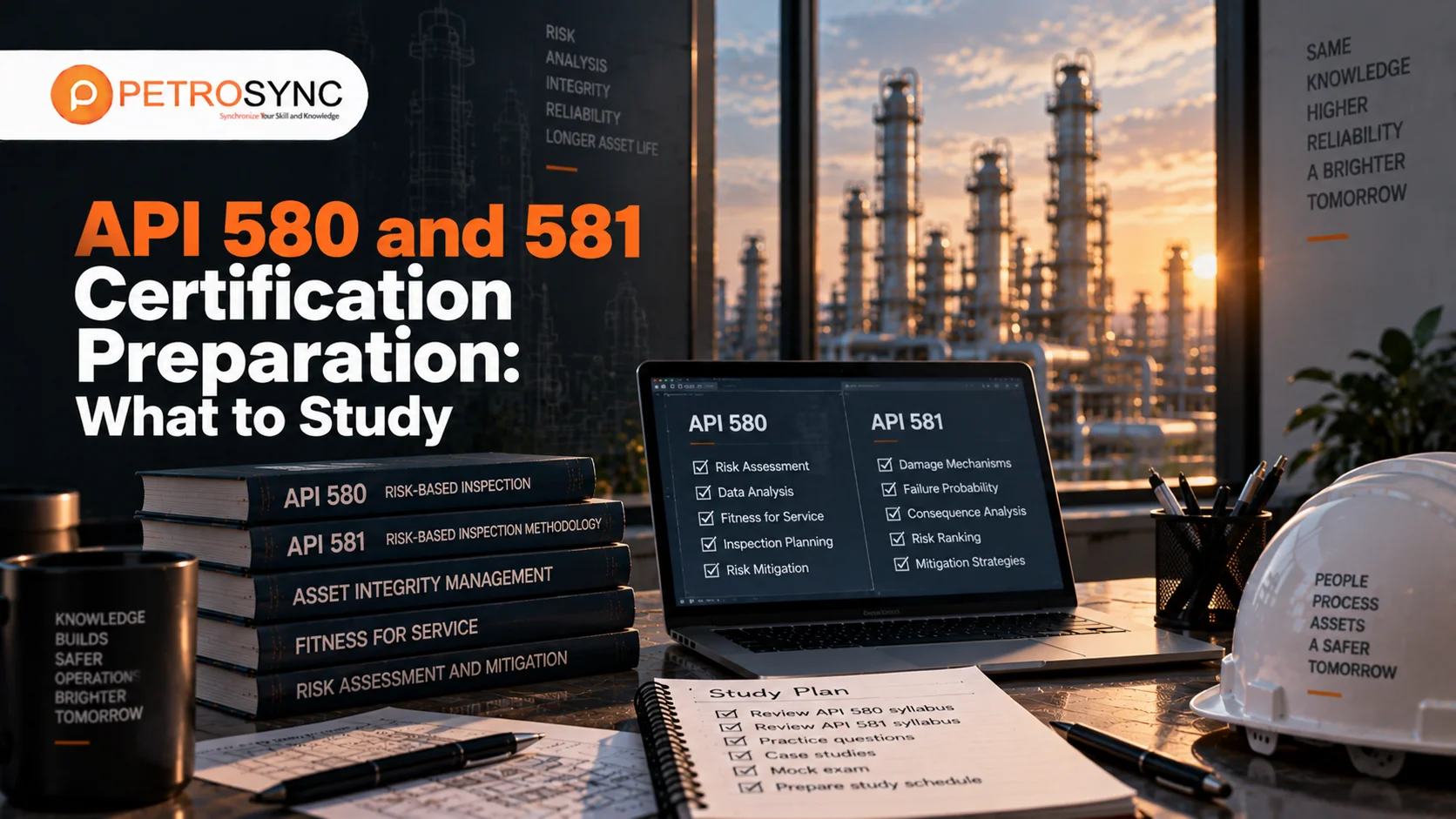
- Start with API’s current API 580 Body of Knowledge and reference publication before adding broader RBI study topics.
- Use API 581 as supporting methodology for probability, consequence and risk analysis rather than assuming every API 581 topic is on the API 580 exam.
- Build a study plan from your starting knowledge, mapped knowledge gaps and repeated study-practice-review cycles.
- Choose self-study, instructor-led training or a combination based on your need for structure, explanations, feedback, time and budget.
- Use PetroSync’s verified RBI coverage, case discussions and API preparation support to address specific knowledge gaps, not to replace API’s official exam scope or eligibility rules.
- Judge readiness by your ability to explain and apply RBI concepts and resolve recurring errors, not by an invented practice-score threshold.
What Should You Study for API 580 Certification Preparation?
For 2026 API 580 preparation, start with API’s official certification page and current Body of Knowledge. Focus on the ten knowledge categories and use API RP 580 as the primary reference. API 581 can support deeper RBI methodology understanding, but it is not listed as the API 580 exam reference publication.
|
Study Area |
What to Review |
Preparation Purpose |
|
Official API 580 exam scope |
2026 API 580 Body of Knowledge and API RP 580, 4th Edition with Addenda 1 |
Establish the current certification-study boundary. |
|
RBI framework and terminology |
Terms, definitions, risk assessment, RBI program, roles and responsibilities |
Build the conceptual framework for the assessed RBI topics. |
|
Assessment inputs and risk relationships |
Data collection, damage mechanisms, probability of failure and consequence of failure |
Understand how RBI inputs contribute to risk evaluation. |
|
Risk management and documentation |
Risk management, RBI documentation and how assessment results inform inspection decisions |
Connect assessment reasoning to inspection planning and records. |
|
API 581 supporting methodology |
More detailed POF, COF, risk-calculation and inspection-planning methodology |
Deepen RBI understanding without treating all API 581 content as automatic API 580 exam scope. |
The API 580 Body of Knowledge is the authority for exam study scope; API 581 is used here as supporting methodology context.
Source: API 580 Body of Knowledge for 2026 exams.
Build Your API 580 Study Plan
The Body of Knowledge groups preparation into Terms, Definitions and Acronyms; Risk Assessment; the RBI Program; Roles, Responsibilities, Training and Qualifications; Data Collection; Damage Mechanisms; Probability of Failure (POF); Consequence of Failure (COF); Risk Management; and RBI Documentation. Treat these categories as your primary study map rather than trying to learn every RBI topic at the same depth.
Connect the categories instead of studying them in isolation. Data and damage mechanisms inform the assessment; POF and COF describe the risk relationship; risk management and documentation connect the assessment to inspection decisions. Reviewing API 580 RBI fundamentals can help with context, while API remains the authority for the current exam scope.
Once you know the official study boundary, the next question is why API 581 often appears beside API 580 in preparation courses.
How Does API 581 Fit Into API 580 Preparation?
API 581 supports API 580 preparation by providing a more detailed RBI methodology for probability of failure, consequence of failure, risk calculation and inspection planning. API’s 2026 API 580 Body of Knowledge lists API RP 580 as the exam reference publication, so use API 581 as supporting context unless a current API source specifically places a topic within the exam scope. A combined course title does not create a separate API 581 personnel certification.
API inspection-training material covers API 580 and API 581 together because they serve related learning functions. API 580 provides the RBI program framework, while API 581 goes deeper into the inputs and calculations used for POF, COF, risk and inspection planning.
API 581 quantitative RBI is useful when you need deeper reasoning behind the assessment. It helps explain how risk drivers and assumptions influence inspection priorities, but broader methodology coverage should not replace the current API 580 Body of Knowledge as the exam-study boundary.
Read Also: The Key Difference of API 580 & API 581 Explained
With that distinction clear, you can turn the official topic map into a study plan based on your own starting point.
How Should You Build an API 580 Study Plan?
Build your API 580 study plan by checking your starting knowledge against the current Body of Knowledge, prioritizing the categories you understand least and cycling through study, practice and review. There is no universal preparation duration in the sources used for this guide, so set the schedule around your actual knowledge gaps and available study time rather than copying a fixed number of weeks.
Assess Your Starting Knowledge
Start by reviewing the ten Body of Knowledge categories and asking whether you can explain the purpose and relationships within each one. You do not need an invented readiness score. The goal is to distinguish topics you can explain confidently from areas where you rely on vague definitions, memory cues or incomplete understanding.
For example, knowing the definition of POF is different from explaining how data quality, damage mechanisms and assumptions influence an assessment. Record that specific gap rather than labeling the whole subject “weak.”
Map Knowledge Gaps to the Current API 580 Scope
Match each knowledge gap back to the current Body of Knowledge and API RP 580 before adding supporting materials. This keeps your preparation focused and reduces the risk of spending too much time on interesting but nonessential material.
Use API 581 selectively where it helps explain POF, COF and risk relationships. Broader calculations or implementation topics are supporting learning unless you can connect them to the current API 580 study scope. Separate “useful to understand” from “officially listed for the exam.”
Schedule Study, Practice and Review
Turn the prioritized gaps into repeatable study blocks. Study one topic, practise applying the concept, review the reasoning behind mistakes, and then revisit the weak area. A plan built around several shorter feedback cycles is easier to adjust than one long schedule that assumes every topic needs equal time.
If your employer supports your preparation, coordinate realistic study windows around operational responsibilities. Focus on study time you can consistently protect rather than assuming formal study leave is available.
Once the plan is clear, you can decide whether to execute it independently or add structured support.
Preparing with colleagues? Discuss an in-house RBI programme around your team’s knowledge gaps and learning priorities.
Discuss In-House API 580 and 581 Training
Should You Use Self-Study or Instructor-Led API 580 Training?
Self-study can fit candidates who can organize the current references, diagnose their own gaps and maintain consistent practice, while instructor-led training can add structure, explanations, feedback and applied discussion. You can also combine the two approaches. Choose based on your starting knowledge, the support you need, available time and budget—not on a promise that one method guarantees the exam result.
When Self-Study Fits Your Preparation Needs
Self-study works best when you are comfortable navigating the current reference material and can create your own study sequence. You should also be able to identify why you made a mistake instead of only checking whether an answer was right or wrong.
This approach lets you spend more time on the categories that need attention, but it is not automatically the best route when difficult RBI relationships remain unclear without discussion.
When Structured Training Adds Value
Instructor-led training can add value when you need a guided sequence, explanations of difficult RBI relationships, opportunities to ask questions and applied discussion. The main benefit is not simply receiving more material. It is having a structure that helps you connect the official scope to examples, reasoning and practice.
Check actual course inclusions rather than assuming every provider offers the same activities or exam support. A comprehensive API 580 course is useful when its coverage matches the gaps you have already identified.
When to Combine Self-Study and Training
A combined approach can use self-study to establish your baseline, instructor-led sessions to clarify difficult areas and post-training review to close the remaining gaps. This keeps you active in the learning process instead of treating training as a substitute for individual preparation.
The balance can change by topic. You may review terminology independently while needing more discussion around POF, COF, risk calculations or inspection-planning logic. Use the method that fits each gap.
After choosing a preparation method, the next step is to evaluate what PetroSync can support within that plan.
Read Also: Comprehensive API 580 Course: Master Risk-Based Inspection
How Can PetroSync Support Your API 580 Preparation?
PetroSync’s API 580 and 581 course provides instructor-led RBI coverage, practical case discussions and API preparation support that can help candidates work through identified knowledge gaps. Use that support alongside the current API 580 Body of Knowledge rather than assuming every item in a combined course agenda is part of the certification exam. Confirm current reference alignment and the selected package details before booking.

Structured Technical Preparation
PetroSync’s course materials and training record cover the RBI framework and methodology, inspection prioritization, risk-based inspection planning and API 580 exam preparation. This gives candidates a structured environment for connecting concepts that may feel fragmented during independent study.
Use the course to strengthen identified gaps, not replace the official study map. PetroSync’s published 2026 brochure still contains older API 581-2016 labels, so do not assume full alignment with the latest API 581 edition. Confirm current learning materials and reference alignment before booking.
Practical Case Studies
PetroSync lists practical case discussions around probability of failure and Level 1 consequence analysis. These activities can help you move from definitions to applied reasoning by examining assumptions, inputs and how an assessment may affect inspection decisions.
Use case studies to explain why the reasoning works, not to memorize scenarios as exam questions. Test whether you can trace how data and assumptions influence POF, COF, risk and inspection priorities.
Exam Preparation Support
PetroSync describes its API Preparation Training as instructor-led preparation before API examinations. PetroSync reports an API exam pass rate of around 90% after its API preparation training. This is a company-reported result for API preparation generally; the cohort size and reporting period are not supplied, and it does not guarantee an individual result.
You can also choose an optional training + API certification exam package, with PetroSync assisting exam registration. Confirm the selected package because the exam is not included automatically in every standard course fee. Source: PetroSync FAQ.
Individual and In-House Training Options
Individual candidates can discuss whether the API 580 and 581 course fits their starting knowledge and learning priorities. Focus on the gaps you want to close rather than simply asking for the broadest syllabus.
For company groups, PetroSync provides an in-house inquiry route to discuss participant backgrounds, common RBI learning needs, delivery arrangements and a custom quotation. Confirm these details directly rather than assuming a fixed group size or public-course price applies.
Preparation support is most useful when it improves what you can explain and apply. That brings the focus back to readiness.
How Can You Assess Your API 580 Exam Readiness?
Assess API 580 readiness by checking whether you can explain the core RBI relationships, apply the reasoning in practice or case discussions and correct recurring mistakes without depending on answer memorization. API does not publish a practice-question cutoff as a readiness benchmark in the sources used here, so use practice as a diagnostic tool rather than as a prediction of your exam result.
Explain Core RBI Concepts Without Relying on Notes
Test whether you can explain the main RBI relationships in your own words. You should be able to connect risk assessment, the RBI program, POF, COF, risk management and documentation rather than recall each item as an isolated definition.
This editorial readiness check is not an API requirement. It helps reveal whether your understanding can support reasoning when wording or context changes.
Review Practice Errors and Revisit Weak Areas
Do more than count correct answers. Classify why an answer was wrong: concept misunderstanding, terminology, method selection, calculation logic or incomplete reasoning. Then return to the relevant official or supporting material and check whether the problem is actually resolved.
A repeated error pattern is more informative than one practice score. If the same mistake continues after review, move that topic back up your study priorities.
Decide What Preparation Support You Still Need
Compare the remaining gaps with what you can realistically close on your own. Some topics may need another focused reading and review cycle. Others may benefit from an instructor explanation or an applied case discussion where you can test your reasoning.
Keep the decision conditional. Training is preparation support, not proof of eligibility or certification, and additional support should address a specific learning need.
Read Also: Get To Know API 580 Exam: Question Types and Procedures
Once your remaining gaps are clear, you can discuss the preparation support that matches them.
Discuss Your API 580 and 581 Preparation Needs With PetroSync
Discuss your API 580 and 581 preparation needs with PetroSync by sharing your current RBI experience, the topics you find difficult and the type of learning support you prefer. Individual candidates can ask about course suitability and preparation support. Company groups can discuss an in-house scope, participant backgrounds and a custom quotation. Use that discussion to choose support that complements the current API 580 exam scope and your own knowledge gaps.
Discuss My API 580 and 581 Preparation Needs
Frequently Asked Questions (FAQ)
Not necessarily. API’s 2026 API 580 Body of Knowledge lists API RP 580 as the exam reference publication, while API 581 provides a more detailed RBI methodology that can support your understanding of probability, consequence and risk. Study API 581 selectively as supporting context unless the current exam scope specifically requires a topic.
No. API’s published API 580 qualification routes are based on current API certification or education and petrochemical experience, not completion of a preparation course. Training can provide structure, explanations and practice support, but it should be treated as preparation assistance rather than a prerequisite that replaces API’s official eligibility requirements.
There is no single preparation duration that suits every candidate. Base your schedule on how familiar you are with the current API 580 Body of Knowledge, how many knowledge gaps you identify and how much consistent study time you can maintain. Build enough time for study, practice, error review and another review cycle.
No. Practice questions can help you identify weak areas and test whether you can apply RBI concepts, but a practice score is not an official API readiness threshold or a guarantee of the exam result. Review why an answer was wrong, return to the relevant source material and check whether the weakness is actually resolved.
Yes. PetroSync provides an in-house training inquiry route for organizations that want a customized learning scope for a team. Share participant backgrounds, common RBI knowledge gaps and the preparation priorities you want addressed, then confirm the delivery arrangement, participant requirements, schedule and quotation directly with PetroSync before treating any arrangement as fixed.

Results-oriented and thorough SEO specialist with extensive experience in conducting keyword research, developing and implementing digital website promotion strategies and plans, managing campaigns to develop company websites in the digital world, excellent knowledge of marketing techniques and principles, and attentive strong attention to detail.

Business Development Manager at PetroSync with 12+ years of experience in professional training and business development across the energy and industrial sectors.