

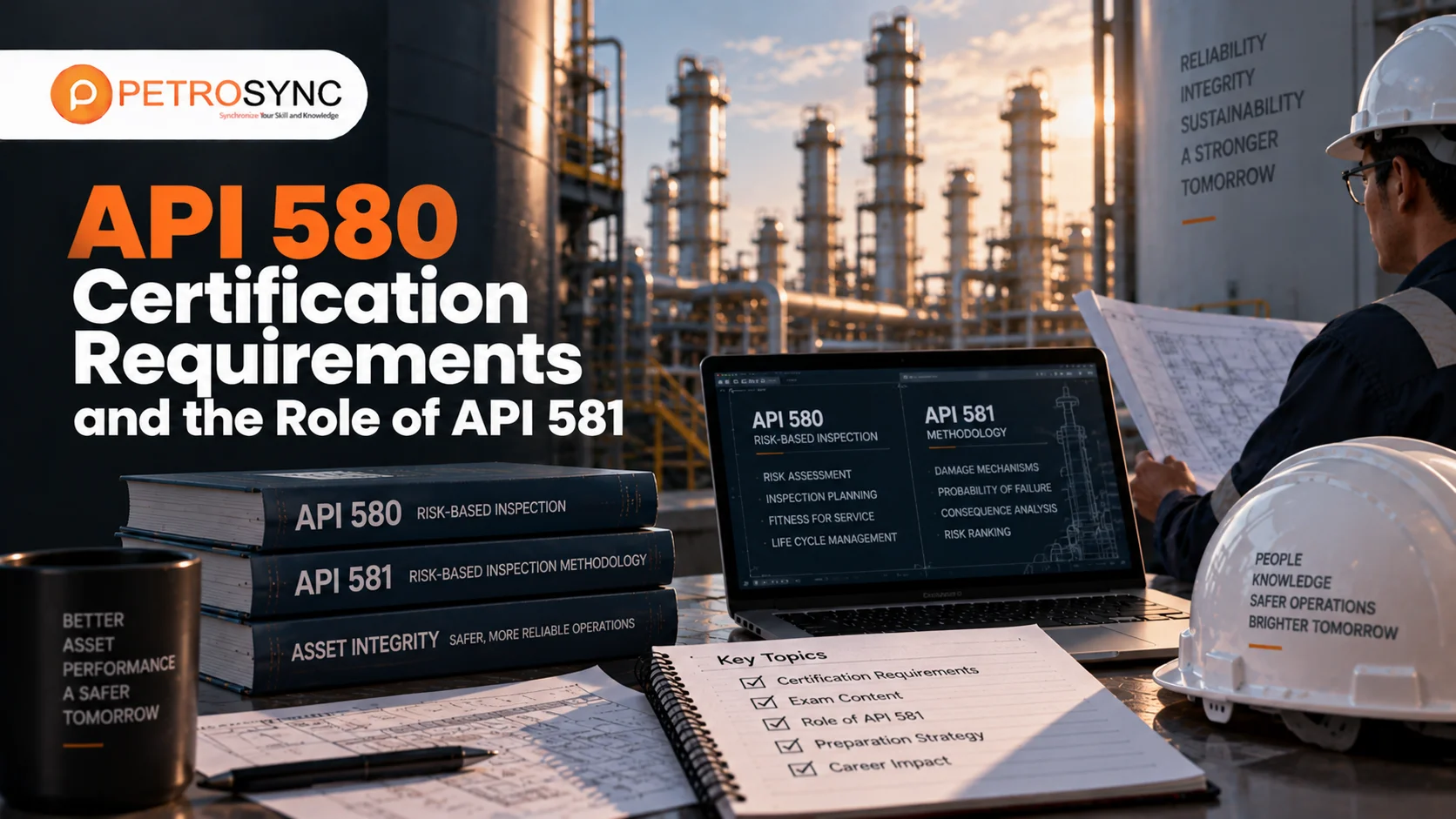
- API 580 eligibility has a current-certification route and an alternative route based on education and petrochemical experience.
- API 581 belongs to the RBI methodology discussion; a combined course title does not establish a separate personnel credential.
- Prepare certification, education and employment information according to the route that applies to you.
- Check course-entry guidance separately from API exam eligibility and your own learning needs.
- Discuss PetroSync’s preparation support for an individual candidate before considering in-house arrangements for a company group.
Before choosing training, make sure you know which API 580 eligibility route applies to you. A combined API 580 and 581 course name can also raise questions about the credential you are working towards. This guide separates qualification criteria, supporting information and course-entry guidance so you can assess your next step with a clearer understanding of each.
Start with your current certification or education and employment record, then consider the learning support that matches your background and the applicable requirements.
What Are the API 580 Certification Requirements?
API 580 exam eligibility can come from a current API 510, API 570 or API 653 certification, or from the required combination of education and petrochemical experience. Without a current qualifying certification, API requires one, two, three, or at least five years of experience, depending on education, gained within the last ten years. An engineering degree is not mandatory for every route, and meeting eligibility requirements is not the same as earning certification.
API 580 Eligibility at a Glance
|
Qualification Route |
Candidate Background |
Requirement to Verify |
|
Current certification |
Active API 510, API 570 or API 653 credential |
Current status qualifies you to sit the API 580 exam. |
|
Education and experience |
BS or higher in engineering or technology |
At least 1 year of petrochemical-industry experience. |
|
Education and experience |
Two-year degree or certificate in engineering or technology |
At least 2 years of petrochemical-industry experience. |
|
Education and experience |
High school diploma or equivalent |
At least 3 years of petrochemical-industry experience. |
|
Education and experience |
No formal education |
At least 5 years of petrochemical-industry experience. |
For the education-and-experience route, the qualifying experience must have been gained within the last ten years and the required minimum must be documented in the application.
Source: API’s official API 580 qualification requirements.
Route for Current API 510, API 570 or API 653 Holders
A current API 510, API 570 or API 653 credential provides the published qualifying route to sit the API 580 examination. Check its current status before relying on this route. Having held one of these certifications previously is not the same as holding it now.
For example, a candidate who already holds API 570 would first confirm that the credential remains current. That check identifies the qualification route; it does not award API 580 certification. The candidate must still satisfy API’s application requirements and pass the examination before receiving the additional credential.
Route Based on Education and Petrochemical Experience
Without a current listed credential, use the table to match your education with the required petrochemical experience. Read the education category and experience requirement together, then check when the experience was gained. The criterion concerns petrochemical-industry experience, rather than a particular job title added by a training provider.
Consider a candidate with a high school diploma or equivalent. They would check the three-year category and identify the relevant employment within the ten-year window. Other categories accommodate different educational backgrounds, including no formal education. Ask API about an unclear qualification instead of assuming that a similarly named award fits the category.
Read Also: Mastering Asset Inspections: API 580 Certification Guide
How Does API 581 Relate to API 580 Certification?
API 581 supplies an RBI assessment methodology, while API 580 is the personnel certification listed by API. The standards may be covered together in a training course, but that course title does not establish two separate API credentials. Distinguish the scope of the learning material from the certification you are applying for.
Risk-based inspection, or RBI, connects inspection planning with an assessment of risk. API 581 addresses assessment calculations involving probability of failure and consequence of failure. The API 580 RBI fundamentals help explain the program framework, while API 581 adds an assessment methodology for the RBI discussion.
For exam preparation, follow API’s applicable Body of Knowledge and its published reference list. A course may cover a broader set of RBI topics than the API 580 examination requires. Once the intended credential is clear, check which information supports your own eligibility for it.
Read Also: The Key Difference of API 580 & API 581 Explained
What Information Supports Your API 580 Eligibility?
Prepare the information that supports your qualification route, following API’s application guidance. This may include current certification details or the relevant education and employment records. Where experience is required, the application must document the minimum qualifying period and provide employer contacts who can verify it.
Current Certification Details
Candidates using the current-certification route should check the identity and status of the credential supporting their application. Start with its type: API 510, API 570 or API 653. Then check that the status is current and that the information matches your own certification records.
Provide the certification information or documentation requested for your application. An unrelated professional certificate should not be treated as one of the listed credentials. This review is specific to the route you are using; candidates relying on education and experience need to establish that different basis for qualification.
Education Records
When education supports your qualification route, prepare records that substantiate the category you claim, such as the pertinent diploma or transcript. The engineering or technology categories need to match the actual qualification. A university degree in another subject should not automatically be classified under those categories.
API’s application guidance requires official English translations of diplomas and transcripts. Arrange the required translation for non-English records, and ask API to clarify an unfamiliar qualification before selecting a category. The no-formal-education route is different: it should not be assigned a diploma requirement that does not apply to that category.
Relevant Employment History
Document the qualifying experience with accurate employer names, employment dates and relevant duties. Provide appropriate employer contacts who can verify the required period, skills and experience. Check the record before submission: API states that changes and additions cannot be made to Employment History after an application is submitted.
A candidate with experience across several employers should record each period under the correct employer, rather than attribute the whole career to one company. Check that the periods used meet the applicable minimum within the ten-year window. Ask API about unclear cases; an employer’s willingness to fund training is separate from verifying your experience.
Preparing with colleagues? Discuss an in-house programme around your team’s RBI learning priorities.
Discuss In-House API 580 and 581 Training
Are Training Requirements the Same as Exam Eligibility?
No. A course provider’s entry guidance addresses whether its training suits your background; API’s eligibility rules determine whether you qualify for the examination. Review both separately so that a course recommendation is not mistaken for a universal exam prerequisite, and confirm any course-entry conditions with the provider.
Course Entry and Recommended Background
When considering an API 580 course, check how the provider’s recommended background relates to your own experience. PetroSync’s published course information says candidates should possess API 510, API 570 or API 653 certification. This is course-page guidance; it is not the complete set of API’s examination qualification routes.
A candidate relying on education and experience can therefore ask PetroSync whether the course suits their starting knowledge and what entry arrangements apply. Explain the qualification route and the topics you need help understanding. Establishing exam eligibility does not, by itself, confirm the provider’s admission arrangements.
Exam Eligibility and Learning Readiness
Eligibility establishes a qualifying background; readiness concerns your understanding of the material being assessed. Meeting an administrative route does not show that you already understand every RBI topic. Use API’s applicable Body of Knowledge to identify the examination scope, then decide where further explanation would help.
An eligible candidate might recognise inspection terminology but still need to strengthen the reasoning behind an RBI assessment. Identifying that gap makes the discussion about preparation more useful. Broader API 581 course content is not automatically an API 580 exam requirement, so match the support you choose to your learning objective.
How Can PetroSync Support Your API 580 Preparation?
PetroSync‘s API 580 and 581 course supports preparation through structured RBI coverage and applied case discussions. Use those learning activities to strengthen the concepts you need to understand for API 580, then discuss the course arrangements that suit you as an individual or as part of a company group.

Structured Technical Preparation
PetroSync’s course provides a structured way to review the RBI framework and its connection to inspection priorities. Its published coverage connects risk assessment, data, failure probability, consequences and inspection planning. Focus on how those topics relate to each other, rather than treating the agenda as a list of definitions to memorise.
You might bring a question about which assumptions affect an inspection priority. Use the relevant discussion to examine the information behind that decision and identify points needing clarification. This gives your learning a specific purpose while keeping API’s examination reference separate from the course’s broader RBI coverage.
Practical Case Studies
The course’s published Daily Aims include probability-of-failure case discussions and Level 1 consequence-analysis case discussions. These activities give you a context for examining assessment inputs and explaining the reasoning behind an inspection decision. The useful question is not only what an assessment concludes, but how its assumptions support that conclusion.
As an illustrative learning exercise, explain the assumptions used when discussing failure probability or the consequence of a release. Note which inputs you understand and which require clarification. This is a way to engage with the listed classroom activities, not a measured field outcome or a preview of certification exam questions.
Exam Preparation Support
Discuss the instructor-led API 580 preparation and the support included in the course arrangements you are considering.
PetroSync reports an exam pass rate of around 90% following its API preparation training. This company-reported result covers API training generally, not API 580 alone, and does not guarantee an individual result.
You can also choose a training + API certification exam package, with PetroSync assisting exam registration; confirm the package inclusions before booking. This is an optional arrangement, rather than an exam fee automatically included in every standard training booking. Keep learning support and administrative assistance distinct from API’s assessment of your qualifications.
Source: PetroSync FAQ.
Individual and In-House Training Options
As an individual, discuss whether the course fits your background and the RBI topics you need to strengthen. Describe the preparation support you are seeking before deciding on an arrangement. This helps keep the discussion focused on your learning needs rather than the combined course title alone.
For a company group, outline shared priorities and differences in experience. A team can describe which RBI concepts members need to understand more clearly, then discuss a suitable in-house scope. Confirm the scope, delivery arrangements, minimum participant requirement and custom quotation with PetroSync; public-course dates and prices are not an in-house offer.
Read Also: API 580 Training for Effective Risk-Based Inspection
Discuss Your API 580 and 581 Training Needs With PetroSync
Discuss your API 580 and 581 training needs with PetroSync by sharing your current experience, the RBI topics you want to strengthen and your preferred learning arrangements. Individual candidates can ask about course suitability and the preparation support included. Company groups can discuss an in-house scope, participant requirements and a custom quotation based on shared learning priorities. Use that conversation to choose the right preparation support after checking your applicable API eligibility route.
Discuss My API 580 and 581 Training Needs
Frequently Asked Questions (FAQ)
Yes, provided you meet API's alternative education-and-experience criteria. The required petrochemical experience depends on your education level and must fall within the last ten years. Check the category that applies to you and document the minimum experience rather than treating another API credential as a universal prerequisite.
No, an engineering degree is not mandatory for every eligibility route. API also provides categories for a qualifying two-year engineering or technology qualification, a high school diploma or equivalent, and no formal education, each with its own experience requirement. Ask API to confirm an unclear qualification before selecting a category.
Experience gained more than ten years ago does not count towards the experience-based qualification route described by API. Assess the qualifying years within that window rather than your entire career total. A current API 510, API 570 or API 653 certification is a separate eligibility route.
No, completing the combined training does not itself award API 580 certification. PetroSync describes its course certificate separately from the professional credential, which requires meeting API's conditions and passing the examination. The inclusion of API 581 in a course title does not establish a second API personnel certification.
API's published qualification routes are based on the candidate's current certification or education and experience, not employer sponsorship. Sponsorship therefore should not be treated as an eligibility exemption. Where experience verification is required, the employer's practical contribution is to provide accurate records and an appropriate contact, separate from paying for training.

Results-oriented and thorough SEO specialist with extensive experience in conducting keyword research, developing and implementing digital website promotion strategies and plans, managing campaigns to develop company websites in the digital world, excellent knowledge of marketing techniques and principles, and attentive strong attention to detail.

Business Development Manager at PetroSync with 12+ years of experience in professional training and business development across the energy and industrial sectors.