

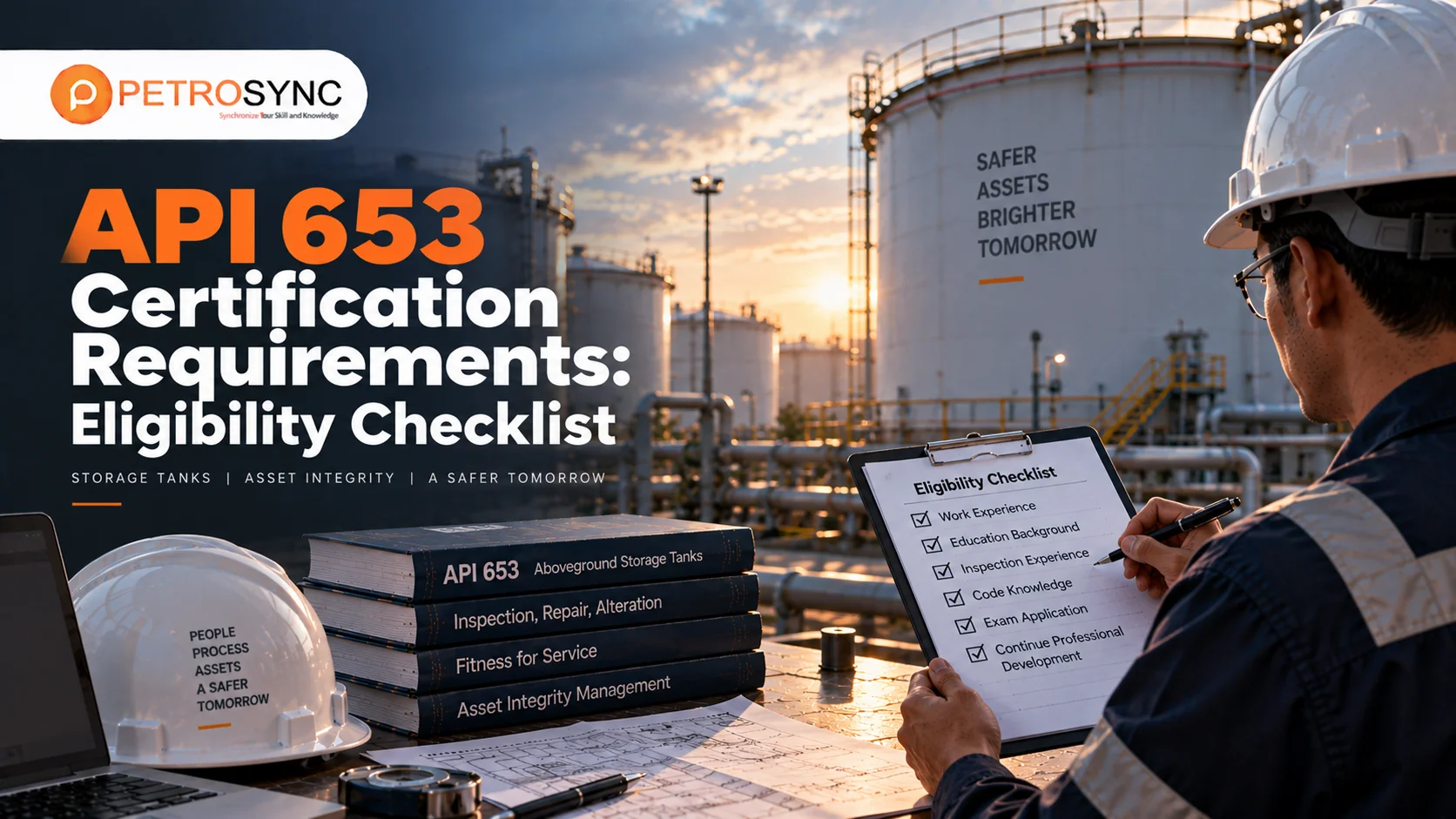
- API 653 eligibility is based on a combination of education and relevant aboveground storage tank experience.
- API provides four qualification routes, so an engineering degree is not mandatory for every candidate.
- Qualifying experience must be relevant to aboveground storage tanks, fit the category-specific requirement, and fall within API’s stated ten-year window.
- Prepare employer verification details and education records before applying; diplomas and transcripts must be officially translated into English when required.
- Training can support exam preparation, but it does not replace API eligibility, documentation, or application approval.
Before choosing an API 653 preparation course, first determine which eligibility route applies to you. The American Petroleum Institute allows candidates to qualify through different combinations of education and relevant aboveground storage tank experience, including a route for people with no formal education but longer work experience. Once your route is clear, you can check whether your employment history and supporting documents are ready for verification before moving on to technical exam preparation.
What Are the API 653 Certification Requirements?
API 653 eligibility is based on education plus relevant aboveground storage tank experience. API currently lists four routes: a BS or higher in engineering or technology with 1 year of experience; a two-year degree or certificate in engineering or technology with 2 years; high school or equivalent with 3 years; or no formal education with 5 or more years. Each route also includes an inspection-activity requirement that must be documented.
|
Education Background |
Minimum Relevant Experience |
Additional Inspection Requirement |
|
BS or higher in engineering or technology, or 3+ years of military service in a technical role (dishonorable discharge disqualifies credit) |
1 year |
Supervision or performance of inspection activities as described in API 653 |
|
Two-year degree or certificate in engineering or technology, or 2 years of military service in a technical role (dishonorable discharge disqualifies credit) |
2 years |
Design, construction, repair, operation, or inspection of aboveground storage tanks; at least 1 year supervising or performing API 653 inspection activities |
|
High school diploma or equivalent |
3 years |
Design, construction, repair, operation, or inspection of aboveground storage tanks; at least 1 year supervising or performing API 653 inspection activities |
|
No formal education |
5 or more years |
Design, construction, repair, operation, or inspection of aboveground storage tanks; at least 1 year supervising or performing API 653 inspection activities |
For all routes, qualifying experience must have been acquired within the last 10 years while employed by, or under contract with, an authorized inspection agency as defined in API 653.
Source: API’s official API 653 qualification requirements.
Education and Experience Pathways
The education category you use determines how much qualifying experience you need. Candidates with a BS or higher in engineering or technology have the shortest published experience requirement, while candidates with less formal education need progressively more relevant experience.
An engineering degree is therefore not mandatory for every candidate. High-school and no-formal-education routes are explicitly listed by API. However, the engineering or technology wording matters for the degree-based routes, so a credential that does not clearly fit the published category should not be assumed to qualify without confirmation from API.
Relevant Aboveground Storage Tank Experience
For the experience-based routes, the work must be relevant to aboveground storage tanks. API identifies activities such as design, construction, repair, operation, or inspection, depending on the eligibility row that applies.
A job title alone does not prove eligibility. For example, a maintenance engineer may have tank-related duties that support the requirement, while another person with the same title may work mainly on unrelated equipment. The useful question is whether the documented duties and dates match the experience described in the applicable API 653 route.
Inspection Activity Requirement
API also distinguishes general tank experience from experience supervising or performing inspection activities described in API 653. For the BS-or-higher route, the required one year is specifically tied to supervision or performance of inspection activities.
For the two-year degree, high-school, and no-formal-education routes, the candidate needs the broader qualifying tank experience for the stated period, and at least one year of that experience must involve supervising or performing API 653 inspection activities. This distinction is important when checking whether your documented history satisfies the complete requirement.
Read Also: API 653 Certification Made Simple: A Step-by-Step Guide
What Counts as Qualifying Experience for API 653?
Qualifying experience must be relevant to aboveground storage tanks, match the activity and inspection requirements for your education route, and have been acquired within the last 10 years. API also states that this experience must have been gained while employed by, or under contract with, an authorized inspection agency as defined in API 653.
Aboveground Storage Tank Work Experience
Relevant experience can include work involving the design, construction, repair, operation, or inspection of aboveground storage tanks when those activities match the route you are using. The focus is on what you actually did, not simply the industry you worked in.
When reviewing your history, compare your documented duties with the applicable API 653 standard requirements. A candidate who has worked on tank repair and inspection projects, for example, should identify the specific periods and responsibilities that support the published criterion instead of treating all oil-and-gas experience as interchangeable.
Experience Within the Required Time Window
API states that the qualifying experience used for API 653 eligibility must have been acquired within the last 10 years. This makes the timing of your relevant work important, even if your overall career is much longer.
Review the employment periods you plan to use before applying. The goal is not to reconstruct every role you have ever held, but to confirm that the minimum qualifying period for your route falls inside the current ten-year window and can be verified.
Supervising or Performing Inspection Activities
The inspection component deserves a separate check because not every form of tank work is inspection work. Depending on the education route, API requires supervision or performance of inspection activities described in API 653 for a defined part—or all—of the minimum qualifying period.
When you compare your experience with the matrix, separate general tank responsibilities from inspection-specific responsibilities. This makes it easier to see whether the minimum experience and the inspection-activity condition are both satisfied.
What Documents Should You Prepare to Verify API 653 Eligibility?
Prepare employer contact information that can verify the qualifying employment period and the education records relevant to the route you claim. API’s application guidance says applicants should provide the information needed to support the minimum qualifying experience, and that diplomas and transcripts need to be officially translated into English.
Employer and Experience Verification
API asks applicants to provide contact information for employers who can verify employment dates, skills, and experience. You only need to support the years required for your qualification route, so the practical task is to identify the relevant employment periods and the people or organizations able to confirm them.
Check the information carefully before submission. API’s current guidance notes that employment history cannot be added or changed after the application is submitted. Employer verification is evidence of your experience; it is not the same thing as employer sponsorship for training or the exam.
Education Documents
If you are using an education-based route, prepare the records that support the category you claim. API’s application guidance refers to education documents such as diplomas, transcripts, and certifications.
The document should support the specific education category in the eligibility matrix. A two-year engineering or technology credential, for example, should not automatically be treated as equivalent to a BS-or-higher route. If your credential is difficult to classify, confirm the category with API rather than relying on an assumption.
English Translation for Supporting Documents
API’s current application guidance says all diplomas and transcripts need to be officially translated into English. If your education documents are issued in another language, arrange the required translation before submitting them.
This is a document-readiness step, not a separate eligibility route. The underlying education credential still has to fit the category you are using.
Once your eligibility route and documents are clear, build the technical knowledge you need for API 653 exam preparation.
Is API 653 Training Required Before Certification?
No. Training can support API 653 exam preparation, but it does not replace API’s education, experience, documentation, or application-verification requirements. Eligibility and learning readiness are separate decisions: first confirm that you meet the applicable API criteria, then choose the preparation support that fits your technical needs.
What Training Can Help You Prepare For
A structured API 653 course can help you review the code concepts that underpin storage tank inspection, design fundamentals, integrity evaluation, repair, alteration, and reconstruction. It can also give you a guided environment for working through practical examples and technical questions.
PetroSync’s API 653 course is positioned as exam preparation for storage tank inspectors, engineers, and integrity professionals. The value of training is in organizing the technical material and helping candidates practice applying the code—not in creating eligibility that the candidate does not already meet.
What Training Does Not Replace
Training does not create qualifying work experience, replace education records or employer verification, or guarantee that API will approve an application. It also does not issue the API 653 certification itself.
Use the course as preparation support after checking your eligibility route. This keeps the learning decision separate from the formal requirements that API evaluates.
Read Also: Best API 653 Training for Oil & Gas Professionals
How Can PetroSync Support Your API 653 Preparation?
PetroSync’s API 653 – Tank Inspection, Repair, Alteration, and Reconstruction course is designed around the technical topics candidates need to understand when preparing for the certification exam. The course can support an individual candidate through structured review and practical application, while company groups can discuss a suitable in-house arrangement when broader team development is needed.

Structured Technical Preparation
Structured preparation helps turn a long body of technical material into a sequence of concepts that can be reviewed and applied. PetroSync’s API 653 course covers storage tank inspection, repair, alteration, reconstruction, design fundamentals, and code application at a certification-oriented level.
For a candidate, the goal is to use that structure to identify weak areas, connect related requirements, and practice interpreting the code in realistic technical contexts. The course does not replace API’s current Body of Knowledge or official exam references, so candidates should always check the applicable API materials for the examination period.
Practical Case Studies and Exercises
Practical exercises help candidates move beyond memorizing terms and start applying tank-integrity concepts to decisions. In the PetroSync course context, this can include discussing inspection findings, repair or alteration considerations, tank-integrity evaluation, and the reasoning behind technical recommendations.
These activities should be treated as learning exercises rather than disclosed exam questions or proof of a particular field outcome. Their value is in helping a candidate explain why a code requirement applies and how different pieces of tank information connect during an integrity assessment.
Exam Preparation Support
PetroSync also offers an optional training-plus-API-certification-exam arrangement with exam-registration assistance. This can simplify the administrative side for candidates who want training and registration support in one package.
The option is not automatically included in every standard training fee, and specific fees or examination dates depend on the selected program. Confirm the current arrangement before booking so you know exactly what is included.
Source: PetroSync FAQ.
Individual and In-House Training Options
Individual candidates can discuss the preparation format that best fits their background and learning needs. If several colleagues require the same technical development, a company can also ask about an in-house arrangement built around the group’s API 653 learning priorities.
Confirm current API 653 training availability directly with PetroSync when you are ready to plan training.
Prepare for API 653 Certification with PetroSync
Once you have identified your API 653 eligibility route and prepared the records needed to support it, the next step is building the technical knowledge required for the exam. PetroSync can support individual candidates with structured API 653 preparation and can also discuss in-house learning for company groups. Review your eligibility first, then choose the preparation route that matches your technical needs.
Frequently Asked Questions (FAQ)
No. API lists four eligibility routes, including high-school and no-formal-education routes. A candidate without an engineering or technology degree may still qualify with the longer relevant-experience requirement that applies to their category, provided the experience and inspection-activity conditions are met and documented.
The minimum depends on education. API currently lists 1 year for BS or higher in engineering or technology, 2 years for a two-year engineering or technology degree or certificate, 3 years for high school or equivalent, and 5 or more years with no formal education, with category-specific inspection requirements.
Yes. API states that the qualifying experience used for API 653 eligibility must have been acquired within the last 10 years while employed by, or under contract with, an authorized inspection agency as defined in API 653. The required minimum experience must also be documented for verification.
Training is not a substitute for API’s eligibility criteria. A preparation course can help you review the technical material and practice applying the code, but you still need to meet the applicable education and experience route and complete API’s application-verification process.
Prepare employer contact information that can verify the qualifying employment period and the education records relevant to your route. API’s current application guidance also says diplomas and transcripts need to be officially translated into English, so non-English records should be prepared accordingly before submission.

Results-oriented and thorough SEO specialist with extensive experience in conducting keyword research, developing and implementing digital website promotion strategies and plans, managing campaigns to develop company websites in the digital world, excellent knowledge of marketing techniques and principles, and attentive strong attention to detail.

Business Development Manager at PetroSync with 12+ years of experience in professional training and business development across the energy and industrial sectors.