

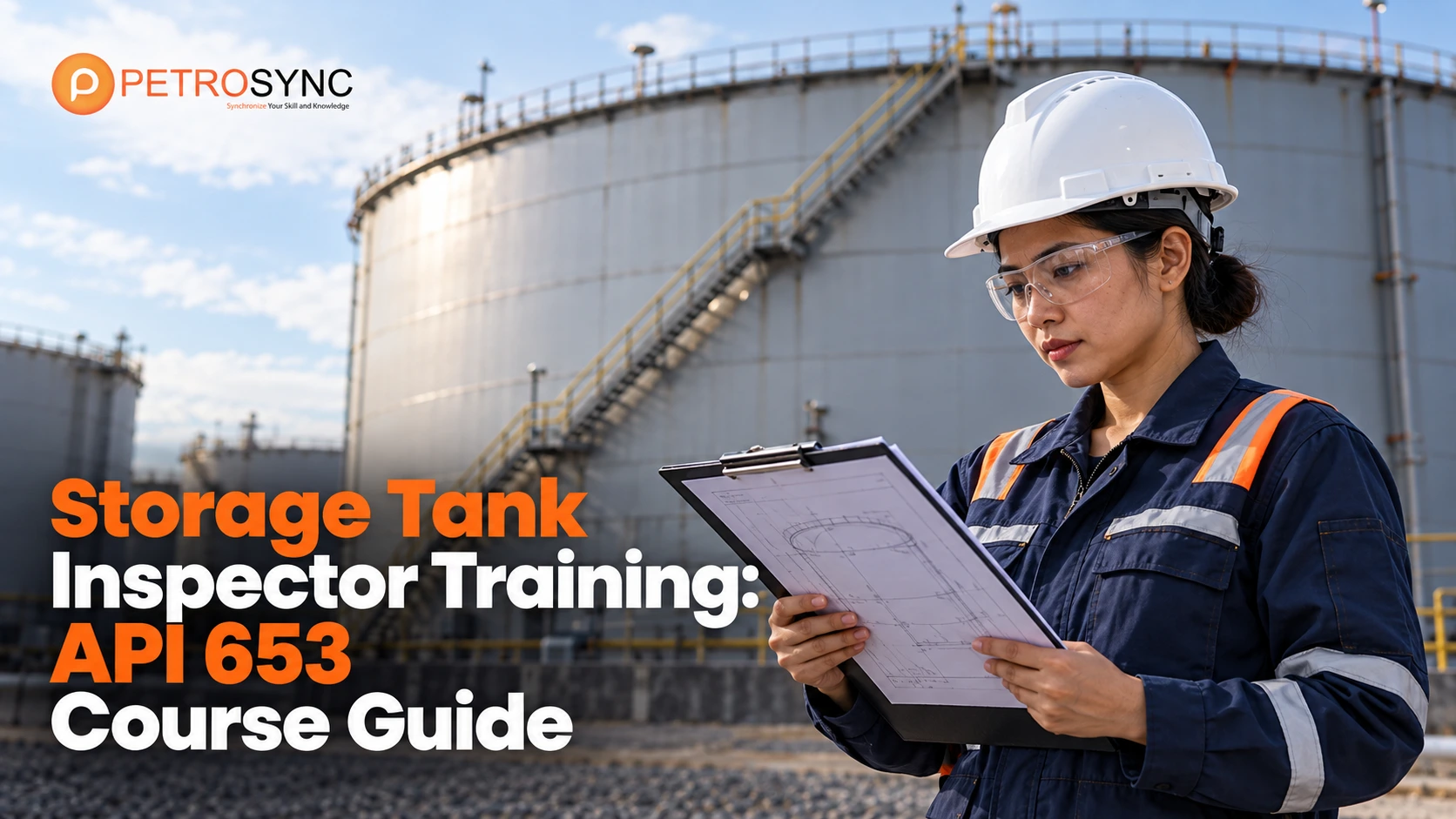
- API 653 training connects code knowledge with the inspection and evaluation of aboveground storage tanks.
- Core learning areas include tank design, corrosion assessment, integrity calculations, repair, welding inspection, and corrosion protection.
- Training supports preparation, while API determines exam eligibility and certification requirements separately.
- The course is relevant to inspection, engineering, corrosion, maintenance, and operations professionals with tank-related responsibilities.
- Course selection should reflect your learning goals, technical references, practical exercises, and training arrangements.
- PetroSync combines structured technical preparation with case studies, calculation exercises, and API 653 exam preparation.
- Individual and company-sponsored candidates can enquire about public training, while in-house training uses a tailored quotation with optional exam-package arrangements.
Inspecting a storage tank means understanding what its condition reveals and how the relevant code guides the next decision. Storage tank inspector training should connect those responsibilities with practical learning, whether you want to strengthen technical skills or prepare for an API 653 examination.
The right course gives you a clear route through the material without losing sight of your work. This guide explains the core skills, suitable participant profiles, and course selection criteria, then explores PetroSync’s learning approach and options for individual or team training.
How Does API 653 Training Prepare Storage Tank Inspectors?
API 653 training prepares storage tank inspectors by connecting code interpretation with the evaluation of tanks already in service. It brings inspection information, engineering concepts, and relevant requirements into a structured learning process, helping participants understand the reasoning behind technical decisions.
The focus is on aboveground storage tanks, consistent with API’s Body of Knowledge for the API 653 inspector examination. For an inspector, that means learning how observations about the shell, bottom, or roof relate to integrity assessment and possible follow-up work.
For example, a thickness reading becomes more useful when you understand the surrounding design information and inspection history. Training develops the knowledge needed to interpret that context and discuss its implications. The most useful starting point is therefore a clear view of the competencies the course teaches.
Read Also: API 653 Tank Inspection & Maintenance Guide
Core Skills Covered in Storage Tank Inspector Training
Core skills include tank design fundamentals, corrosion assessment, integrity calculations, repair, welding inspection, and corrosion protection. Each area connects a different type of technical information with the inspector’s work; the following four groups explain what those connections look like in practice:
1. Tank Design Fundamentals and Inspection Requirements
Tank design fundamentals help you understand how a tank’s original construction relates to its condition in service. Learning covers the roles of the shell, bottom, and roof, with API 650 providing the design and construction context for later inspection discussions.
API 653 then brings the discussion to evaluation of the operating tank. A learning exercise might begin with design information before examining an inspection finding. This helps you see why a condition needs context, rather than treating each observation as an isolated item on a checklist.
2. Corrosion Assessment and Tank Integrity Calculations
Corrosion assessment and integrity calculations help you interpret thickness measurements in relation to tank condition. API’s Body of Knowledge includes corrosion rates, remaining life, inspection intervals, and thickness evaluations, giving the learning process a practical focus on understanding what the available data can support.
For example, comparing thickness records from two dates introduces the relationship between metal loss and elapsed time. The learning task is to understand the inputs, units, and assumptions before interpreting a result. That reasoning provides a foundation for discussing inspection needs and the implications of deterioration.
Read Also: API 653 Body of Knowledge: Key Concepts for Tank Engineers
3. Tank Repair, Alteration, and Reconstruction
Training in tank repair, alteration, and reconstruction explains how different types of work relate to inspection requirements. PetroSync’s syllabus includes these subjects alongside tank bottom replacement, allowing participants to understand the technical context of changes to an existing tank.
A repair discussion, for instance, can examine what work is proposed and which inspection considerations follow from it. The emphasis is on understanding the relationship between the work and its evaluation. This supports more informed technical discussions when a tank requires attention beyond routine condition monitoring.
4. Welding Inspection and Corrosion Protection
Welding inspection and corrosion protection add context for evaluating tank work and understanding deterioration. Learning includes welding procedure specifications (WPS), procedure qualification records (PQR), nondestructive examination, cathodic protection, and tank bottom lining, with attention to how these topics support inspection decisions.
A document-review exercise might examine the information recorded in a WPS or PQR and its relevance to the work under discussion. Alongside corrosion protection topics, this gives participants a clearer vocabulary for technical reviews. Applying that knowledge is the next step in building practical inspection skills.
Explore API 653 training.
API 653 Training and Inspector Certification
API 653 training supports learning and exam preparation, while API determines eligibility and awards professional certification through its own process. Attending a course does not replace the experience required for an application, and a training attendance or completion certificate is separate from API certification.
According to API’s qualification requirements, eligibility combines education with relevant aboveground storage tank experience. Qualifying experience must fall within the previous 10 years and have been gained while employed by, or under contract with, an authorized inspection agency.
If certification is your goal, your learning plan and application therefore serve different purposes. One develops knowledge; the other demonstrates that you meet the program’s requirements. Course suitability starts with your responsibilities and learning needs, which may extend beyond preparation for an exam.
Read Also: API 653 Certification Made Simple: A Step-by-Step Guide
Who Should Attend Storage Tank Inspector Training?
Storage tank inspector training is relevant to inspectors and professionals in mechanical engineering, corrosion, maintenance, operations, and technical supervision. The strongest fit comes from the responsibilities you handle: interpreting findings, evaluating tank condition, planning related work, or coordinating the people involved in those decisions.
|
Participant Profile |
Relevant Inspection Responsibilities |
Training Focus |
|
Storage Tank Inspectors |
Interpret tank condition findings |
Inspection requirements and evaluation |
|
Mechanical and Technical Engineers |
Review design, repair and tank integrity |
Design context for in-service evaluation |
|
Corrosion Engineers |
Assess metal loss and damage mechanisms |
Corrosion assessment and calculations |
|
Maintenance and Operations Professionals |
Address operating tank maintenance needs |
Inspection planning and repair context |
|
Inspection Supervisors and Managers |
Coordinate inspection work and team reviews |
Technical framework for oversight |
These profiles describe learning relevance; exam eligibility follows API’s separate requirements. Once you identify the work you need to understand better, comparing course content and delivery becomes more focused.
How Do You Choose the Right API 653 Course?
Choose an API 653 course by matching your learning goals with its technical coverage, practical exercises, instructor experience, and training arrangements. A useful comparison shows how the program will support the decisions or preparation tasks you need to handle.
- Alignment with Your Inspection Responsibilities and Learning Goals: Prioritize the gaps relevant to your work, whether they concern interpreting findings, reviewing repair needs, or organizing exam preparation.
- Relevant Code Coverage and Structured Learning Materials: Look for API 653 study materials that connect the course topics with the BOK and the applicable exam references.
- Practical Exercises and Instructor Experience: Evaluate how examples develop technical reasoning and whether the instructor’s background relates to the inspection subjects you need to understand.
- Clear Training Arrangements and Exam Preparation Support: Match the program’s duration, format, and preparation support with your learning priorities and available time.
Those criteria also provide a clear way to understand PetroSync’s approach.
Prepare for Tank Inspection with PetroSync API 653 Training

PetroSync’s API 653 course combines structured technical learning with case studies and calculation exercises to support inspection knowledge. Its learning approach connects the material with practical reasoning and examination preparation through the following three areas, helping you organize how you study:
1. Structured Technical Preparation
Structured preparation helps you organize technical subjects and understand how to use the relevant code requirements. PetroSync lists its API 653 program as a five-day, Intermediate course, with course notes supporting the interpretation of material covered during learning.
For your own study plan, that structure provides a way to identify which topics need greater attention. You might understand inspection terminology but need more practice interpreting a particular requirement. Linking each topic to a learning goal makes revision more purposeful than working through references without a clear priority.
2. Practical Case Studies and Calculation Exercises
Case studies and calculation exercises connect technical concepts with the information needed to reason through a problem. PetroSync’s course includes practical cases and calculations, giving the learning process a setting in which inputs, units, references, and conclusions can be considered together.
An illustrative exercise might ask you to organize supplied inspection data before deciding what it can show. Explaining why an input matters is as valuable as obtaining a result. That approach helps you recognize where your understanding is strong and where further study would be useful.
3. API 653 Exam Preparation Support
Exam preparation support helps you organize study around the topics and references relevant to the API 653 examination. PetroSync’s course includes certification preparation, while API’s BOK and corresponding effectivity sheet provide the framework for understanding the examination’s subject coverage and reference editions.
A useful study habit is to review the reasoning behind practice answers and revisit the topics behind any mistakes. This gives subsequent study a specific purpose. Alongside the learning approach, the provider’s reputation offers another basis for deciding where to invest your preparation time.
Quote: Rated 4.9/5 on Google from 1,000+ reviews.
Source: Google Business Profile, PetroSync Jakarta — snapshot dated 6 September 2026.
This record of customer feedback adds a reputational reason to consider PetroSync when choosing your training provider.
PetroSync API 653 Training Options and Costs
Individual and company-sponsored candidates can enquire about public API 653 training, while teams can discuss an in-house program with a tailored quotation. Training-only and optional training-plus-exam arrangements cover different needs, so the choice begins with how you intend to participate.
- Individual and Company-Sponsored Participation: Public-course enquiries can cover your intended learning goals and attendance arrangements. The same route can support an individual whose employer funds the training, without requiring the organization to commission a dedicated team program.
- In-House Training Scope and Team Requirements: An in-house discussion focuses on the team’s responsibilities, learning priorities, and delivery needs. PetroSync confirms the minimum group requirement and prepares a custom quotation for the proposed program.
- Training Fees, Package Inclusions, and Exam Arrangements: PetroSync’s FAQ explains that the standard training fee covers preparation, while an optional training + certification exam package includes assistance with exam registration. Discuss the package that matches your learning and certification plans.
Discuss Your API 653 Training Needs with PetroSync
Build your API 653 learning plan around the inspection responsibilities you want to handle with greater understanding. Talk to PetroSync about individual course preparation or the development needs of your team. For a dedicated program, discuss in-house training to explore a suitable scope, delivery format, and custom quotation, connecting the learning priorities identified here with a practical next step for you or your organization.
Frequently Asked Questions (FAQ)
Familiarity with API 650 helps participants understand the design and construction topics covered in API 653 training. Before class, review basic shell, bottom, and roof terminology and how these components relate to tank design. If you have a different technical background, discuss your learning readiness with PetroSync before enrolling.
API 653 training in this context focuses on aboveground storage tanks, consistent with the scope of API's inspector Body of Knowledge. For underground tanks, choose a training route that matches the equipment and your inspection objectives. The general term storage tank inspector does not identify a single certification pathway, so confirm the applicable requirements before choosing a course.
Use the code editions specified in the Publications Effectivity Sheet for your intended API 653 exam window. The 2026 API 653 Body of Knowledge explains the examination topics and their relationship to the applicable effectivity sheet. Review the official [API 653 Body of Knowledge](https://www.api.org/-/media/Files/Certification/ICP/ICP-Certification-Programs/653/2026%20files/March%202026_653_BOK_final.pdf) before preparing. A newer standard edition does not automatically replace the edition specified for an examination.
Start with basic algebra, careful interpretation of inputs, and consistent units. Explain each calculation step before checking the final answer, and use the units specified in the examination question. Working through [API 653 practice questions](https://www.petrosync.com/blog/api-653-sample-questions/) can help you identify mistakes, strengthen your understanding, and focus your preparation on areas that need improvement.
Your team can discuss the use of its own inspection cases with PetroSync when defining the proposed in-house training scope. Explain your learning objectives and ask whether the examples are suitable for the program. Before sharing any cases, obtain the necessary organizational approval and remove confidential or sensitive information.

Results-oriented and thorough SEO specialist with extensive experience in conducting keyword research, developing and implementing digital website promotion strategies and plans, managing campaigns to develop company websites in the digital world, excellent knowledge of marketing techniques and principles, and attentive strong attention to detail.

Business Development Manager at PetroSync with 12+ years of experience in professional training and business development across the energy and industrial sectors.