

- Tank inspection is a strategic discipline that drives safety, compliance, environmental protection, and long-term asset reliability in oil and gas.
- Weak oversight leads to corrosion, leaks, shutdowns, penalties, and rising repair costs that hurt operations and reputation.
- Structured programs detect defects early, extend service life, and shift maintenance from reactive fixes to data-driven planning.
- Align practices with API standards, digitize records, and apply risk-based methods to stay audit-ready and reduce exposure.
- Build real competency through applied training, case studies, and experienced instructors to turn inspection into measurable ROI.
Tank Inspection is no longer just a routine maintenance activity—it is a strategic discipline that directly influences safety performance, environmental protection, regulatory compliance, and overall asset reliability in the oil and gas industry.
Across upstream terminals, midstream storage facilities, and downstream refineries, storage tank serve as critical containment systems for crude oil, refined products, and hazardous chemicals. When inspection practices are weak, inconsistent, or poorly understood, the consequences can escalate from minor leaks to catastrophic failures.
For asset managers, reliability engineers, inspection supervisors, and HSE leaders, mastering tank inspection is not optional – it is a professional responsibility. This guide provides a comprehensive overview of best practices, risk considerations, compliance frameworks, and competency development pathways to help organizations strengthen inspection performance and reduce operational exposure.
What is Tank Inspection?
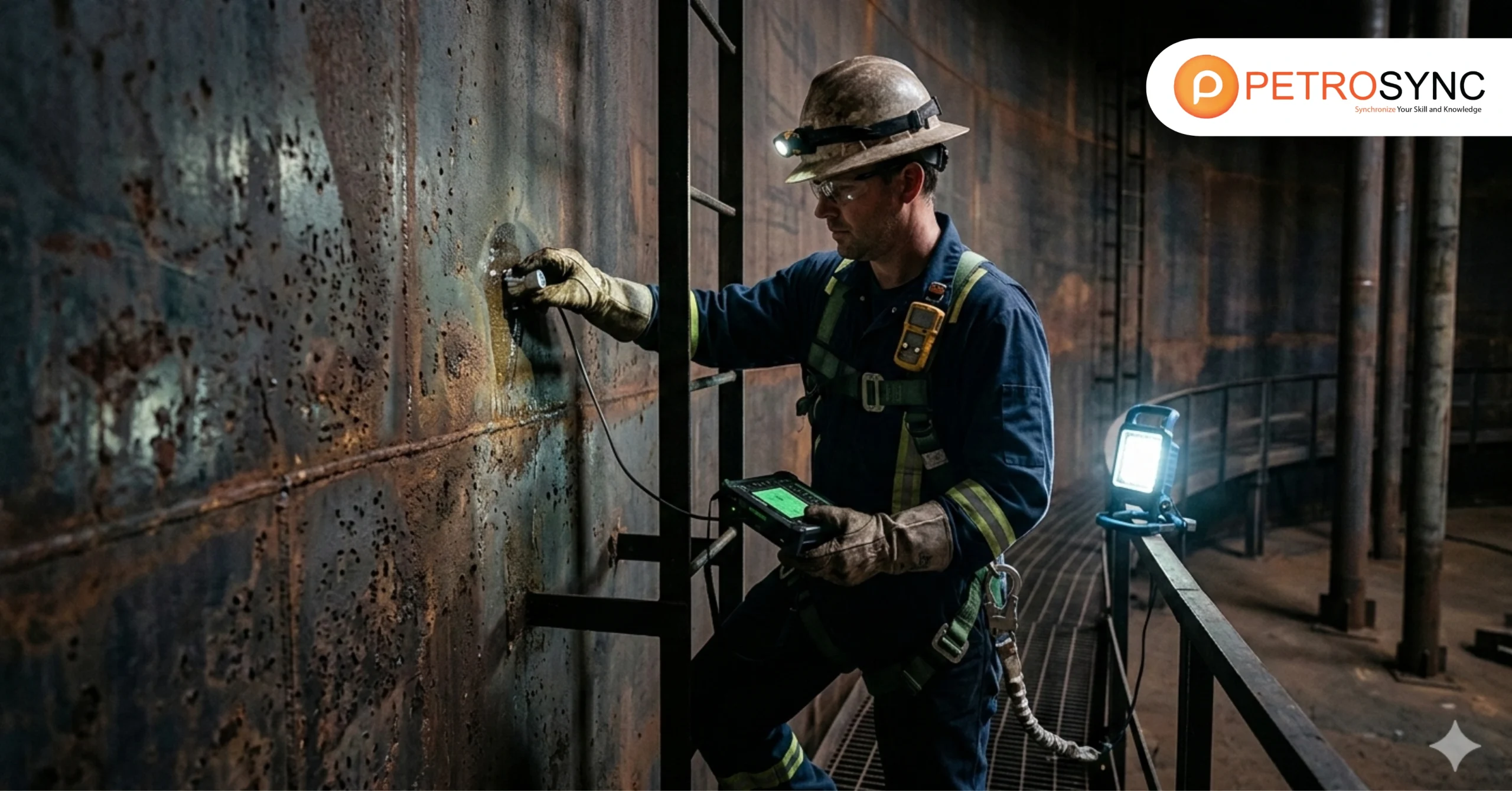
Tank inspection is a systematic process of evaluating the structural integrity, mechanical condition, and operational reliability of storage tanks. It involves visual assessments, non-destructive testing (NDT), thickness measurements, corrosion evaluation, settlement checks, coating inspections, and compliance verification against industry standards.
In the oil and gas sector, tank inspection commonly refers to inspections conducted under internationally recognized standards such as:
- American Petroleum Institute (API)
- American Society of Mechanical Engineers (ASME)
Specifically, standards like API 653 govern the inspection, repair, alteration, and reconstruction of aboveground storage tank, while API 570 covers piping systems connected to tanks.
Effective tank inspection ensures:
- Structural integrity
- Corrosion control
- Leak prevention
- Regulatory compliance
- Operational continuity
Potential Risks of Improper Management or Misunderstanding of Tanks Inspection
1. Corrosion, Leakage & Structural Failures
Undetected corrosion—especially bottom plate corrosion—can lead to product leakage or tank collapse. Settlement issues and shell distortion may remain invisible without systematic inspection protocols.
2. Environmental & Safety Hazards
Hydrocarbon releases can contaminate soil and groundwater. Vapor emissions increase fire and explosion risks. In severe cases, tank failures may result in fatalities and large-scale environmental penalties.
3. Regulatory Non-Compliance
Failure to follow standards such as API 653 may result in non-compliance findings during audits, government penalties, and reputational damage.
4. Operational Downtime & Production Loss
Unexpected tank failures force emergency shutdowns. Production delays disrupt supply chains and contractual commitments.
5. Increased Maintenance Costs
Reactive repairs are significantly more expensive than preventive maintenance. Emergency welding, patching, and reconstruction often multiply lifecycle costs.
Benefits of Mastering Tank Inspection for the Oil & Gas Industry
1. Enhanced Asset Reliability & Safety
Structured inspection programs reduce uncertainty and ensure tanks operate within safe design limits.
2. Proactive Risk Mitigation
Early identification of corrosion, cracking, and settlement allows corrective action before failure occurs.
3. Extended Equipment Lifespan
Proper inspection intervals and coating management extend tank service life.
4. Regulatory Compliance Assurance
Alignment with API and international standards protects companies from penalties and legal exposure.
5. Optimized Maintenance Scheduling
Inspection data supports condition-based maintenance planning rather than calendar-based guesswork.
Improved Safety & Operational Reliability
1. Minimized Incident Risks
Routine thickness measurement and settlement monitoring significantly reduce failure probability.
2. Robust Emergency Preparedness
Inspection findings feed into risk registers and emergency response planning.
3. Systematic Safety Checks
Inspection programs enforce structured evaluation processes rather than ad-hoc visual checks.
4. Enhanced Field Operational Efficiency
Clear inspection procedures reduce rework, confusion, and miscommunication between operations and inspection teams.
Compliance with Industry Standards, Codes & Regulations
1. Adherence to API 653 & API 570 Guidelines
Compliance with API 653 and API 570 ensures inspection activities follow internationally recognized best practices.
2. Local & International Regulatory Alignment
Many jurisdictions adopt API standards into local regulations. Proper documentation protects organizations during regulatory audits.
3. Documentation & Reporting Accuracy
Inspection reports must include thickness readings, corrosion rates, repair recommendations, and fitness-for-service evaluations.
4. Audit-Ready Inspection Records
Digitized, traceable documentation ensures companies are always prepared for third-party inspections and compliance reviews.
Reduced Asset Failure & Field Incident Risks
1. Early Detection of Defects
Cracks, pitting, weld defects, and settlement issues can be identified before reaching critical thresholds.
2. Timely Preventive Maintenance
Inspection-driven maintenance minimizes reactive repair cycles.
3. Mitigation of Environmental Hazards
Leak detection and bottom plate monitoring reduce contamination risks.
4. Minimized Operational Disruptions
Planned maintenance avoids unexpected production shutdowns.
Optimized Equipment Performance, Lifespan & Integrity
1. Structural Health Monitoring
Routine data analysis tracks long-term integrity trends.
2. Corrosion Management
Cathodic protection systems and coating programs can be optimized based on inspection findings.
3. Material & Coating Assessments
Periodic coating inspections prevent accelerated corrosion.
4. Performance Trend Analysis
Historical inspection data supports lifecycle forecasting and capital budgeting decisions.

Cost Efficiency in Operations, Maintenance & Downtime
1. Reduced Emergency Repairs
Preventive inspection reduces high-cost emergency interventions.
2. Extended Asset Service Life
Well-maintained tanks operate safely beyond original expectations.
3. Lower Operational Expenditure
Condition-based strategies reduce unnecessary shutdowns.
4. Optimized Inspection Intervals
Risk-based methodologies adjust inspection frequency according to asset condition.
How to Address Tank Inspection Challenges More Effectively
1. Implement Risk-Based Inspection Programs
Risk-Based Inspection (RBI) prioritizes high-risk tanks, optimizing resources and minimizing exposure.
2. Utilize Advanced Inspection Technologies
Technologies such as robotic tank floor scanners, drone inspections, and advanced ultrasonic testing improve accuracy and safety.
3. Train Personnel for Accurate Assessment
Competent inspectors understand corrosion mechanisms, settlement evaluation, and fitness-for-service calculations.
4. Maintain Comprehensive Documentation
Digital inspection systems improve traceability and audit readiness.
5. Integrate Lessons Learned into Practices
Continuous improvement ensures inspection findings translate into actionable maintenance strategies.
Develop Professional Competence through Structured Programs like PetroSync
Technical knowledge alone is insufficient. Effective tank inspection requires applied competency.
1. Relevant for Field Applications & Engineering Practices
Programs focus on real operational challenges faced by inspectors and engineers.
2. Practical & Applied Case Study Approach
Participants analyze real tank failure cases and inspection scenarios.
3. Experienced Instructors from Global Industry Practitioners
Courses are led by professionals with hands-on industry experience.
4. Curriculum Aligned with International Standards & Best Practices
Training references globally recognized codes including API standards.
5. Trusted by Energy Companies & Global Industries
Professionals from upstream, midstream, and downstream sectors participate.
6. International Reputation as an Oil & Gas Training Provider
PetroSync has established credibility as a specialized oil & gas competency development provider.
PetroSync Tank Inspection Competency Development Programs for Oil & Gas Professionals
1. Curriculum Based on International Standards & Industry Practice
2. Experienced Instructors from Practitioners & Subject Matter Experts
3. Practical & Applied Learning Approach
4. Case Studies Based on Real Field Conditions
5. Public & In-House Program Schemes
6. Always Updated & Relevant Learning Materials
7. Learning Experience Support from Engineers to Management
8. Program Certificate for Competency & Career Development
PetroSync Tank Inspection Program Advantages for Companies
1. Relevant for Various Disciplines & Professional Levels
2. Focused on Competency Improvements with Real Impact
3. Supports Compliance, Audits & Operational Reliability
4. Flexible for Project, Asset & Organizational Needs
5. Global Reputation & Experience in the Oil & Gas Industry
6. Demonstrable ROI through Reduced Risk & Maintenance Costs
Schedule Your PetroSync Tank Inspection Competency Program Now
In an industry where asset failure can cost millions—and compromise lives—structured tank inspection competency is a strategic investment. Whether you are an inspection engineer, maintenance manager, asset integrity leader, or operations executive, strengthening tank inspection capability directly improves safety, compliance, reliability, and profitability.
Empower your team with internationally aligned knowledge, practical application skills, and real-world case studies. Schedule your PetroSync Tank Inspection competency program today and transform inspection excellence into operational advantage.
Frequently Asked Questions (FAQ)
Tank inspection is a systematic process of evaluating the structural integrity, mechanical condition, and operational reliability of storage tanks used for crude oil, refined products, and hazardous chemicals. It includes visual inspections, non-destructive testing (NDT), thickness measurements, corrosion assessments, settlement checks, coating inspections, and compliance verification with standards such as API 653 and API 570.
API 653 provides internationally recognized guidelines for the inspection, repair, alteration, and reconstruction of aboveground storage tanks. Compliance with API 653 ensures structural integrity, regulatory adherence, corrosion control, leak prevention, and safe long-term tank operation, reducing environmental, safety, and financial risks.
Improper tank inspection management can lead to undetected corrosion, bottom plate failures, structural collapse, hydrocarbon leaks, environmental contamination, fire and explosion hazards, regulatory penalties, operational downtime, and increased maintenance costs due to reactive emergency repairs.
Risk-Based Inspection (RBI) improves tank reliability by prioritizing inspection resources based on risk level, probability of failure, and consequence of failure. This approach optimizes inspection intervals, enhances early defect detection, reduces unnecessary shutdowns, and supports condition-based maintenance planning.
Professionals can develop tank inspection competency through structured training programs aligned with international standards such as API codes. Effective programs combine practical case studies, real field scenarios, experienced industry instructors, and applied engineering methodologies to strengthen technical capability, compliance readiness, and asset integrity management.

SEO specialist by day, fact-checker by night. An avid reader and content writer dedicated to delivering accurate and engaging articles through research and credible sources.