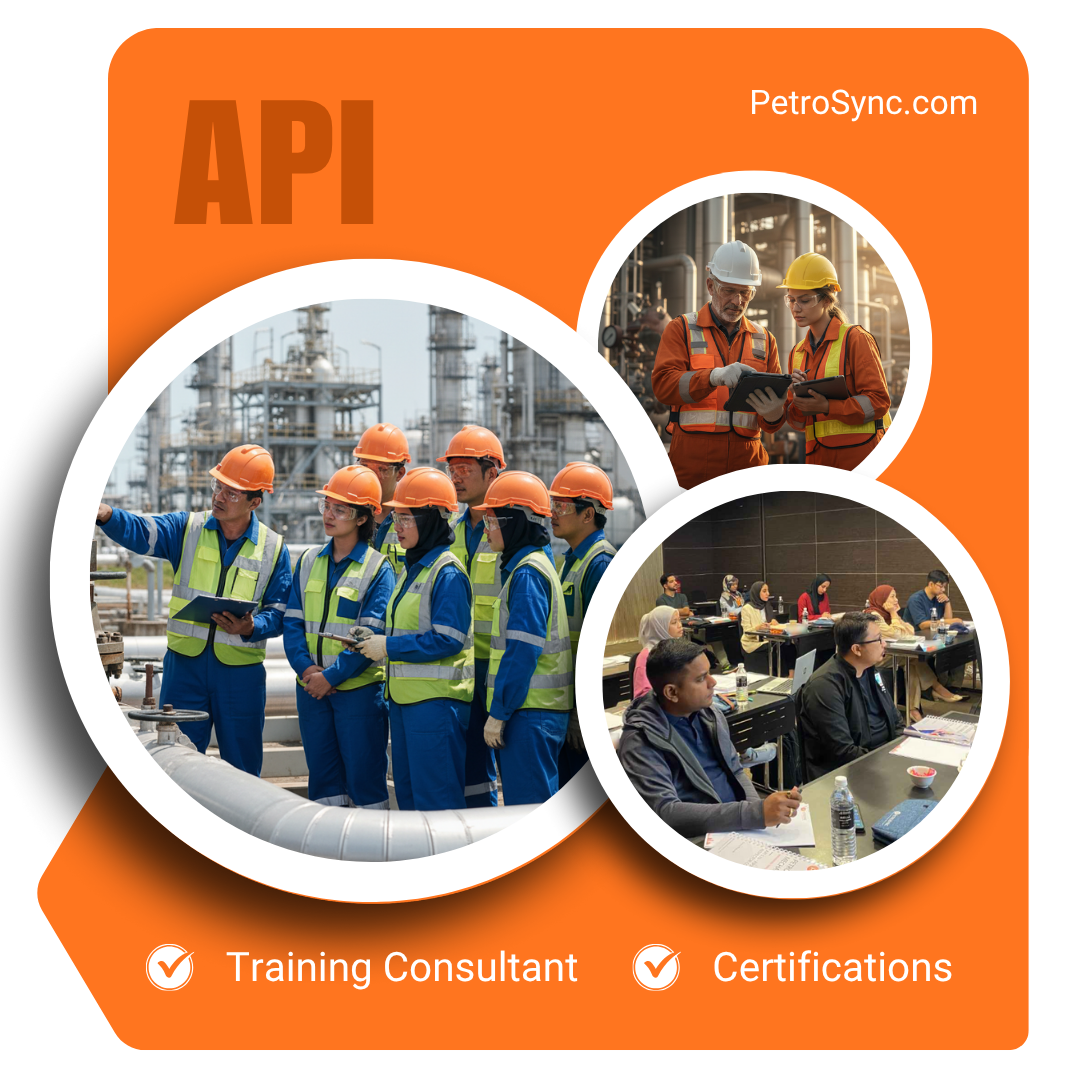



- API Certification is a globally recognized marker of authority, validating technical judgment for safety, reliability, and high-impact asset decisions.
- Certified professionals apply proven standards to cut compliance risk, strengthen governance, and deliver more defensible inspection outcomes.
- Structured inspection and integrity programs help reduce unplanned shutdowns by 20–30%, improving safety and stabilizing operations.
- API credentials accelerate careers, opening access to senior roles, higher pay, and stronger influence in technical leadership discussions.
- Practical, risk-based methods from API 510, 570, 653, 579, and RBI programs align asset integrity with real business value.
API Certification has become a critical benchmark for professionals in the oil and gas industry who are responsible for safety, reliability, and long-term asset performance. As facilities grow more complex and regulatory expectations continue to rise, organizations are under increasing pressure to improve asset reliability, maintain strong safety performance, and control operational costs.
In this environment, leadership decisions must be supported by recognized standards, proven methodologies, and credible professional judgment. For senior engineers, managers, and executives, API Certification is not merely a personal credential. It represents authority, accountability, and readiness to lead high-impact technical and operational decisions.
Recognized globally, API Certification bridges deep technical knowledge with practical, real-world application, making it a powerful career accelerator across upstream, midstream, and downstream energy operations.
What is API Certification and its Scope?

API Certification is a professional qualification that validates an individual’s competence in applying internationally recognized inspection, integrity, and risk assessment standards within oil, gas, and petrochemical facilities. Unlike academic qualifications that emphasize theory, API certifications focus on operational decision-making, ensuring professionals can interpret codes, assess equipment conditions, and determine safe operating limits.
The scope of API Certification covers critical asset classes such as pressure vessel, piping systems, storage tank, and risk-based inspection frameworks. Certified professionals are trained to evaluate damage mechanisms, determine inspection intervals, assess remaining life, and recommend corrective actions that align with both safety and business objectives.
As a result, API Certification is highly relevant not only for inspectors and engineers, but also for managers and technical leaders responsible for asset integrity programs, maintenance strategies, and regulatory compliance across multiple facilities.
Why API Certification is Important for Professionals
1. Ensuring Compliance with Industry Standards
Regulatory expectations across the energy sector continue to increase, with greater emphasis on documented integrity management and competent personnel. API Certification provides structured guidance on how to apply recognized standards consistently, reducing ambiguity in inspection and maintenance decisions.
Industry benchmarking data shows that organizations with certified inspection and integrity personnel experience fewer compliance findings during audits and assessments. This is largely due to improved documentation practices, clearer inspection criteria, and more defensible engineering decisions.
For senior leaders, this translates into reduced regulatory exposure and stronger governance across operations.
2. Enhancing Safety and Operational Reliability
Unplanned failures often stem from incomplete inspections, misjudged damage severity, or ineffective inspection prioritization. API Certification addresses these risks by equipping professionals with systematic evaluation methods grounded in real operating experience.
Operational performance analyses across multiple facilities indicate that structured inspection and integrity programs can reduce unplanned shutdowns by approximately 20–30% over several years of consistent implementation. These improvements are driven by better identification of high-risk components and more effective allocation of inspection resources.
Improved reliability not only enhances safety outcomes but also stabilizes production and reduces disruption to business operations.
3. Supporting Career Growth and Recognition
From a career standpoint, API Certification serves as a globally recognized benchmark of competence. Many organizations consider certification a prerequisite for senior inspection, integrity, and reliability roles.
Market compensation analyses consistently show that professionals holding specialized technical certifications tend to command higher salaries and broader career mobility compared to non-certified peers. More importantly, certification strengthens professional credibility, enabling individuals to participate more confidently in high-level technical and strategic discussions.
Key Benefits of API Certification for Engineers and Managers
1. Advancing Career Opportunities
API Certification opens pathways to advanced roles such as Integrity Manager, Senior Inspection Engineer, Reliability Lead, or Technical Authority. These positions require not only experience but also formal recognition of competence in applying standards and making risk-informed decisions.
Certified professionals are often entrusted with greater responsibility, including approval authority, oversight of inspection programs, and engagement with regulators or third-party assessors.
2. Strengthening Technical Expertise
API Certification programs emphasize practical application rather than rote memorization. Candidates develop a deeper understanding of corrosion mechanisms, damage evaluation, inspection effectiveness, and remaining life calculations.
This depth of expertise allows professionals to move beyond checklist-driven inspections and toward proactive asset management strategies that balance safety, reliability, and cost.
3. Increasing Professional Credibility and Market Value
In senior roles, credibility is critical. API Certification signals commitment to professional excellence and continuous improvement. Certified leaders are often viewed as trusted advisors who can translate technical findings into business-relevant insights.
This credibility enhances influence within organizations and strengthens professional positioning in a competitive talent market.
Popular API Certification Programs You Should Consider
1. API 510 – Pressure Vessel Inspection
API 510 focuses on the inspection, rating, repair, and alteration of pressure vessels. It equips professionals with the skills to evaluate vessel integrity under varying operating conditions and make informed decisions regarding continued service.
2. API 570 – Piping Inspection
API 570 addresses in-service piping systems, emphasizing corrosion assessment, inspection planning, and repair criteria. This certification is widely recognized across refineries, petrochemical plants, and processing facilities.
3. API 653 – Storage Tank Inspection
API 653 concentrates on aboveground storage tank, covering inspection methodologies, repair requirements, and fitness-for-service evaluation. It plays a critical role in preventing leaks, environmental incidents, and operational disruptions.
4. API 579 – Fitness-for-Service Assessment
API 579 provides advanced assessment techniques to determine whether equipment with identified damage can continue operating safely. Proper application of these methods can prevent unnecessary equipment replacement and significantly reduce capital expenditure.
5. API 580 and 581 – Risk-Based Inspection Programs
API 580 and 581 focus on risk-based inspection methodologies, enabling organizations to prioritize inspection activities based on risk rather than fixed intervals. Industry experience shows that effective risk-based inspection implementation can lower inspection costs by up to 25% while maintaining or improving safety performance.
How to Prepare for API Certification Exams Effectively
Successful API Certification candidates approach preparation strategically. Rather than relying solely on self-study, they focus on understanding the intent behind requirements, practicing calculation-based scenarios, and reviewing real inspection case studies.
Performance data from training programs indicates that participants who engage in structured exam preparation demonstrate significantly higher pass rates compared to those relying only on independent study. This structured approach also improves long-term retention and practical application of knowledge.
API Certification Knowledge to Career Advancement
The true value of API Certification lies in its application. Certified professionals who actively apply their knowledge often drive measurable improvements in inspection effectiveness, maintenance planning, and asset life extension.
By linking technical evaluations to business outcomes—such as reduced downtime, predictable maintenance budgets, and improved risk visibility—API-certified leaders position themselves as strategic contributors rather than functional specialists.
Elevate Your Career with PetroSync API Certification Training
For professionals seeking to maximize the value of API Certification, selecting the right training partner is essential. PetroSync’s API Certification Training programs are designed for engineers, managers, and executives who want more than exam preparation alone.
The training emphasizes practical interpretation of standards, real-world case discussions, and decision-making frameworks aligned with operational realities. Participants gain not only the confidence to pass certification exams but also the capability to apply the knowledge directly to improve asset performance and organizational outcomes.
For senior professionals aiming to strengthen credibility, enhance leadership impact, and unlock advanced career levels, PetroSync provides a structured and practical pathway that aligns professional growth with measurable business value.
Frequently Asked Questions (FAQ)
API Certification is a professional qualification that validates competence in applying internationally recognized inspection, integrity, and risk-based standards in oil, gas, and petrochemical facilities.
API Certification supports high-impact technical decisions, strengthens regulatory compliance, improves asset reliability, and signals authority and accountability in leadership roles.
It equips professionals with structured inspection and evaluation methods that reduce misjudged damage, improve inspection prioritization, and help lower unplanned shutdowns by 20–30%.
Popular programs include API 510 for pressure vessels, API 570 for piping, API 653 for storage tanks, API 579 for fitness-for-service, and API 580/581 for risk-based inspection.
API Certification enhances professional credibility, opens access to senior technical roles, increases market value, and enables certified professionals to contribute more strategically to business outcomes.

Results-oriented and thorough SEO specialist with extensive experience in conducting keyword research, developing and implementing digital website promotion strategies and plans, managing campaigns to develop company websites in the digital world, excellent knowledge of marketing techniques and principles, and attentive strong attention to detail.