

- Start with the job problem or competency gap before comparing training providers.
- Check whether the provider’s syllabus covers the code, standard, or technical scope you actually need.
- Review the instructor’s relevant industry experience and subject-matter fit, not only the course title.
- Prefer training that includes practical exercises, case studies, problem solving, or other applied-learning elements where appropriate.
- Compare delivery format, schedule clarity, support, and public versus in-house options before committing.
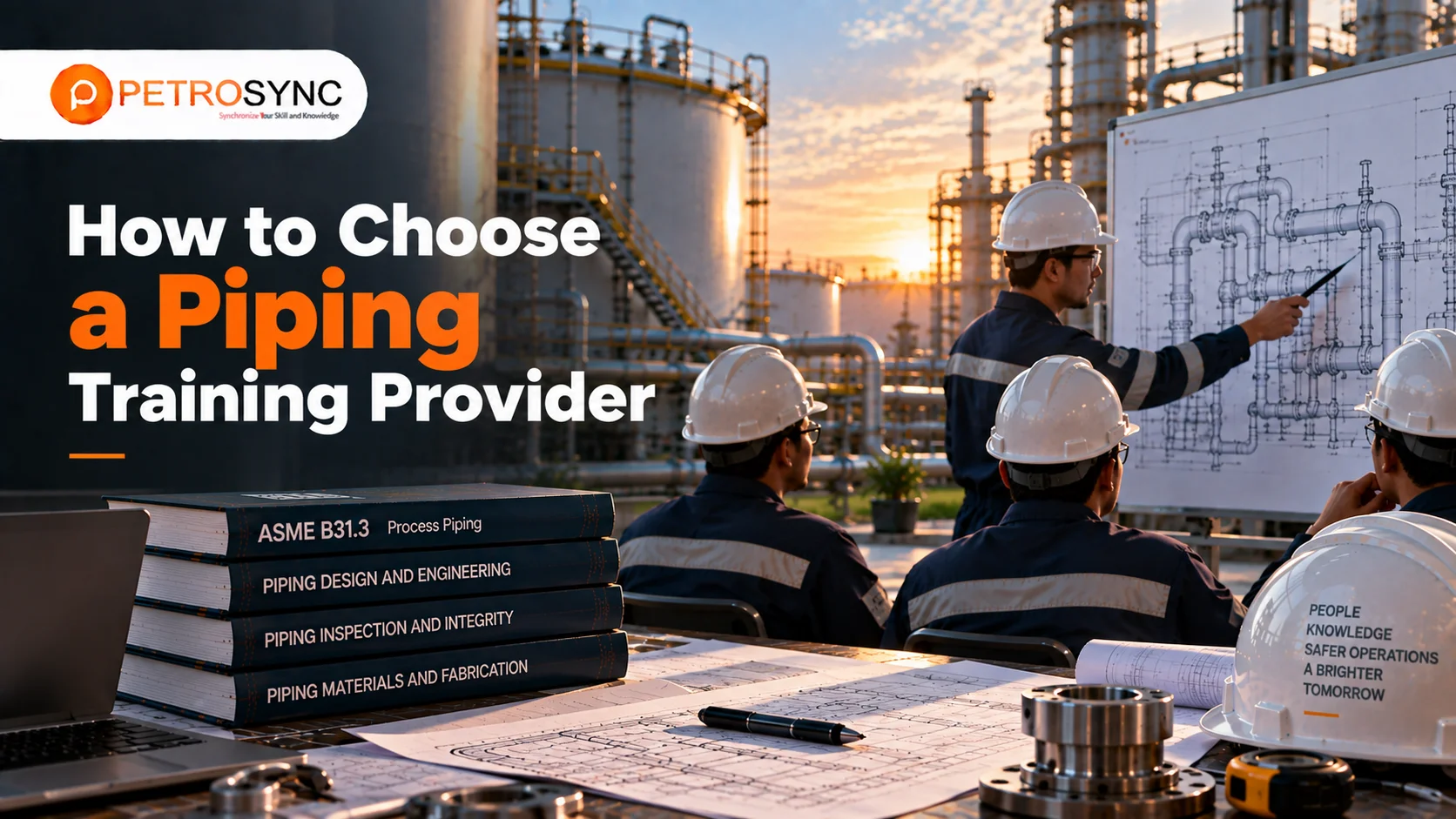
Choosing a piping training provider should start with the capability you need to build, not with the provider name alone. A process-piping designer, an in-service inspector, and a maintenance engineer can all search for “piping training” while needing very different technical outcomes. The right provider should therefore match your work requirement, the standards you use, the depth of learning you need, and the format that fits your situation. This guide focuses on how to evaluate that fit rather than ranking training companies.
What Is a Piping Training Provider?
A piping training provider is an organization that delivers technical learning related to piping design, code compliance, inspection, integrity, maintenance, repair, or certification preparation. Its role is to help professionals build knowledge and applied capability. That is different from a certification authority, which sets qualification rules, evaluates candidates, administers credentialing requirements, and issues certifications where applicable.
1. Piping Training Provider vs Certification Body
A training provider supports learning. It may deliver classroom instruction, technical exercises, case studies, code interpretation, exam preparation, course materials, and follow-up support. Completing a course can show that you attended or finished a training program, but it does not automatically mean you earned an independent professional certification.
A certification body or credentialing authority has a different role. For example, the API Individual Certification Programs independently evaluate technical and inspection personnel and include API 570 Piping Inspector among their certification programs. That means a training provider can help you prepare, while API controls the certification requirements and credentialing process.
2. What Types of Piping Training Can a Provider Offer?
Piping training can cover several different needs. Some programs focus on process-piping design and code application. Others focus on in-service inspection, mechanical integrity, remaining-life assessment, degradation, repair, or maintenance. Another group is designed as certification preparation when a formal credentialing program exists.
A provider may offer courses across several of these areas, but breadth alone does not prove fit. The more important question is whether the syllabus, instructor background, exercises, and learning outcomes match the job you need to perform after the course.
Read Also: Planning To Be A Piping Engineer? Here’s Your Complete Guide
What Should You Look for in a Piping Training Provider?
Look for a provider whose course matches your role, technical scope, and required codes or standards. Review the instructor’s relevant experience, whether the program includes applied learning, the delivery format, schedule transparency, and the support available before or after training. The right provider is the one that fits your technical outcome, not simply the one with the largest course catalog.
|
Criteria |
What to Check |
Why It Matters |
|
Course Relevance |
Does the syllabus solve the work problem or competency gap? |
Avoids choosing a course that is technically interesting but not useful for the target role. |
|
Standards Covered |
Are the required codes, standards, or topics explicitly included? |
Confirms technical alignment with the work scope. |
|
Instructor Experience |
Is the instructor experienced in the relevant piping discipline and code application? |
Helps connect code requirements with real engineering or inspection practice. |
|
Practical Exercises / Case Studies |
Does the course include calculations, exercises, case studies, or problem solving where applicable? |
Supports application rather than passive theory-only learning. |
|
Delivery Format |
Is the program face-to-face, online, public, or available as in-house/customized training? |
Determines fit with learning preference and logistics. |
|
Schedule Transparency |
Are dates, location or format, duration, and changes communicated clearly? |
Helps participants and companies plan attendance and work coverage. |
|
Post-Training / Registration Support |
Is follow-up, Q&A, material access, or exam-registration assistance available when relevant? |
Adds practical support beyond the classroom. |
1. Match the Course to Your Job Requirement
Start with the work problem you want to solve. A piping designer may need stronger process-piping code application and design judgment. An inspector may need deeper knowledge of in-service inspection, degradation, remaining-life calculations, or repair decisions. A maintenance or integrity professional may need training around repair methods, risk, or failure mechanisms.
This makes job fit more important than course quantity. A provider with many programs can still be a poor match if the selected course does not address your actual responsibilities, technical gap, or level of experience.
2. Check the Standards and Technical Scope
“Piping training” is a broad label, so read the syllabus closely. If your role involves process-piping design and code compliance, ASME B31.3-oriented training may be relevant. If your work focuses on in-service inspection and mechanical integrity, API 570-oriented training may be a better fit.
Do not assume every piping course covers the same topics. Check which standards, inspection practices, calculations, damage mechanisms, testing requirements, or design topics are actually included, and compare those subjects with the tasks you perform at work.
3. Review the Instructor’s Technical Background
A strong syllabus still depends on how well the instructor can connect the subject to real technical decisions. Review whether the instructor has experience in the discipline being taught, such as piping design, inspection, integrity, maintenance, welding, materials, or code application.
Look for a transparent instructor profile rather than relying only on course branding. Relevant field experience can help participants understand why a requirement matters, how different code provisions connect, and how engineering or inspection judgment is applied in practice. Credentials can help establish background, but they should not be treated as the only measure of teaching quality.
4. Look for Practical Exercises and Case-Based Learning
Technical piping topics are easier to apply when participants work through realistic examples. Depending on the course, this may include calculations, inspection scenarios, code-navigation exercises, design problems, case studies, or discussions about repair and integrity decisions.
Practical learning does not always mean physical field work or laboratory activity. What matters is whether the program gives participants a chance to use the concepts rather than only listen to lectures. When comparing providers, check the course description for evidence of exercises, problem solving, case-based discussion, or other applied-learning methods.
5. Check Delivery Format, Schedule, and Support
Training must also fit your logistics. Review whether the program is delivered face-to-face, online where available, as a public course, or through an in-house or customized format. Check whether duration, delivery method, schedule, and location information are clearly communicated.
Support can also matter, especially for technical or certification-preparation programs. Depending on the provider, this may include access to course materials, follow-up clarification, administrative assistance, or exam-registration support. Compare these elements together rather than evaluating the course only by title or price.
Compare the course scope, instructor background, practical learning, and delivery format before deciding.
Button: Explore PetroSync Training
Which Piping Training Should You Choose for Your Goal?
Choose the course based on the technical outcome you need. Process-piping design and code-compliance work may call for ASME B31.3-oriented training, while in-service piping inspection and integrity work may align better with API 570-oriented training. Repair and maintenance needs can require a different program again, depending on the equipment problem and applicable standard.
1. For Process Piping Design and Code Compliance
ASME B31.3-oriented training is commonly relevant for engineers who work with process piping in industries such as oil and gas, petrochemical, chemical, and related process facilities. The focus is not simply memorizing clauses, but understanding how code requirements influence design, materials, fabrication, examination, testing, flexibility, and integrity decisions.
PetroSync’s ASME B31.3 training, for example, covers the process from design requirements through testing and includes in-class problem solving and case studies. Use that type of syllabus as a benchmark when comparing whether a provider gives enough technical depth for your role.
Read Also: ASME B31.3 Training: Process Piping Design & Compliance
2. For Piping Inspection and Integrity
For professionals responsible for in-service piping, API 570-oriented training can be relevant because it connects inspection practices with mechanical integrity decisions. Typical topics can include inspection methodologies, remaining-life calculations, degradation mechanisms, repair and rerating, NDE, welding, and related API and ASME references.
PetroSync’s API 570 Piping Inspector Course is structured around those inspection and integrity themes and also supports API certification preparation. If certification is part of your objective, confirm separately that you meet the official credentialing requirements because attending a training course does not create eligibility by itself.
Read Also: API 570 Training: Benefits, Course Outline & Certification
3. For Repair and Maintenance Challenges
Repair and maintenance training should be selected according to the specific piping or equipment problem you need to manage. A course focused on inspection may not provide enough depth on repair methods, just as a design-code course may not address every maintenance decision.
Standards such as ASME PCC-2 can be relevant when the learning need involves repair of pressure equipment and piping. Before choosing a provider, check whether the training scope matches the repair methods, engineering evaluation, or maintenance decisions your team actually faces rather than selecting a course only because it belongs to the broader piping category.
How Should Individuals and Companies Evaluate a Provider Differently?
Individuals usually evaluate a provider around personal skill gaps, job role, technical depth, schedule, and preparation needs. Companies and L&D teams need to look at a broader set of factors, including team competency gaps, consistency of learning, customization, instructor fit, delivery logistics, and relevance to operating or engineering challenges across the organization.
1. For Individual Piping Professionals
Start with your current role and experience level. Identify the technical capability you want to improve, then check whether the syllabus assumes knowledge you already have or fills a gap you still need to develop. Review the course depth, exercises, format, and timing before deciding.
If certification preparation matters, separate the training decision from the credentialing decision. Confirm the official certification requirements independently, then choose a course that supports the technical preparation you need. Training should strengthen capability, not be treated as a guarantee of promotion, salary growth, exam success, or certification.
2. For Company and L&D Teams
For a company, the first question is usually not “Which course is popular?” but “Which competency gap are we trying to close?” Teams may need a common understanding of a code, stronger inspection consistency, better repair decision making, or a more standardized technical foundation across multiple roles.
Evaluate whether the provider can adapt examples, emphasis, and delivery to the group’s context. Instructor fit is especially important when the training needs to connect technical standards with company-specific engineering, inspection, or maintenance challenges. In-house or customized delivery can be useful when several participants share the same competency requirement.
How Can PetroSync Support Piping Training Needs?
PetroSync is one provider option for professionals and organizations looking for piping-related technical development. Its current course portfolio includes training for piping inspection and process-piping code application, along with public and in-house training options. The relevant course should still be selected based on the participant’s role, technical gap, and required learning outcome rather than brand name alone.

1. Piping Inspection Training Through API 570
The API 570 Piping Inspector Course is designed for piping inspectors, engineers, maintenance personnel, and integrity professionals who work with in-service piping. The course covers inspection methodologies, remaining-life concepts, degradation mechanisms, repair and rerating, NDE, welding, and related API and ASME references.
It is also positioned as certification preparation for candidates pursuing API 570. That makes it relevant when the training need combines piping integrity knowledge with exam preparation. Current schedules and prices should still be confirmed directly before enrollment because training availability and commercial details can change.
2. Process Piping Design Training Through ASME B31.3
The ASME B31.3 Process Piping Code Design Requirements course is aimed at professionals who need stronger understanding of process-piping code application. Its scope includes design requirements, materials, fabrication, welding, inspection and NDT, pressure testing, flexibility, and integrity considerations.
The course also includes problem solving and case-study-based learning. For someone comparing providers, that combination is useful evidence that the program is not limited to a high-level code overview. As with other training, current availability should be checked separately rather than assumed from a previous schedule.
3. Practical and Case-Based Learning
PetroSync’s course materials emphasize practical exercises, problem solving, case studies, and real-world technical examples. These features matter because provider selection is not only about whether a standard appears in the course title; it is also about how participants are expected to use the material.
A PetroSync internal customer testimonial rated a training experience 10/10 and said, “The instructor is very knowledgeable. The course is very relevant to my work.” This is first-party participant feedback, not an industry benchmark, but it supports the importance of instructor knowledge and job relevance when evaluating training.
4. Public and In-House Training Options
Individual professionals can join relevant public training when a suitable program is available. Organizations that need a shared learning program can also consider PetroSync’s in-house training service, which is designed for customized organizational requirements.
PetroSync states that customized programs can be tailored to an organization’s needs. That can be useful when a company wants to align examples, emphasis, or learning objectives with a specific competency gap. Availability, format, and commercial terms should be discussed directly rather than assumed to be identical across every piping course.
Discuss Your Piping Training Needs with PetroSync
If you are evaluating piping training, start by identifying the job role, technical gap, and competency you need to strengthen. PetroSync can help individual professionals explore relevant public training and discuss customized in-house requirements with company or L&D teams. The goal is to match the training scope to the professional technical outcome you need, without treating course attendance as a guarantee of certification or competence.
Frequently Asked Questions (FAQ)
Check whether the syllabus matches your job requirement, which codes or standards are covered, the instructor’s relevant experience, practical or case-based learning, the delivery format, schedule transparency, and support. Evaluate the provider on fit for the technical outcome rather than course quantity alone.
No. A training provider delivers learning, technical development, and preparation, while a certification body or credentialing authority sets qualification requirements, evaluates candidates, and issues a credential where applicable. For example, API’s Individual Certification Programs administer API 570 Piping Inspector certification.
If your role involves in-service piping inspection, integrity, remaining-life assessment, degradation, repair, or rerating, an API 570-oriented training program may be relevant. Check the syllabus against your actual inspection responsibilities and whether you need technical development, certification preparation, or both.
For process-piping design and code-compliance work, ASME B31.3-oriented training is a common fit because it covers design requirements, materials, fabrication, examination and testing, and related code application. Confirm the syllabus and context required by your company or project before selecting a course.
Yes, when the provider offers customized or in-house delivery. PetroSync has a dedicated in-house training service and states that customized programs can be tailored to an organization’s needs, allowing companies to align the training scope with team competency gaps and operational priorities.

Results-oriented and thorough SEO specialist with extensive experience in conducting keyword research, developing and implementing digital website promotion strategies and plans, managing campaigns to develop company websites in the digital world, excellent knowledge of marketing techniques and principles, and attentive strong attention to detail.

Business Development Manager at PetroSync with 12+ years of experience in professional training and business development across the energy and industrial sectors.