

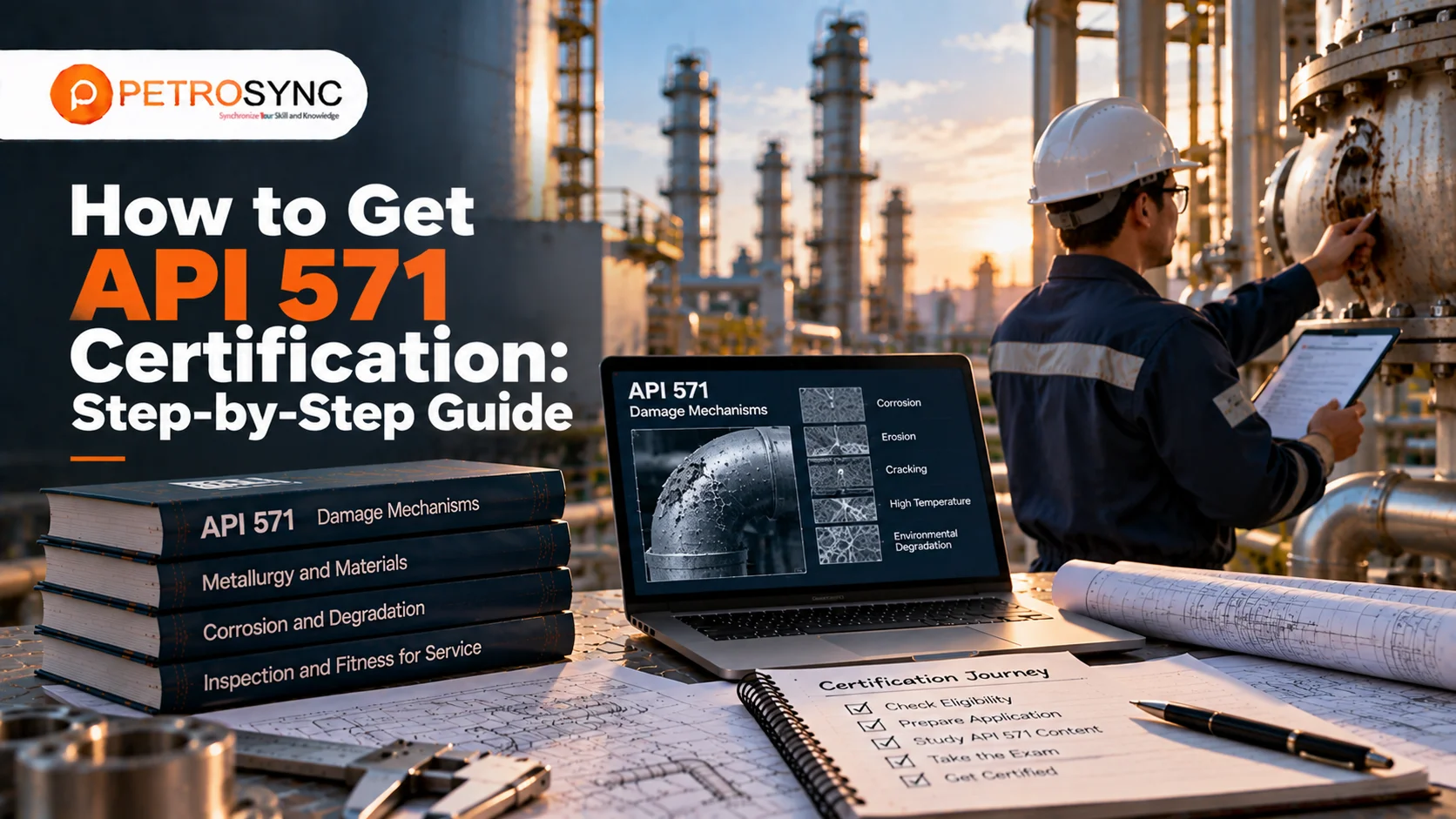
- Check whether you qualify automatically through a current API 510, API 570, or API 653 certification, or through the education and petrochemical-industry experience route.
- Apply through the API ICP Portal with the required employment and supporting documentation.
- After approval, schedule the API 571 exam through Prometric; API 571 currently supports test-center and remote-proctored delivery where available.
- Prepare using the current API 571 Body of Knowledge and API RP 571 reference; training is optional preparation support, not an eligibility prerequisite.
- After the exam, follow API’s result and certification process; API 571 certification is valid for three years and must be recertified under current API rules.
Getting API 571 certified is a process, not simply a matter of taking a course. You first need to confirm that you qualify, submit an application through the American Petroleum Institute’s Individual Certification Programs, complete the required employment or supporting documentation, receive approval, schedule and take the exam, and then complete API’s result and certification steps. API is the certification authority. Training from PetroSync or another provider can support preparation, but it does not replace API eligibility, application approval, or the exam itself.

How Do You Get API 571 Certification?
To get API 571 certification, first confirm your qualification route, apply through the API ICP Portal, provide the required employment and supporting information, and wait for API’s review. If approved, API sends exam authorization details so you can schedule through Prometric. You then take the API 571 exam and, once the application is complete and any deficiencies are cleared, API completes the result and certification process.
|
Stage |
What You Do |
Main Checkpoint |
|
Eligibility |
Confirm qualification route |
Current API 510/570/653 certification or education + petrochemical-industry experience |
|
Application |
Apply through API ICP Portal |
Required employment/supporting information complete |
|
API Review |
Wait for qualification/application review |
Resolve any deficiency before certification |
|
Exam Authorization |
Receive API authorization/eligibility details |
Candidate may schedule through Prometric |
|
Exam |
Take API 571 |
Prometric test center or remote proctoring where available |
|
Result & Certification |
Receive exam result and certification |
API issues certification only after requirements are satisfied |
|
Recertification |
Renew before expiry |
Follow current API recertification process |
Who Is Eligible for API 571 Certification?
API 571 has two main qualification routes. A candidate who currently holds API 510, API 570, or API 653 certification automatically qualifies to take the API 571 exam. Candidates without one of those current certifications can still qualify through a combination of education and petrochemical-industry experience acquired within the last 10 years, using the matrix published on API’s current API 571 certification page.
1. Automatic Qualification Through API 510, 570, or 653
If you hold a current API 510, API 570, or API 653 certification, API states that you automatically qualify to take the API 571 Corrosion and Materials exam. This route can simplify the qualification check because you do not need to rely on the separate education-and-experience matrix for exam eligibility. The key word is current: the official API wording refers to a current certification, so an expired credential should not be treated as an automatic qualification route without checking API’s current program rules.
2. Qualification Through Education and Petrochemical Experience
Candidates without a current API 510, 570, or 653 credential can qualify through education and petrochemical-industry experience. API currently requires one year of experience for a BS or higher in engineering or technology, two years for a two-year engineering or technology degree or certificate, three years for a high school diploma or equivalent, and five or more years with no formal education. API describes the experience for each route as any experience in the petrochemical industry, acquired within the last 10 years and documented on the application.
How Do You Apply for API 571 Certification?
After confirming that you qualify, submit the application through API’s ICP Portal. Before you submit, prepare employer contacts who can verify the employment dates, skills, and experience used for qualification, along with relevant education or certification documents where applicable. API also warns that changes or additions cannot be made to the Employment History section after submission, so the minimum qualifying experience needs to be documented correctly from the start.
1. Create or Access Your API ICP Portal Account
API manages new certification, reschedule, and recertification applications through the ICP Portal. For a first API 571 application, start by reviewing the program qualification rules, then create or access your portal account and submit the certification application. The official API ICP application guidance is the best place to confirm the current application process because portal instructions can change. This article focuses on the process checkpoints rather than reproducing a click-by-click interface that may become outdated.
2. Prepare Employment and Supporting Documents
API asks applicants to provide contact information for employers who can verify the employment dates, skills, and experience needed for qualification. It is only necessary to provide employer information for the years of experience required. Applicants should also prepare relevant documents, such as diplomas, transcripts, or certifications, when applicable. API requires applicants to provide official English translations for diplomas and transcripts when necessary. Applicants must document the minimum experience required for API 571 when they submit their application.
3. Submit the Application and Wait for API Review
Once submitted, the application enters API’s review process. API says application processing may take up to six weeks, so that timeframe should be treated as a maximum processing estimate rather than a promised approval date. If you qualify for the exam but the application is incomplete, API may send a deficiency email identifying the missing information. An application must be fully complete before certification can be issued, even if the candidate later passes the exam.
What Happens After Your API 571 Application Is Approved?
After API approves the application, you receive an Exam Authorization email with an Eligibility ID and instructions for scheduling. The exam is booked through Prometric within the testing window approved on the application. For API 571, candidates can currently choose an in-person Prometric test center or remote-proctored delivery where available, but the remote option still depends on technical requirements and the current scheduling rules.
1. Schedule the Exam Through Prometric
API’s exam scheduling guidance says approved candidates receive an Exam Authorization email containing an Eligibility ID and instructions for scheduling through Prometric. You can schedule only within the testing window for which your application was approved. Prometric test-center seating is limited, and API does not guarantee a seat at a particular location or on a specific date. Use the official API exam scheduling guidance before booking so you are working from the current rules and Prometric process.
2. Choose Test-Center or Remote-Proctored Delivery
API 571 is currently one of the ICP programs available for remote proctoring, and it can also be taken at Prometric test centers. Remote delivery uses Prometric’s ProProctor platform and requires a suitable computer setup, internet connection, system-readiness check, and the required application. Treat remote testing as an available option rather than a universal guarantee: candidates should confirm that the remote route is supported for their location, exam window, and technical setup before scheduling.
3. Check the Current Exam Window and Application Deadline
API’s schedule page, checked on Sep 29, 2026, lists the next 2026 API 571 exam window as Dec 4, 2026–Dec 25, 2026, with an application deadline of Oct 2, 2026. It also lists 2027 API 571 windows for Apr 9, 2027–Apr 30, 2027 and Aug 6, 2027–Aug 27, 2027. The current initial certification fee is USD 380 for API members and USD 440 for non-members; the reschedule/retest fee and late application fee are both USD 200. These dates and fees can change, so recheck API before applying.
What Is the API 571 Exam Like?
The current API 571 exam is a 3.25-hour, closed-book certification exam with 110 questions, of which 100 are scored and 10 are unscored pretest questions. API states that the questions are based on API RP 571 and that the exam uses a set passing scaled score. Do not convert that scaled standard into an invented raw passing percentage.
|
Item |
Current Official Detail |
|
Exam type |
Closed-book, multiple-choice |
|
Duration |
3.25 hours |
|
Total questions |
110 |
|
Scored questions |
100 |
|
Pretest questions |
10 |
|
Delivery |
Prometric test center or remote proctoring where available |
|
Main technical reference |
API RP 571, 3rd edition (2020), per current 2026 API 571 Body of Knowledge |
|
Passing standard |
API scaled score; do not convert to a raw percentage |
1. Use the Current API 571 Body of Knowledge
For 2026 exams, API states that the API 571 Body of Knowledge covers the entire API RP 571, 3rd edition, published in 2020. Therefore, the official BOK should guide your study for each exam window. API 571 certification and API RP 571 are related but different. Certification validates candidate knowledge, while API RP 571 provides the technical reference for the exam. Always check the BOK again for your own testing period.
2. Prepare Around Damage Mechanisms, Corrosion, and Materials
Preparation should focus on understanding why damage mechanisms occur, the materials and process conditions that influence them, and how monitoring, mitigation, examination, and testing connect to integrity decisions. High-value study areas include corrosion behavior, metallurgical degradation, cracking mechanisms, critical factors, inspection methods, and the practical application of API RP 571 concepts. The goal here is not to reproduce the complete BOK, but to build enough technical context to apply the recommended practice to refinery and petrochemical equipment scenarios.
What Happens After You Take the API 571 Exam?
After the exam, Prometric normally emails the final score report within 24 hours of testing, and API says final results are uploaded to the ICP Portal within three business days. Passing the exam does not by itself complete certification if the application still has unresolved deficiencies. Once the exam result and application requirements are satisfied, API can issue the certification, which is valid for a three-year term.
1. Receive Your Exam Result
API’s current examination guidance says candidates receive final score reports by email from Prometric within 24 hours of testing. API also states that final results are uploaded to the ICP Portal within three business days. These result checkpoints are useful for planning, but they should not be confused with the certification itself. A favorable score report confirms the exam result; API still needs the candidate’s certification application to be complete before issuing the credential.
2. Receive the API 571 Certification
API issues the professional certification after the exam and application requirements are satisfied and any deficiencies have been resolved. API now issues ICP certifications digitally, so certified candidates can access their credential through the ICP Portal and receive an email link for the digital certificate. A hard copy can be ordered separately. This API credential is different from a training attendance or completion certificate issued by a course provider, which should not be presented as the API 571 professional certification.
3. Plan for API 571 Recertification
API 571 certification is valid for three years. Currently, API states that employment verification is not required for API 571 recertification. Candidates can access the recertification application 90 days before their certification expires. API also provides a 90-day grace period after expiration, with late fees applying during that period. If the application is not submitted by the end of the grace period, the certification expires and the candidate must submit a new application and pass the full exam to become certified again.
How Can You Prepare for API 571 Certification?
Training is optional preparation support for API 571; it is not an API eligibility prerequisite. A sound preparation plan should follow the current Body of Knowledge and API RP 571. It should also develop practical understanding of damage mechanisms, corrosion, and materials. Focus on monitoring, mitigation, examination methods, and integrity applications. Use study resources and training to strengthen technical readiness. They should not replace API qualification, application approval, or the certification exam.
1. Review the Current API 571 Reference and Exam Scope
Begin with API’s current BOK for your exam window and confirm the applicable edition of API RP 571. This keeps your preparation aligned with API’s official scope. Avoid relying on older blog posts, informal pass-score claims, or outdated exam summaries. Build a topic checklist from the current reference. Then, organize study sessions around difficult mechanisms and decision factors. The official reference may change across future testing periods. Verify the BOK again before your application and exam date.
2. Use Study Materials and Practice Questions
Study resources can help turn the BOK into a practical learning plan. PetroSync’s API 571 study materials page can be used to organize reference sources, while its API 571 practice questions page can support recall and application practice. Use those materials as preparation aids rather than as authority for current eligibility, fees, or scoring rules. For sensitive certification facts, keep API’s official program pages as the primary source and use provider content only for learning support.
3. Consider API 571 Training for Structured Preparation
A structured course can help candidates work through damage mechanisms, corrosion and materials, monitoring and mitigation, examination methods, and case-based application in a defined sequence. The PetroSync API 571 training course is a five-day intermediate, face-to-face program led by Chintamani M. Khade and includes case-study discussion. A PetroSync internal customer testimonial rated a training experience 10/10 and stated, “The instructor is very knowledgeable. The course is very relevant to my work.” This is individual feedback, not an API 571 pass-rate or industry-wide outcome claim.
Read Also: API 571 training guide
Discuss Your API 571 Preparation Needs
That option is not included in every standard training fee. Confirm the package, fee, and timing for your selected program before registration. The training page is a useful starting point for discussing your preparation needs. Confirm current public API 653 dates directly rather than relying on past training batches. Companies can also discuss broader team-development needs separately without treating training as a certification prerequisite.
Frequently Asked Questions (FAQ)
No. A current API 510, API 570, or API 653 certification automatically qualifies you to take the API 571 exam, but it is not the only route. Candidates without one of those current credentials can also qualify through API’s education and petrochemical-industry experience matrix, provided the required experience is properly documented.
Yes. API 571 is currently listed as available through Prometric remote proctoring as well as in-person test-center delivery. Remote testing is available where supported and requires the appropriate computer, internet connection, and system-readiness checks, so confirm the current API and Prometric requirements for your exam window before scheduling.
API says application processing may take up to six weeks. An otherwise qualified candidate whose application is incomplete may receive a deficiency email, so the actual timeline depends on how complete the submitted information is and how quickly any requested deficiencies are resolved before certification.
No. Training is not an API 571 eligibility prerequisite. A course can provide structured preparation for API RP 571 and the current Body of Knowledge, but you still need to satisfy API’s qualification and application requirements independently and pass the official API 571 certification exam.
API 571 certification is valid for three years. API currently allows recertification applications starting 90 days before expiration and provides a 90-day grace period after expiration, with late fees applying during the grace period. Always confirm the program-specific recertification rules in force when your credential approaches expiry.

Results-oriented and thorough SEO specialist with extensive experience in conducting keyword research, developing and implementing digital website promotion strategies and plans, managing campaigns to develop company websites in the digital world, excellent knowledge of marketing techniques and principles, and attentive strong attention to detail.

Business Development Manager at PetroSync with 12+ years of experience in professional training and business development across the energy and industrial sectors.