

- Start with the mechanical integrity decisions you need to support.
- FFS assesses equipment condition; RBI helps prioritize inspection.
- Both paths require equipment context and careful use of inspection information.
- Apply learning to option reviews, inspection priorities and technical communication.
- Choose the starting course by the task and your readiness.
- PetroSync provides distinct FFS and RBI course options.
- Compare confirmed inclusions and separate public fees from custom in-house scope.
- Apply learning through your company’s existing MI review process.
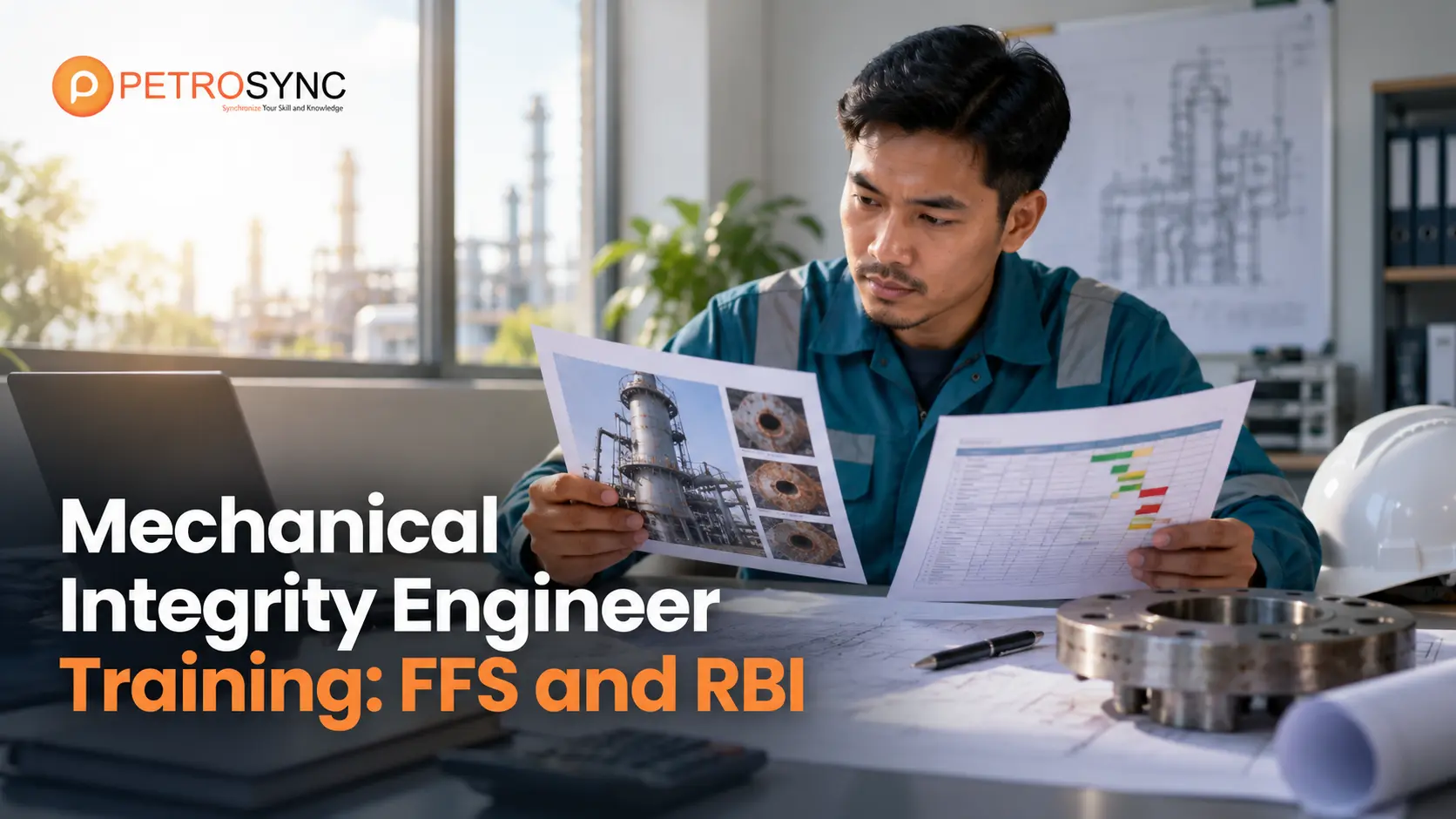
Mechanical integrity engineer training is most useful when it addresses a decision you need to support. A concern about equipment condition may call for different learning from a review of inspection priorities, even though both sit within the same mechanical integrity program.
Fitness-for-service and risk-based inspection provide two relevant learning directions. Understanding their different purposes helps you choose a starting course, assess your readiness and plan how to use the learning at work. The following guide connects those choices with PetroSync’s FFS and RBI options.
Matching Training to Mechanical Integrity Responsibilities
Match training to the mechanical integrity responsibilities you actually handle. If your immediate question concerns the condition of damaged equipment, assessment knowledge may be the priority. If you need to understand why inspection work receives a particular priority, focus your comparison on inspection-planning knowledge.
These responsibilities operate within a wider company program. Inspection, engineering and operations may each contribute information or review a recommendation. One course can strengthen a particular area of understanding, but it does not represent every activity, responsibility or authorization in that program.
Before comparing providers or dates, write down the decision you want to support and the information you usually receive. Note where your understanding becomes uncertain. This creates a practical learning objective and helps you distinguish a technical knowledge gap from a missing input or an unclear internal responsibility.
Read Also: What Is Asset Integrity Management? Definition & Key Aspects
How Do FFS and RBI Training Differ?
Fitness-for-service, or FFS, focuses on equipment condition and assessment needs, while risk-based inspection, or RBI, helps structure inspection priorities. The two approaches can support related integrity discussions, but they answer different questions, so course selection should follow the work you need to understand rather than an assumed training sequence.
1. FFS for Equipment Condition Assessment
FFS learning concerns the engineering assessment of equipment already in service when damage or flaws require evaluation. PetroSync’s API 579 training provides a relevant route for understanding assessment concepts and the information needed to examine an equipment-condition question more carefully within a technical review.
For example, a team considering repair, rerating or replacement first needs a clear assessment basis. Your learning objective might be to understand which inputs support that discussion and which remain missing. This helps you ask more precise questions without treating course attendance as authority to declare an actual component fit for service.
2. RBI for Inspection Prioritization
RBI learning addresses how information about equipment, degradation and risk supports inspection prioritization. The focus is on understanding the reasoning behind an inspection plan, including the assumptions and information on which the plan depends. That purpose differs from assessing a particular flaw.
An illustrative learning question is why one inspection task receives attention before another. A useful course helps you follow the basis of that discussion and recognize where information quality matters. It does not allow a participant to select inspection intervals for real equipment without the applicable review process and supporting assessment.
|
Training Focus |
Decision Supported |
Information Used |
Scope Boundary |
|
FFS / API 579 |
Assessment of damaged in-service equipment |
Condition findings and relevant engineering inputs |
Does not establish the whole inspection program |
|
RBI / API 580–581 |
Inspection prioritization |
Equipment, damage, likelihood and consequence information |
Does not replace an FFS assessment of a particular flaw |
Which Technical Skills Support Both Training Paths?
Both learning paths benefit from equipment knowledge, awareness of degradation and the ability to read inspection information critically. You need enough context to understand the question under review before discussing an assessment method or an inspection priority. Familiar terminology alone does not supply that context.
Practise identifying what an inspection record actually establishes. For example, wall thickness measurement needs an understandable measurement context before it can contribute to a wider discussion. Look for the information’s source, the equipment involved and any limitations that the report identifies.
Build the same habit when reading technical conclusions: separate observations from assumptions and ask what remains uncertain. This provides a useful foundation for either course. Keep preparation recommendations distinct from admission guidance, however; a sensible readiness checklist does not replace the provider’s published expectations for a particular program.
Read Also: The Ultimate Guide to Fitness for Service based on API 579
Where Can These Skills Support Plant Decisions?
FFS and RBI learning can help you frame engineering options, question inspection priorities and explain the basis of a recommendation. Use these capabilities within the plant’s existing review and authorization process, with the information and responsibilities clearly defined before any operational decision follows.
1. Evaluating Repair, Rerating, or Replacement Options
Learning about FFS can help you understand what a review of repair, rerating or replacement options needs to address. Start by identifying the equipment-condition question and the information available, then consider which assumptions or gaps require attention before comparing possible responses.
An illustrative exercise is to prepare a list of unanswered questions for the responsible assessor. You might identify an unclear operating context or an incomplete description of the reported condition. This supports a more focused discussion of the options while leaving the actual assessment and approval with the appropriate technical authority.
2. Reviewing Inspection Priorities
Training can help you examine how an inspection priority relates to the underlying information. In an RBI assessment, it is useful to understand the stated damage concerns, the information used and the assumptions that influence the proposed priority, rather than accepting a ranking without explanation.
A review discussion could ask where the information came from and how the team handled uncertainty. This helps separate an understandable rationale from a result that needs clarification. A lower priority should not become a casual claim that equipment needs no inspection; the applicable plan and review requirements still govern the work.
3. Explaining the Basis of Technical Recommendations
Explain a recommendation in a way that allows another person to examine its basis. Identify the work question, summarize the available information and state what remains uncertain. This supports a useful discussion between the functions that supply inputs and those that review the proposed next step.
For example, an internal note might distinguish an observed condition from an assumption and identify who should resolve each open question. That is a practical communication exercise, not a client case study. The goal is to make the reasoning and review responsibilities visible without implying that training transfers decision authority.

Need to understand inspection priorities more clearly? Explore API 580 581 training and compare its scope with the decisions you support.
How Do You Choose Your Starting Course?
Choose the starting course by the question you need to address and the guidance for its intended participants. A condition-assessment need points toward FFS learning, while a need to understand inspection prioritization points toward RBI. Then compare your background with the selected course’s expectations.
PetroSync’s API 579 page describes API 510, API 570 or API 653 certification as an added advantage. Its API 580/581 course page says candidates should possess at least one of those certifications. Preserve that distinction when discussing suitability; the two descriptions do not set identical expectations.
Consider course depth as well as the topic name. Explain what you already understand and where you need support before choosing a date. The nearest scheduled course is only useful if its subject and participant guidance fit the work question that prompted your search.
Read Also: Risk-Based Inspection Methodology for Asset Integrity
FFS and RBI Training Options with PetroSync
PetroSync offers separate FFS and RBI courses that you can compare against your mechanical integrity responsibilities. An individual participant can begin with a defined learning need, while a team can discuss how a proposed in-house scope would address shared technical questions.

API 579 provides an FFS learning option for equipment-condition and assessment discussions. API 580/581 addresses RBI concepts and inspection-prioritization needs. Consider the scope and audience guidance together; these courses do not form an automatic combined mechanical integrity certification.
A Google Business Profile snapshot supplied by the project owner, dated 6 September 2026, recorded a 4.9/5 rating from 1,061 reviews for PetroSync Jakarta.
Use that dated provider-level information alongside your assessment of course suitability. For a team enquiry, describe the decisions participants support, their experience and the learning gap. This gives PetroSync a clearer basis for discussing the relevant course or in-house scope without assuming that every participant needs both.
What Should You Compare in Training Costs?
Compare training costs through the confirmed scope and inclusions, as well as the time participants need to commit. The course fee alone does not explain the whole attendance plan. Ask for a written description of what the proposed arrangement covers before comparing alternatives.
Review material and reference requirements, preparation time and time away from normal duties. Include travel and accommodation where relevant. If a professional examination forms part of a participant’s objective, clarify its arrangements separately rather than assuming any course fee includes an examination.
An in-house quotation should reflect the proposed team scope. Do not extrapolate it from a public-course price or assume two courses form a discounted package. Confirm the applicable minimum participant requirement with PetroSync, then compare the quotation against the learning objectives and delivery arrangements your team actually needs.
Applying the Learning Within Your MI Program
Apply the learning through your company’s existing mechanical integrity process. Choose an appropriate internal review activity and identify the people who provide information, evaluate the technical basis and authorize action. This connects the course to real responsibilities while keeping accountability clear.
For example, participants could discuss an authorized case summary and explain the assumptions behind a proposed recommendation. Ask them to identify missing information, distinguish evidence from interpretation and describe the review still required. The discussion should reveal how they use the learning, rather than simply repeat course terminology.
Record the questions that remain and assign internal follow-up. Some may require better information; others may indicate a further learning need. This is a team application plan, not a promise of a provider assessment or a reason to change an operating decision without the normal technical review.

Bring your team’s FFS or RBI questions together, then contact PetroSync to discuss the learning scope that fits your responsibilities.
Discuss Your In-House Mechanical Integrity Training Needs
Tell PetroSync which mechanical integrity decisions your team supports and whether the priority concerns equipment-condition assessment or inspection planning. Include participants’ backgrounds and the questions you want the learning to address.
Request an in-house training quotation to discuss the proposed course scope, delivery arrangements and inclusions. A focused enquiry gives your team a useful starting point for comparing the training with its existing MI responsibilities and internal development plan.
Frequently Asked Questions (FAQ)
No specific FFS-first sequence is stated for PetroSync's API 579 Fitness-for-Service (FFS) and Risk-Based Inspection (RBI) courses. Choose a course based on your immediate work requirements and the participant guidance for each program. A suggested learning path can help organize your professional development, but it should not be treated as a mandatory prerequisite for attending the other course.
No. PetroSync's FFS and RBI courses are not presented as NDT method-certification programs. NDT information may contribute to equipment assessment discussions, but qualifying to perform a specific NDT method follows a separate certification or qualification process. If you need NDT credentials, identify the relevant method and confirm its applicable qualification requirements.
Eligibility guidance differs between PetroSync's API 579 and RBI courses. The API 579 course describes API 510, API 570, or API 653 certification as an added advantage, while the RBI course guidance states that candidates should hold one of these certifications. If you do not hold an API certification, contact PetroSync to confirm your suitability for the RBI course before registering.
Practical activities depend on the selected course. PetroSync's API 579 syllabus explicitly includes calculations and exercises, while its RBI syllabus includes analysis and case studies. Contact PetroSync to confirm the workshop activities for your selected batch, especially if you require a specific practical format or expect to use particular software.
Advance delivery of the complete course materials is not confirmed in the reviewed course descriptions. Ask PetroSync for the reading list and material release schedule for your selected course. This helps you plan your preparation without assuming that registration immediately provides every reference document or the complete set of teaching materials.

Results-oriented and thorough SEO specialist with extensive experience in conducting keyword research, developing and implementing digital website promotion strategies and plans, managing campaigns to develop company websites in the digital world, excellent knowledge of marketing techniques and principles, and attentive strong attention to detail.