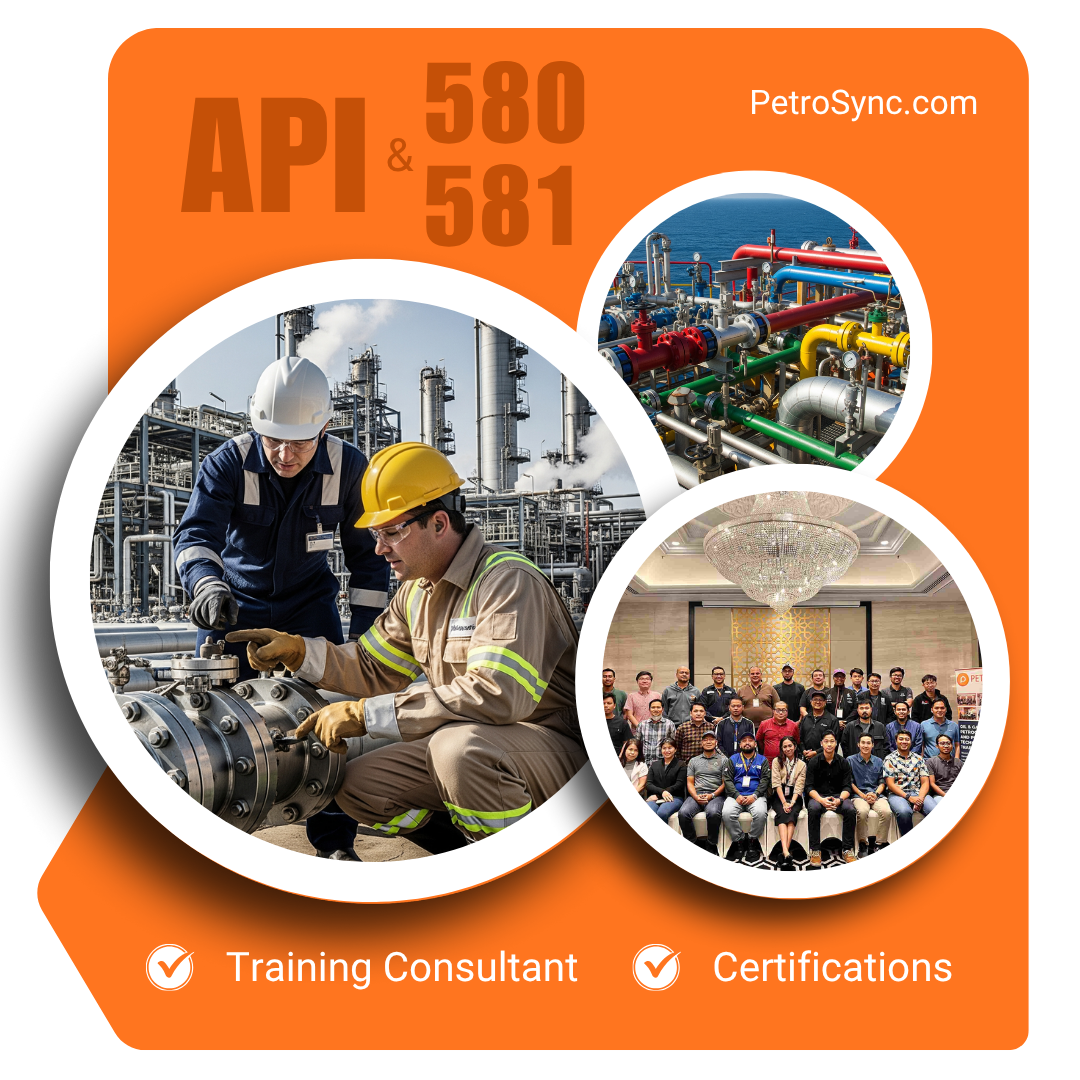



- API 580 & 581 Training is a Risk-Based Inspection program that teaches professionals to assess risk, prioritize inspections, and protect critical oil and gas assets.
- Learn to identify damage mechanisms, evaluate probability of failure, and plan smarter inspections that improve equipment reliability and operational safety.
- Apply RBI methodology to reduce unplanned downtime, prevent equipment failure, and support proactive maintenance strategies across industrial facilities.
- Strengthen compliance with global API standards while improving inspection planning, maintenance decisions, and risk management practices.
- Gain practical skills through real case studies and expert guidance to optimize asset integrity, extend equipment lifespan, and control maintenance costs.
In the oil and gas industry, managing equipment integrity and mitigating operational risks are fundamental to maintaining safe and efficient operations. Industrial assets, such as pressure vessel, piping, and storage tank, are exposed to corrosion, fatigue, and other degradation mechanisms over time.
Without a structured approach to inspection and risk assessment, organizations face increased downtime, asset failure, and safety hazards. API 580 & 581 Training addresses these challenges by providing professionals with the knowledge and tools needed to implement Risk-Based Inspection (RBI) programs.
This training equips engineers, inspectors, and maintenance personnel with the skills to assess risk, prioritize inspections, and make informed maintenance decisions, ensuring asset reliability and operational safety.
By completing API 580 & 581 Training, participants gain the ability to integrate RBI into maintenance planning, enhance compliance with industry standards, and reduce the likelihood of catastrophic failures, all while improving operational efficiency and cost-effectiveness.
What is API 580 & 581 Training?
API 580 & 581 Training is a professional program focused on Risk-Based Inspection (RBI) methodology for pressure equipment and piping systems. API 580 provides the framework for implementing RBI, while API 581 offers quantitative procedures and risk assessment calculations.
The training covers the identification of damage mechanisms, risk analysis, inspection prioritization, and maintenance planning. Participants learn to apply engineering principles, historical data, and probabilistic models to evaluate the probability of failure and its consequences.
By mastering API 580 & 581, professionals can optimize inspection intervals, allocate resources efficiently, and enhance the safety and reliability of oil and gas operations, while being fully prepared for industry-recognized certification in Risk-Based Inspection.
Key Benefits of Mastering API 580 & 581 Training for the Oil & Gas Industry
1. Improved Safety & Operational Reliability
RBI methodology enables early detection of potential equipment failures, reducing the likelihood of accidents, leaks, or catastrophic incidents. API 580 & 581 Training equips participants with the tools to assess risk systematically, ensuring safer and more reliable operations.
2. Compliance with Industry Standards, Codes & Regulations
Participants gain a thorough understanding of API 580 & 581 standards and their practical application, ensuring compliance with international codes, regulatory requirements, and corporate governance policies.
3. Reduced Asset Failure & Field Incident Risks
By prioritizing inspections based on risk assessment, damage mechanisms, and equipment criticality, organizations can minimize unplanned downtime, prevent failures, and reduce field incident risks, supporting proactive maintenance strategies.
4. Optimized Equipment Performance, Lifespan & Integrity
RBI allows for targeted inspection and maintenance planning, optimizing the performance and integrity of pressure equipment and piping systems. Participants learn to maximize asset lifespan and reliability while maintaining operational safety.
5. Cost Efficiency in Operations, Maintenance & Downtime
Through risk-based prioritization, companies can allocate resources more effectively, reduce unnecessary inspections, and avoid premature replacements, achieving cost efficiency without compromising safety or compliance.

What is API 580 & 581 Training Objective?
The main goal of the API 580 and 581 training course is to ensure that participants gain a thorough comprehension of the API 580 Risk-Based Inspection (RBI) and API 581 Risk-Based Inspection Technology standards. In general, PetroSync’s main objectives are:
- Introduction to the basic concept of Risk-Based Inspection and the basis for the API 580 RBI program and methodology
- Understand the purpose, scope, and examination of the critical steps in the RBI process
- Overview of deterioration mechanisms and failure modes affecting the plant equipment
- Introduction to the risk-based inspection priority matrix and the means to utilize its results in determining inspection priorities
- Introduction to the iso-risk plot and its use, especially in combination with the risk-based inspections priority matrix
- Discussion of risk-based inspection documentation and record-keeping needs
- Understanding of the basic concepts of risk acceptance, risk assessment, risk perception, risk mitigation, and managing residual risk.
What is API 580 & 581 Training Outline?
1. Day 1
- Benchmark Quiz
- Introduction to RBI
- Introduction To API 580
- API 580 Section 1: Scope and Applications
- API 580 Section 3: Important Definitions
- API 580 Section 4: Basic Risk Assessment Concepts
– What is Risk
– Risk Management and Risk Reduction
– The evolution of the Inspection Interval and Due dates
– Overview of Risk Analysis
– Inspection Optimization
– Relative Risk VS Absolute Risk - API 580 Section 5: Introduction to Risk-Based Inspection
– Key Elements of RBI Program
– Consequence and Probability for RBI
– Types of RBI Assessment - API 581 Edition 2000 – Case Study on Qualitative Analysis
2. Day 2
- API 580 Section 5: Introduction to Risk-Based Inspection
– Precision VS Accuracy
– Understanding how RBI can help to manage operating Risk
– Management of Risk
– Relationship between RBI and other Risk-Based and Safety Initiatives
– Relationship between Jurisdictional requirement - API 580 Section 6: Planning the RBI Assessment
– Getting Started
– Establishing Objectives and Goals of RBI
– Initial Screening
– Establishing Operating Boundaries
– Selecting a type of RBI
– Estimating Resources and Time Required - API 581 – 2016 – Part 1 – Inspection Planning using API RBI
– Technology
– Probability of Failure
– Generic Failure Frequency
– Management Systems Factor
– Damage Factors
– Consequence of Failure
– Level 1 Analysis
– Level 2 Analysis
– Risk Analysis
– Determination of Risk
– Risk Matrix
– Inspection Planning Based on Risk Analysis
– Risk Target
– Inspection Effectiveness
– Inspection Planning - API 581-2016 – Part 2 – Determination of Probability of Failure in an API RBI Assessment
– Determination of Probability of Failure
– Damage Factor Combination for Multiple Damage Mechanisms
– Inspection Effectiveness Category
– THINNING DAMAGE FACTOR
– SCC DAMAGE FACTOR – CAUSTIC CRACKING
– SCC DAMAGE FACTOR – SULFIDE STRESS CRACKING
– SCC DAMAGE FACTOR – HIC/SOHIC-H2S
– SCC DAMAGE FACTOR – CLSCC
– CUI DAMAGE FACTOR – FERRITIC COMPONENT
– PIPING MECHANICAL FATIGUE DAMAGE FACTOR
– HTHA DAMAGE FACTOR - Case Studies and Discussions on Probability of Failure
3. Day 3
- Case Studies and Discussions on Probability of Failure (continued)
- API 580 Section 7: Data and Information Collection for RBI Assessment
– RBI Data needs
– Data Quality
– Codes and Standards – National and International
– Sources of Site-specific Data and Information - API 580 Section 8: Damage Mechanism and Failure Modes
– Damage Mechanisms
– Failure Modes
– Accumulated Damage - API 580 Section 9: Assessing Probability of Failure
– Unit Measure of Probability Analysis
– Types of Probability Analysis
– Determination of POF
4. Day 4
- API 581- 2016 -Part 3 Consequence of Failure
– Consequence Analysis – Level 1
– Determine Representative Fluid and Associated Properties
– Release Hole Size Selection
– Release Rate Calculations
– Estimate the Fluid Inventory Available for Release
– Determine the Release Type ( Continuous or Instantaneous)
– Estimate the Impact of Detection and Isolation Systems on Release Magnitude
– Determine the Release Rate and Mass for Consequence Analysis
– Determine Flammable and Explosive Consequences
– Determine Toxic Consequences
– Determine Non-Toxic, Non-Flammable Consequences
– Determine the Component Damage and Personnel Injury Consequence Areas and – Final Consequence Areas
– Determine the Financial Consequences - Case Studies and Discussions on Consequence Analysis – Level 1
- API 580 Section 10: Assessing Consequence of Failure
– Types of Consequence Analysis
– Unit Measure of Consequence Analysis
– Consequence effect Categories
– Determination of Consequence - API 580 Section 11: Risk Determination, Assessment, and Management
– Determination of Risk
– Risk Management Decisions and Acceptable Level of Risk
– Risk Presentation
– Risk Management
5. Day 5
- API 580 Section 12: Risk Management with Inspection Activities
– Managing Risk by Reducing Uncertainty Through Inspection
– Identifying Risk Management Opportunities from RBI Results
– Establishing an Inspection Strategy Based on Risk Assessment
– Managing Risk with Inspection Activities
– Managing Inspection Costs with RBI
– Assessing Inspection Results and Determining Corrective Action
– Achieving Lowest Life Cycle Costs with RBI - API 580 Section 13: Other Risk Management Activities
- API 580 Section 14: Reassessment and Updating RBI
– RBI Reassessments
– Why Conduct an RBI Reassessment?
– When to Conduct an RBI Reassessment - API 580 Section 15: Roles, Responsibilities, Training, and Qualifications
– Team Approach
– Team Members, Roles, and Responsibilities
– Training and Qualifications for RBI Application - API 580 Section 16: RBI Documentation and Record Keeping
- API 580 Section 17: Summary of Risk-Based Inspection Pitfalls
- Discussion
Who Should Attend API 580 & 581 Training Course?
This course will specifically benefit Engineers, Supervisors, Managers and Individuals who are responsible for implementing risk-based inspection programs within their own company or plant facility.
Some of the relevant roles such as Mechanical integrity, Equipment Reliability, and Inspection Personnel, are responsible for maintaining the serviceability of process plant equipment based on a cost-effective inspection program.
Each attendee must bring a Laptop computer with the Microsoft operating system and a scientific calculator
API 580 & 581 Training Program by PetroSync

PetroSync delivers a comprehensive API 580 & 581 Training program, blending practical exercises, real-world case studies, and expert instruction. Participants gain the skills to:
- Conduct quantitative and qualitative risk assessments
- Identify and evaluate damage mechanisms
- Develop inspection and maintenance strategies based on risk prioritization
- Implement RBI programs aligned with international standards
Delivered by experienced global practitioners, the program ensures participants are prepared to apply RBI effectively in operational environments.
Advantages of Joining API 580 & 581 Training at PetroSync
1. Aligned with API 580 & 581 Standards & Risk-Based Inspection Practices
The curriculum strictly follows API 580 & 581 frameworks, preparing participants for certification and operational implementation.
2. Practical & Applied Case Study Approach
Participants work through real industry examples to develop problem-solving skills and apply RBI principles effectively.
3. Experienced Instructors from Global Industry Practitioners
Trainers are seasoned engineers and risk assessment experts with international experience, offering actionable insights from operational practice.
4. Curriculum Aligned with International Standards & Best Practices
The program covers RBI methodology, risk assessment calculations, inspection planning, and operational decision-making, ensuring participants learn globally recognized best practices.
5. Trusted by Energy Companies & Global Industries
PetroSync has a proven record with leading oil, gas, and energy companies worldwide, ensuring high-quality training delivery.
6. International Reputation as an Oil & Gas Training Provider
With years of experience in technical training and professional development, PetroSync is recognized globally as a trusted provider for industry professionals.
How Much Does API 580 & 581 Training Cost at PetroSync?
PetroSync’s API 580 & 581 Training is priced at $3,350 per participant, with sessions available in Kuala Lumpur, Malaysia, Bali, Indonesia, and Bandung, Indonesia. The fee includes full access to the training program, practical exercises, case studies, course materials, and expert guidance. Participants leave the program with hands-on skills, knowledge for operational implementation, and readiness for RBI certification.
This training strengthens career growth, operational safety, and compliance while enhancing risk management and inspection capabilities
Advance Your Risk-Based Inspection Career with API 580 & 581 Training at PetroSync
PetroSync’s API 580 & 581 Training equips professionals with essential expertise in Risk-Based Inspection, risk assessment, and inspection prioritization. Through practical exercises, applied case studies, and global expert guidance, participants develop skills to reduce risk, optimize maintenance, and improve operational efficiency.
Advance your career and become a trusted Risk-Based Inspection expert by joining PetroSync’s globally recognized API 580 & 581 training
Frequently Asked Questions (FAQ)
API 580 & 581 Training is a professional program focused on Risk-Based Inspection (RBI) methodology for pressure equipment and piping systems. API 580 provides the RBI framework, while API 581 delivers quantitative risk assessment procedures used to evaluate probability and consequence of failure.
This training is designed for engineers, inspectors, supervisors, managers, and maintenance professionals responsible for implementing Risk-Based Inspection programs, equipment reliability, and mechanical integrity within industrial facilities.
API 580 & 581 Training helps professionals improve operational safety, reduce asset failure risks, optimize inspection intervals, enhance regulatory compliance, and implement risk-based maintenance strategies in oil and gas facilities.
The API 580 & 581 Training program typically runs for five days and includes lectures, practical exercises, case studies, and discussions covering RBI methodology, probability of failure analysis, consequence assessment, and risk management.
The API 580 & 581 Training at PetroSync costs USD 3,350 per participant. The fee includes course materials, practical exercises, case studies, and expert instruction delivered by experienced industry practitioners.

Results-oriented and thorough SEO specialist with extensive experience in conducting keyword research, developing and implementing digital website promotion strategies and plans, managing campaigns to develop company websites in the digital world, excellent knowledge of marketing techniques and principles, and attentive strong attention to detail.