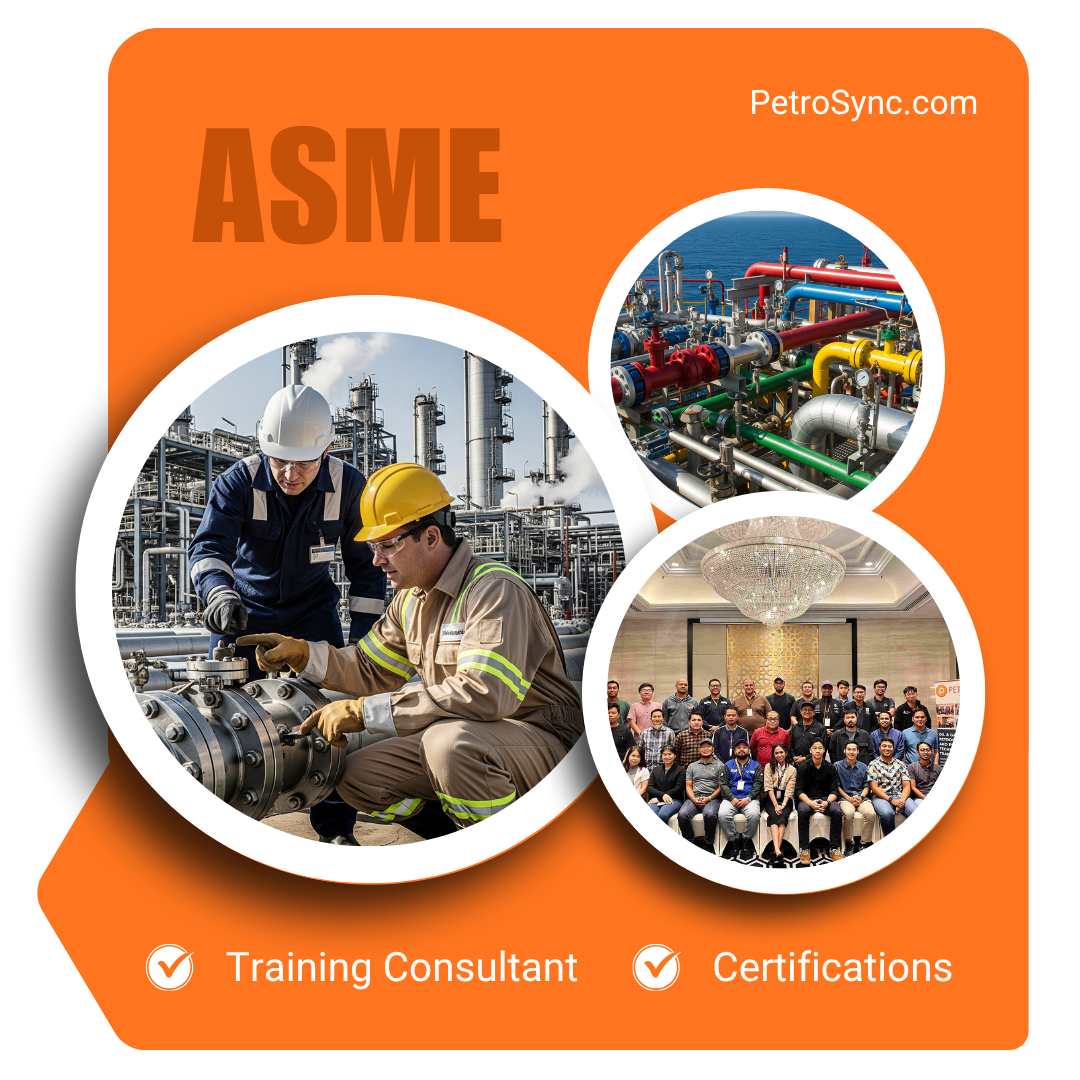



- ASME Course is a strategic necessity that turns code knowledge into real-world engineering competence for safer, compliant operations.
- Misreading ASME standards can trigger failures, shutdowns, audit penalties, and costly maintenance issues.
- Structured training helps engineers apply Section VIII, B31.3, and Section IX accurately in daily decisions.
- Strong code mastery improves safety margins, asset lifespan, and operational reliability across projects.
- PetroSync delivers practical, case-based programs that boost team capability and measurable performance impact.
ASME Course is no longer just an optional training program for engineers in the oil and gas industry. It has become a strategic necessity. In an industry where high pressure, extreme temperatures, and complex mechanical systems are part of daily operations, even a minor misinterpretation of engineering standards can result in catastrophic failures, costly downtime, or serious safety incidents.
Most global energy companies rely on standards developed by the American Society of Mechanical Engineers as the backbone of their pressure vessel, piping, boiler, and mechanical integrity systems. However, simply owning the code book is not enough. Engineers must understand how to interpret, apply, and integrate these standards into real-world engineering decisions.
This is where a structured and professionally delivered ASME Course becomes critical — transforming theoretical code knowledge into practical engineering competence that directly impacts safety, compliance, and operational reliability.
What is ASME Course?

An ASME Course is a professional training program designed to help engineers understand, interpret, and apply ASME Codes and standards in practical industrial environments.
These courses typically cover areas such as:
- ASME Section VIII – Pressure Vessels
- ASME B31.3 – Process Piping
- ASME Section IX – Welding & Brazing Qualifications
- Mechanical Integrity & Inspection Requirements
- Code interpretation strategies
The objective is not just to memorize clauses but to:
- Prevent design misinterpretation
- Ensure compliance with international standards
- Improve asset reliability
- Support audits and regulatory inspections
- Strengthen engineering decision-making\
In short, an ASME Course bridges the gap between code documentation and operational execution.
Potential Risks of Improper Management or Misunderstanding of ASME Codes & Standards
1. Non-Compliance with Critical Engineering Standards
Failure to understand ASME requirements can result in non-compliant designs, fabrication errors, and documentation gaps. During audits, this may lead to penalties, project delays, or operational shutdowns.
2. Increased Operational & Safety Risks
Improperly designed pressure-retaining components increase the risk of overpressure events, fatigue cracking, material failure, or catastrophic rupture.
3. Inefficient Equipment Performance
Without proper code-based calculations, engineers may overdesign (wasting cost) or underdesign (risking failure), leading to reduced efficiency and shortened equipment life.
4. Higher Maintenance Costs & Downtime
Equipment failures caused by incorrect code application can trigger unplanned shutdowns and expensive corrective maintenance.
5. Limited Professional Competence
Engineers who rely solely on field experience without structured ASME training may struggle to interpret code revisions or handle complex engineering scenarios.
Benefits of Mastering ASME Course for the Oil & Gas Industry
1. Based on ASME Code & Real Engineering Applications
The course content is directly aligned with official ASME standards and applied in realistic engineering contexts.
2. Practical & Applied Case Study Approach
Participants learn through real case studies, enabling them to connect theory with actual project conditions.
3. Experienced Instructors from Global Industry Practitioners
Training is delivered by instructors with international project experience and deep technical expertise.
4. Curriculum Aligned with International Standards & Best Practices
The course integrates global engineering practices and current regulatory expectations.
5. Trusted by Energy Companies & Global Industries
ASME-based training programs are widely recognized and implemented across the global energy sector.
6. International Reputation as an Oil & Gas Training Provider
Professionals who complete recognized ASME training enhance both individual credibility and corporate reputation.
Improved Safety & Operational Reliability
Understanding ASME allowable stresses, corrosion allowances, weld qualification requirements, and inspection intervals significantly enhances safety margins. Engineers can confidently validate whether operating conditions remain within safe limits. This leads to improved equipment reliability and reduced incident rates.
Compliance with Industry Standards, Codes & Regulations
Regulatory authorities in many countries reference ASME Codes as mandatory compliance standards. By mastering an ASME Course, organizations strengthen their ability to pass audits and meet regulatory requirements without disruption.
Reduced Asset Failure & Field Incident Risks
Many asset failures originate from design miscalculations or improper material selection. Proper ASME training equips engineers to identify potential risks during design, fabrication, and inspection stages — long before failures occur.
Optimized Equipment Performance, Lifespan & Integrity
A thorough understanding of code-based design principles helps extend asset lifespan. Engineers can optimize thickness calculations, pressure ratings, and material selection while maintaining integrity and performance efficiency.
Cost Efficiency in Operations, Maintenance & Downtime
The cost of structured ASME training is significantly lower than the financial impact of a single major equipment failure.
Investing in an ASME Course directly contributes to:
- Reduced corrective maintenance
- Lower downtime costs
- Improved lifecycle asset management
- Better capital expenditure decisions

How to Address ASME Course Challenges More Effectively
1. Develop Professional Competence through Structured Programs like PetroSync
Structured training ensures systematic learning rather than fragmented knowledge acquisition.
2. Apply Relevant Industry Best Practices & Standards for ASME Course
Courses must go beyond theory and incorporate global engineering best practices.
3. Integrate ASME Course Knowledge into Operational & Engineering Processes
Knowledge should be embedded into company procedures, work instructions, and design workflows.
4. Enhance Team Capability through Case Studies & Field Learning
Interactive discussions and real case simulations strengthen team-wide problem-solving skills.
5. Conduct Evaluation, Review & Continuous Improvement
Regular assessment ensures that knowledge remains current with evolving ASME code updates.
Competency Development Solutions for ASME Course via PetroSync
PetroSync provides globally recognized ASME training programs specifically tailored for oil & gas professionals — from engineers and supervisors to technical managers and asset integrity leaders. The programs are designed to transform code knowledge into measurable operational impact. Professional training session featuring engineering discussions on pressure vessel design calculations using ASME Code references.
PetroSync ASME Course Competency Development Programs for Oil & Gas Professionals
1. Based on ASME Code & Real Engineering Applications
2. Practical & Applied Learning Approach
3. Experienced Instructors from Practitioners & Subject Matter Experts
4. Curriculum Based on International Standards & Industry Practice
5. Case Studies Based on Real Field Conditions
6. Public & In-House Program Schemes
7. Always Updated & Relevant Learning Materials
8. Learning Experience Support from Engineers to Management
9. Program Certificate for Competency & Career Development
10. Focused on Competency Improvements with Real Impact
Each program is structured to deliver not just knowledge — but performance improvement in safety, compliance, and operational reliability.
PetroSync ASME Course Program Advantages for Companies
1. Based on ASME Code & Real Engineering Applications
2. Relevant for Various Disciplines & Professional Levels
3. Focused on Competency Improvements with Real Impact
4. Supports Compliance, Audits & Operational Reliability
5. Flexible for Project, Asset & Organizational Needs
6. Global Reputation & Experience in the Oil & Gas Industry
PetroSync’s global exposure ensures that training remains aligned with evolving international energy standards and operational challenges.
Strengthen Your Engineering Team with PetroSync ASME Course Programs
Engineer analyzing pressure vessel design drawings alongside ASME Code documentation in a technical review session.
Schedule Your PetroSync ASME Course Competency Program Now
The oil & gas industry does not tolerate engineering uncertainty. Ensure your team possesses structured, code-based competence that strengthens safety, reliability, and regulatory compliance. Schedule your PetroSync ASME Course program today and position your organization for sustainable operational excellence.
Frequently Asked Questions (FAQ)
An ASME Course is a structured professional training program that helps engineers understand, interpret, and apply ASME Codes such as Section VIII, B31.3, and Section IX in real industrial environments to improve safety, compliance, and operational reliability.
ASME training is considered strategic because misinterpreting engineering standards can lead to catastrophic failures, costly downtime, audit penalties, and serious safety incidents in high-pressure and high-temperature operations.
Improper understanding of ASME Codes can result in non-compliant designs, fabrication errors, overpressure events, equipment failure, increased maintenance costs, unplanned shutdowns, and reduced professional competence.
Mastering an ASME Course helps engineers optimize design calculations, validate allowable stresses, select appropriate materials, extend asset lifespan, strengthen audit readiness, and reduce failure risks across operations.
PetroSync provides globally recognized ASME training with practical case studies, experienced industry instructors, updated learning materials, flexible public and in-house programs, and a strong focus on measurable improvements in safety and compliance.

Results-oriented and thorough SEO specialist with extensive experience in conducting keyword research, developing and implementing digital website promotion strategies and plans, managing campaigns to develop company websites in the digital world, excellent knowledge of marketing techniques and principles, and attentive strong attention to detail.