


The Petroleum Industry Future is entering a transformational era, driven by global energy transition, rapid digitalization, and shifting economic pressures. These structural shifts are redefining how companies operate, invest, and compete globally.
For senior engineers, managers, and executives, understanding the direction of the petroleum industry future is not just helpful — it is essential for sustaining long-term competitiveness in an increasingly unpredictable energy ecosystem.
As new technologies reshape operations and global policies pressure companies to accelerate low-carbon strategies, one insight stands out: organizations that anticipate change consistently outperform those that react late.
With that foundation, this article offers a solution-focused, research-backed perspective on the trends that will define the petroleum industry future — and what leaders can do today to build resilience for the next decade.
How Will the Energy Transition Shape the Petroleum Industry Future?
Energy transition is at the core of strategic planning across the global petroleum sector. Its influence extends beyond environmental commitments — it is fundamentally reshaping investment priorities and operational models.
1. Low-Carbon Investment & Emissions Reduction Imperatives
Low-carbon investments are increasing rapidly worldwide. Independent energy assessments indicate that global clean-energy spending has grown at a double-digit rate over the last few years. This momentum signals a clear shift: petroleum companies must embed emissions reduction into their long-term business strategy, not as a compliance task but as a value-creating necessity.
Companies that have aggressively reduced emissions — such as implementing electrified operations, optimizing flare management, and deploying high-efficiency systems — have reported operational savings and greater investor confidence. Low-carbon strategy is evolving into a competitive differentiator.
2. Hydrogen, CCUS & Biofuels Integration Growth
Hydrogen, carbon capture (CCUS), and sustainable fuels are emerging as central pillars in future energy portfolios. A widely referenced global climate analysis showed that CCUS alone has the potential to reduce industrial emissions by more than 15% by 2035 when scaled adequately.
Petroleum operators are naturally positioned to lead these developments thanks to:
– subsurface reservoir expertise
– pipeline and transport infrastructure
– large-scale processing capabilities
Rather than becoming obsolete, the petroleum sector is transforming into a key enabler of new-energy integration.
3. Regulatory Pressures Influencing Long-Term Capital Decisions
Regulatory tightening across major economies is accelerating the shift toward low-carbon operations. Policy evaluations reveal that stricter environmental standards have redirected billions in capital expenditure toward cleaner technologies and more sustainable operating models.
Leaders who understand regulatory momentum are better equipped to make investment decisions that remain profitable in a carbon-constrained future.
Will Digital Transformation Redefine Operational Excellence in the Petroleum Industry Future?
Digitalization is redefining what operational excellence means in oil and gas. It is no longer about incremental gains; it is about building safer, smarter, and more predictive operations.
1. AI-Driven Predictive Maintenance & Real-Time Optimization
AI combined with IoT sensors is transforming maintenance practices. Industry case studies show that predictive maintenance can reduce unplanned downtime by 30–50%—a massive value driver for asset-heavy facilities such as refineries, offshore platforms, and LNG plants.
Real-time analytics also enhances process optimization, enabling faster decisions, more stable operations, and improved asset reliability.
2. Digital Twin Adoption Improving Safety & High-Risk Planning
Digital twins provide a real-time virtual model of physical systems. This innovation enables teams to simulate scenarios, validate engineering decisions, and troubleshoot without exposing personnel to risk. As adoption increases, digital twins are enhancing:
– emergency preparedness
– integrity management
– complex engineering planning
– operator training
They are quickly becoming the backbone of high-risk asset management.
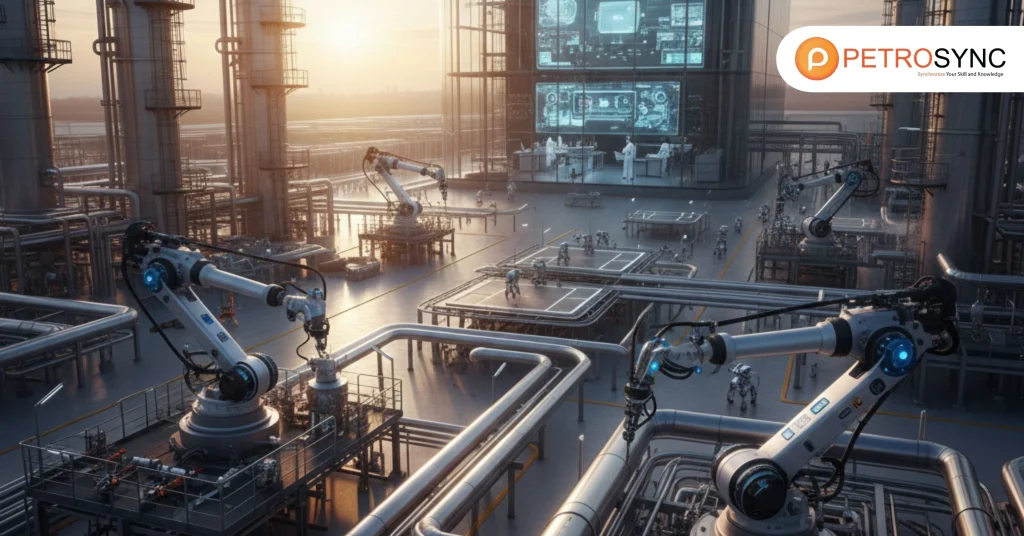
3. Advanced Automation, Robotics & Unmanned Operations
Robotic inspection tools, autonomous drones, unmanned wellhead platforms, and automated pipeline monitoring systems are expanding rapidly. Research from industrial safety organizations indicates that automation reduces hazardous exposure by more than 70%, while improving operational continuity in remote environments.
The future workforce will increasingly supervise intelligent systems rather than perform physical field tasks — a shift that improves both safety and efficiency.
How Will Value Chain Models Evolve in the Petroleum Industry Future?
The industry’s upstream, midstream, and downstream segments are reshaping themselves to remain competitive in a rapidly shifting energy landscape.
1. Upstream Efficiency Focus & Disciplined CAPEX
Upstream operators are prioritizing high-quality reservoirs, automated drilling solutions, and fast-payback projects. Capital discipline is now central to upstream strategy. Digital drilling analytics and real-time geosteering allow companies to increase recovery while reducing cost overruns.
2. Midstream Flexibility Through LNG & Pipeline Adaptability
Demand forecasting shows strong LNG growth driven by industrial expansion, energy security concerns, and a global pivot from coal to gas. As a result, midstream operators must enhance system flexibility through:
– adaptive pipeline networks
– hydrogen-ready infrastructure
– real-time integrity monitoring
This adaptability ensures that midstream assets maintain relevance amid energy system volatility.
3. Downstream Shift to Petrochemicals & Circular Economy Strategies
Global demand for petrochemical continues to surge, prompting refiners to diversify away from traditional fuels. The downstream sector is accelerating shifts toward:
– low-carbon fuels
– recycled feedstocks
– advanced petrochemical production
– circular processing models
These innovations support both sustainability targets and long-term profitability.
What Skills & Leadership Capabilities Will Determine Success in the Petroleum Industry Future?
Despite advancements in technology, leadership strength remains the ultimate success factor. Tomorrow’s petroleum leaders will require a different blend of skills.
1. Strategic Agility & Market Foresight
Leaders must navigate volatility with precision. Strategic agility allows organizations to adapt rapidly to evolving market forces, policy changes, and technological disruptions.
2. Digital Fluency & Data-Driven Decision Leadership
Executives do not need to write code, but they must understand how data systems, automation, and AI influence operational and strategic decisions. Digital fluency ensures leaders make accurate, timely choices.
3. Sustainability-Driven Engineering Competencies
Future engineers must incorporate carbon-aware design, lifecycle asset management, and integrated energy system understanding. These capabilities help companies innovate responsibly and maintain operational resilience.
Why Future-Ready Competencies Matter Before the Next Industry Shift
The petroleum industry is experiencing one of the largest transformations in its history. Technology can accelerate processes, but talent determines the real outcome. Companies that bridge the skills gap early consistently achieve stronger resilience, better project outcomes, and higher profitability.
Investing in future-ready competencies ensures that teams can:
– manage regulatory changes with confidence
– apply digital tools effectively
– optimize operations sustainably
– make decisions that secure long-term value
Advance Technical Leadership for the Petroleum Industry Future with PetroSync Training
To navigate this evolving landscape, professionals need more than theoretical knowledge—they need practical insight, strategic clarity, and technical confidence. PetroSync provides training programs specifically designed for senior professionals, managers, and executives in the petroleum sector.
Our programs focus on:
– digital transformation in oil & gas
– asset & reliability management
– operational excellence fundamentals
– petroleum engineering core principles
– energy transition readiness
Led by global industry practitioners, PetroSync’s courses equip you with the capabilities required to lead effectively in the petroleum industry future. Strengthening your expertise today ensures you remain competitive, relevant, and ready for the next phase of industry transformation.

Results-oriented and thorough SEO specialist with extensive experience in conducting keyword research, developing and implementing digital website promotion strategies and plans, managing campaigns to develop company websites in the digital world, excellent knowledge of marketing techniques and principles, and attentive strong attention to detail.