

1. ASME is a global authority shaping safety, reliability, and quality through codes, standards, and certifications used in 100+ countries.
2. ASME standards reduce industrial risk, helping prevent equipment failure, accidents, and costly downtime in high-risk operations.
3. Compliance strengthens credibility, boosts efficiency up to 30%, and opens access to regulated international markets.
4. ASME enables innovation by providing proven frameworks for advanced technologies without compromising safety.
5. Strong ASME knowledge builds engineering leadership, improves asset reliability, and drives long-term operational excellence.
ASME (American Society of Mechanical Engineers) stands as one of the most influential engineering organizations in the world, shaping safety, reliability, and quality standards across a wide range of industrial applications. In an era where operational risks are rising and performance expectations continue to accelerate.
ASME provides the engineering community with globally recognized codes, standards, certification programs, and technical guidance essential for protecting people, assets, and environments. The role of ASME extends far beyond publishing technical documents. It establishes a culture of discipline, accountability, and professional integrity within the engineering world.
In high-risk industries such as oil and gas, power generation, manufacturing, and large-scale construction, ASME standards serve as a universal foundation to ensure that pressure equipment, piping systems, and mechanical components operate safely under demanding conditions.
Understanding ASME is not just about compliance — it is about enabling safer designs, improving asset reliability, and supporting innovation rooted in proven engineering principles. For senior engineers, managers, and business leaders responsible for critical operations, knowing What is ASME? and recognizing its strategic value is essential for leading high-performance industrial environments.
Before exploring the broader significance of ASME in modern engineering, let’s begin with its fundamental definition and purpose.
What is ASME?
ASME (American Society of Mechanical Engineers) is a global professional engineering society founded in 1880 to promote technical knowledge, improve engineering safety, and support innovation across industries.
ASME develops internationally recognized codes and standards, provides certification programs, supports research, and delivers professional training and technical resources for engineering development. The organization is best known for its ASME Boiler and Pressure Vessel Code (BPVC) — a global benchmark that governs the design, fabrication, inspection, testing, and repair of pressure-containing equipment.
Today, ASME standards are used in more than 100+ countries, and ASME certification is widely required for industrial equipment approval and project compliance worldwide.
Why ASME Matters in the Engineering World
The engineering world relies on ASME as a core foundation of safety, reliability, and standardization. Its importance can be understood across four main perspectives:
1. Ensuring Safety and Reliability
The primary purpose of ASME standards is to protect lives and prevent catastrophic failures. Pressure vessel explosions, pipeline ruptures, and equipment breakdowns can result in injuries, environmental damage, and significant financial loss.
Research published in engineering safety studies indicates that adopting standardized safety methodologies and inspection guidelines can reduce major industrial accidents by up to 47%, highlighting the critical impact of structured engineering standards.
ASME standards define material requirements, design methods, testing processes, and inspection criteria to minimize the risk of component failure under extreme operating conditions.
2. Driving Market Competitiveness and Growth
ASME compliance enhances credibility and improves business performance. Industrial benchmarking studies show that organizations implementing strong engineering standards and structured asset management processes achieve up to 30% improvement in operational efficiency, alongside reduced downtime and lower maintenance spending.
Higher reliability translates into sustained productivity and competitive advantage.
Many global clients and regulators require ASME-certified equipment, making compliance essential for international market access.
3. Enabling Innovation with Confidence
While innovation drives industry progress, it must be supported by disciplined engineering frameworks. ASME provides guidelines that allow engineers to safely adopt new technologies such as hydrogen systems, carbon capture, nuclear small modular reactors (SMRs), digital twins, and advanced materials.
By establishing validated safety margins, ASME empowers engineers to innovate without compromising safety.
4. Facilitating Global Engineering Collaboration
In a world where equipment may be designed in one country, manufactured in another, and operated in a third, ASME creates a common engineering language. By harmonizing requirements, pressure vessel reduces technical disputes, improves supply chain alignment, and ensures that global projects move efficiently and safely.
The Core Standards and Principles of ASME
Pressure vessel develops more than 600 standards and codes used to regulate engineering practices worldwide. The core principles behind these standards reflect essential engineering objectives:
1. Ensuring Safety and Reliability
ASME standards establish safety margins and design requirements to prevent equipment failure and industrial accidents. For example, the BPVC sets essential criteria for designing and inspecting boilers, pressure vessels, and piping systems.
2. Supporting Innovation and Quality Design
pressure vessel encourages evidence-based engineering by providing scientific guidelines and validation methods. Engineers can safely deploy advanced technologies, optimize design performance, and improve engineering integrity with confidence.
3. Promoting Global Engineering Collaboration
Pressure vessel standards enable consistency in manufacturing, inspection, and project execution across borders. They support supply chain uniformity, reduce regulatory complexity, and strengthen project transparency worldwide.

Applications of ASME Standards Across Industries
1. Oil and Gas Sector
ASME BPVC and ASME B31.3 piping codes govern equipment such as pressure vessels, heat exchanger, refining boilers, and high-pressure pipelines. In a sector where reliability and safety are non-negotiable, pressure vessel certification is essential for preventing catastrophic process safety failures.
2. Power Generation and Energy
Conventional power plants, nuclear facilities, and renewable energy systems depend on pressure vessel guidelines to manage high-pressure equipment, steam systems, and turbine components safely. Pressure vessel plays a central role in emerging hydrogen and carbon-neutral energy technologies.
3. Manufacturing and Construction
Pressure vessel ensures quality, material integrity, welding procedures, fabrication standards, and equipment interoperability across industrial manufacturing and large-scale construction projects, enabling durable and efficient production performance.
Building Engineering Excellence Through ASME Knowledge
Mastery of ASME standards builds strong engineering judgment and leadership capability. For technical specialists and decision-makers, ASME knowledge strengthens reliability-focused culture and supports operational excellence.
Industrial performance research demonstrates that organizations investing in engineering training and standardized practices achieve:
– Up to 28% reduction in equipment failure
– 25–40% improvement in asset reliability
– Significant operational cost optimization
Continuous professional development enables engineers to make smarter, risk-informed decisions and lead safer, more efficient industrial operations.
What are Some ASME Codes and Standards?
this standard develops a number of norms and standards that apply to many sectors of mechanical engineering. Some of the most commonly utilized this standard codes and standards are:
1. ASME B31.1:
This standard applies to the design and construction of power pipe systems. It specifies the materials, design, fabrication, and inspection standards for pipe systems in power plant.
2. ASME Section I:
This section of the ASME Boiler and Pressure Vessel Code addresses the design and construction requirements for power boilers.
3. ASME PCC-2:
This code governs the repair and maintenance of pressure-retaining components, particularly in industries such as oil and gas.
4. ASME B31.3:
This standard applies to the design and installation of process pipes, including chemical and petrochemical plant.
5. ASME Section VIII:
This section of the ASME BPVC outlines the design, construction, inspection, and testing of pressure vessels.
These norms and standards are essential for guaranteeing the safety, dependability, and efficiency of mechanical systems in a wide range of businesses.
Advance Your ASME Expertise with PetroSync Training
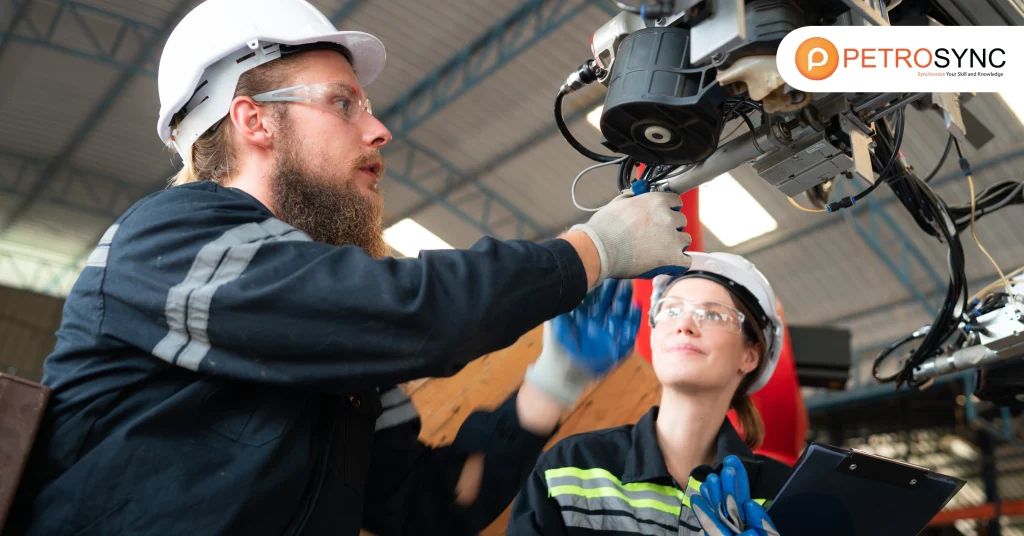
For engineers, managers, and leaders committed to improving asset integrity and engineering performance, professional ASME training provides essential depth and practical competency. PetroSync delivers specialized training programs led by global industry experts, combining real industrial case studies, design and calculation workshops, and hands-on application of ASME standards across high-risk industries.
Participant Benefits:
1. Master detailed ASME code interpretation and real-world implementation
2. Learn through practical examples from oil & gas, power, and manufacturing facilities
3. Strengthen engineering decision-making and technical confidence
4. Gain certification to increase professional credibility and career advancement
5. Connect with experienced professionals across industries
With the right training, engineers transform knowledge into measurable performance improvement — improving safety, optimizing reliability, and supporting sustainable innovation.
Frequently Asked Questions (FAQ)
ASME is a global engineering society founded in 1880 that develops codes, standards, certifications, and training to improve safety, reliability, and innovation across industries.
ASME standards help prevent equipment failure, reduce industrial accidents, and protect people, assets, and the environment in sectors such as oil and gas, power generation, and manufacturing.
ASME defines material requirements, design methods, inspection criteria, and testing processes that reduce risk and improve equipment performance under extreme operating conditions.
ASME provides validated engineering frameworks and safety margins that allow engineers to adopt new technologies such as hydrogen systems, carbon capture, and advanced materials with confidence.
Widely used ASME standards include BPVC Section I and VIII, ASME B31.1 and B31.3 piping codes, and ASME PCC-2 for pressure equipment repair and maintenance.

Results-oriented and thorough SEO specialist with extensive experience in conducting keyword research, developing and implementing digital website promotion strategies and plans, managing campaigns to develop company websites in the digital world, excellent knowledge of marketing techniques and principles, and attentive strong attention to detail.