

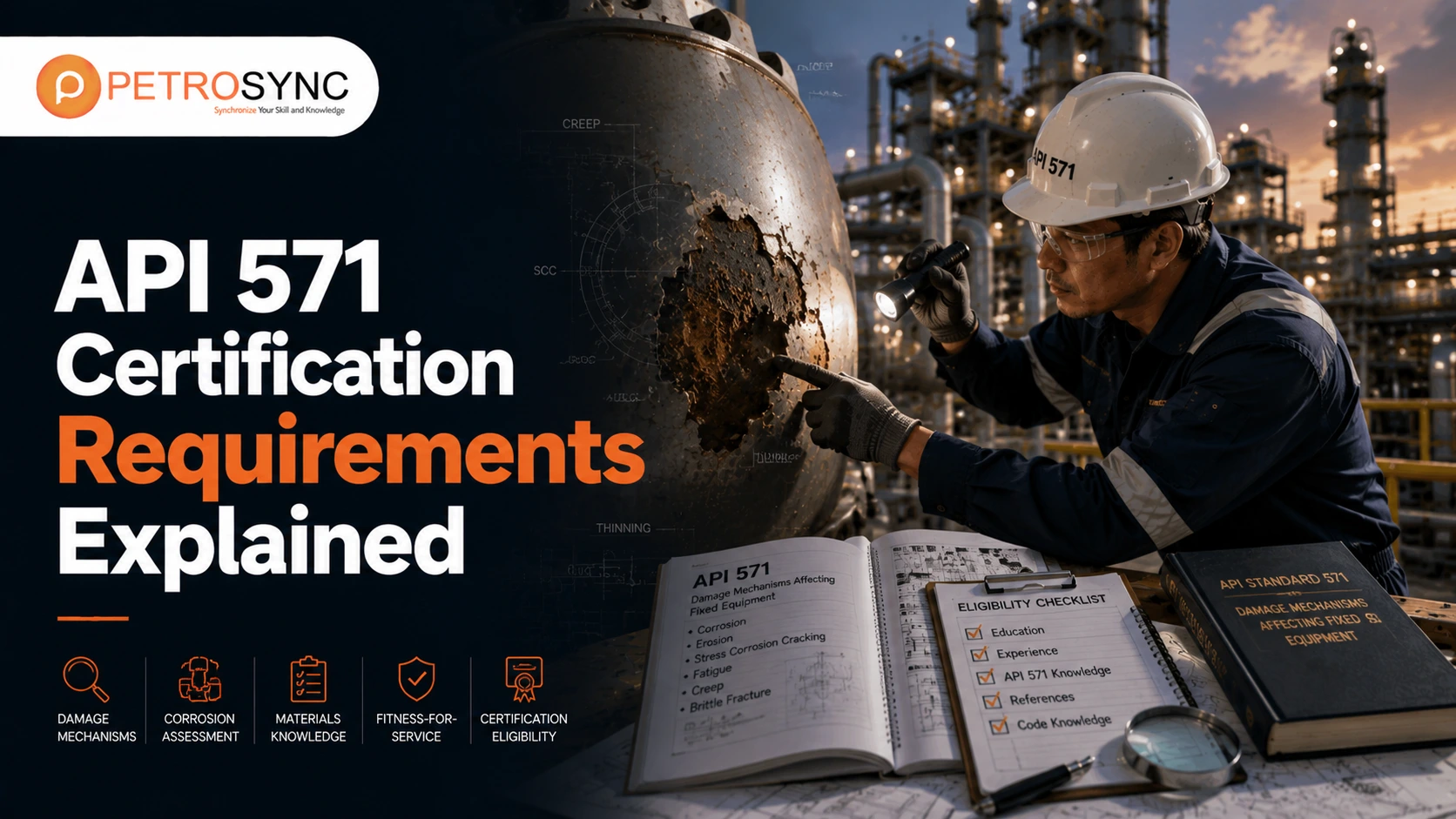
- API 571 certification requires a combination of education, relevant industry experience, and knowledge of damage mechanisms affecting fixed equipment.
- Your eligibility depends on the API education and experience matrix, with different requirements based on your educational background.
- Practical experience in corrosion, materials engineering, inspection, or fixed equipment integrity is essential before applying for certification.
- Candidates should understand the API 571 Body of Knowledge, including API 571, API 510, API 570, API 580/581, and relevant ASME standards.
- Joining structured API 571 training can help strengthen your understanding of damage mechanisms and improve your readiness for the certification exam.
Understanding why equipment fails is one of the most important aspects of maintaining safe and reliable operations in the oil and gas industry. Corrosion, high-temperature damage, mechanical deterioration, and other degradation mechanisms can significantly affect the integrity of fixed equipment if they are not properly identified and managed.
The API 571 certification, administered by the American Petroleum Institute (API) through its Individual Certification Program (ICP), is designed for professionals who want to demonstrate their knowledge of damage mechanisms affecting fixed equipment. However, candidates cannot simply register for the examination. They must first meet specific eligibility requirements related to education, industry experience, and technical knowledge.
This guide explains the API 571 certification requirements and helps you determine whether you are ready to pursue certification.
What are the API 571 Certification Requirements?
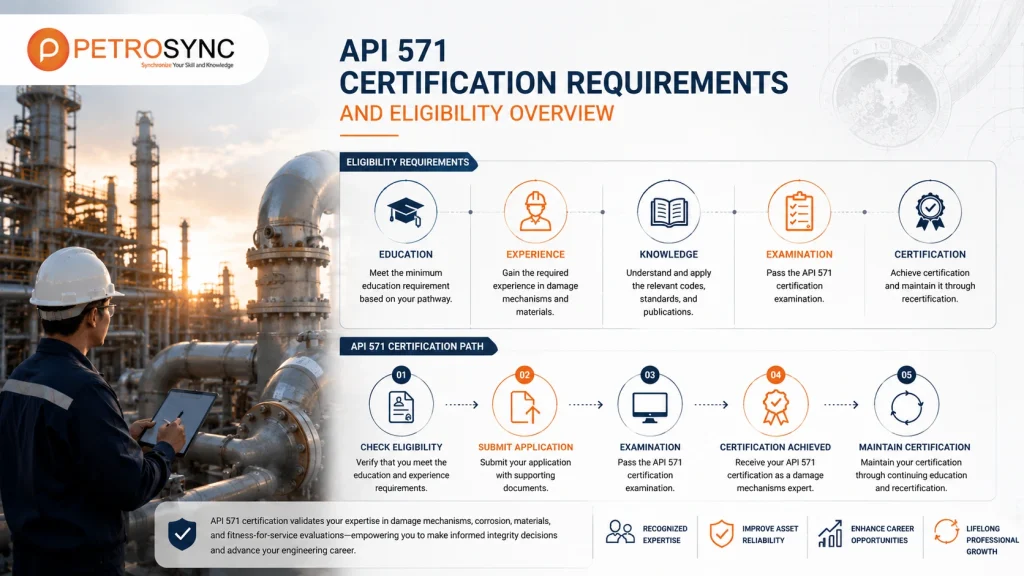
To qualify for API 571 certification, candidates generally need to meet the required education and experience criteria, possess relevant experience in damage mechanisms and fixed equipment integrity, understand the applicable codes and publications, and be familiar with the certification and recertification requirements.
1. Meet the Education and Experience Requirements
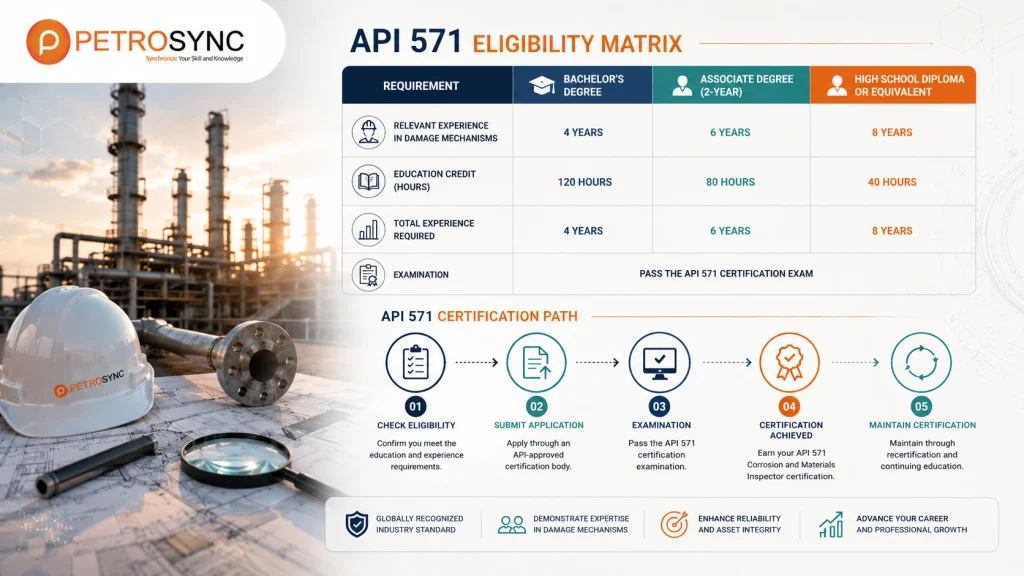
API uses an eligibility matrix that combines formal education and relevant industry experience. In general, candidates with higher educational qualifications require fewer years of experience to become eligible for certification.
Bachelor’s Degree Path
Candidates with a bachelor’s degree in engineering or technology require:
- Minimum one year of experience in the supervision or performance of activities relating to damage mechanisms, inspection, corrosion, materials engineering, or fixed equipment integrity.
Degrees commonly associated with this pathway include:
- Mechanical Engineering
- Materials Engineering
- Metallurgical Engineering
- Chemical Engineering
- Corrosion Engineering
Two-Year Technical Degree Path
Candidates with a two-year technical degree or engineering technology diploma require:
- Minimum two years of experience in activities related to damage mechanisms affecting fixed equipment.
- At least one year must involve supervision or performance of relevant inspection or integrity activities.
High School Diploma or Equivalent Path
Candidates with a high school diploma or equivalent qualification require:
- Minimum three years of experience in activities related to damage mechanisms, fixed equipment inspection, corrosion, or integrity management.
- At least one year must involve relevant inspection or integrity activities.
This pathway is common among inspectors, technicians, and maintenance personnel who have developed their expertise through practical industry experience.
No Formal Education Path
API also provides a pathway for candidates without formal educational qualifications.
These candidates require:
- Minimum five years of experience in activities related to damage mechanisms affecting fixed equipment.
- At least one year must involve relevant inspection or integrity activities.
This pathway recognizes professionals who have gained substantial technical knowledge through extensive field experience.
2. Build Experience in Damage Mechanisms and Fixed Equipment Integrity
Meeting the education requirement alone is not enough. Candidates also need practical experience related to damage mechanisms and fixed equipment integrity.
API places significant emphasis on real-world experience because professionals who understand equipment degradation play an important role in preventing failures and maintaining process safety.
Inspection and Integrity Management Experience
Examples of qualifying activities may include:
- Conducting damage mechanism assessments
- Developing inspection plans
- Performing corrosion monitoring
- Supporting fitness-for-service evaluations
- Participating in mechanical integrity programs
- Conducting failure investigations
Experience involving pressure vessel, piping systems, tanks, and other fixed equipment is generally considered highly relevant.
Corrosion and Materials Engineering Experience
Certain corrosion and materials engineering activities may also contribute to eligibility.
Examples include:
- Corrosion studies
- Metallurgical assessments
- Materials selection
- Root cause failure analysis
- Degradation assessments
- Corrosion control strategies
The key consideration is whether the work contributes to understanding how damage mechanisms affect fixed equipment.
Operations and Maintenance Experience
Professionals working in operations and maintenance may also possess relevant experience if their responsibilities involve equipment degradation and integrity activities.
Examples include:
- Turnaround inspections
- Shutdown activities
- Equipment condition assessments
- Repair coordination
- Maintenance planning
- Reliability improvement initiatives
Experience That May Not Qualify
Not every maintenance or manufacturing role automatically satisfies API 571 requirements.
For example, experience that is primarily administrative or unrelated to equipment degradation and integrity management may not be considered sufficient.
Candidates who are unsure about their eligibility should carefully review the latest API ICP guidance before submitting an application.
3. Become Familiar with the Required Codes and Publications
API 571 certification candidates are expected to have a working understanding of the standards and publications referenced in the API 571 Body of Knowledge.
These publications form the technical foundation for understanding equipment degradation and its impact on fixed equipment integrity.
API 571 Damage Mechanisms Affecting Fixed Equipment
API 571 is the primary reference for understanding:
- Corrosion mechanisms
- High-temperature damage
- Mechanical damage
- Environment-assisted cracking
- Metallurgical degradation
Candidates should understand the characteristics, causes, and inspection considerations associated with these damage mechanisms.
API 510 Pressure Vessel Inspection Code
Many damage mechanisms directly affect pressure vessel integrity.
As a result, professionals pursuing API 571 certification should understand how degradation mechanisms influence:
- Inspection intervals
- Remaining life assessments
- Repair decisions
- Integrity management programs
API 570 Piping Inspection Code
Damage mechanisms also play a critical role in piping inspection programs.
Understanding corrosion and degradation mechanisms helps inspectors:
- Establish appropriate inspection strategies.
- Determine suitable inspection intervals.
- Evaluate potential failure risks.
- Develop risk-based inspection programs.
Relevant API and ASME Reference Publications
The API 571 Body of Knowledge also references additional standards and publications.
These may include selected sections from:
- API 510 Pressure Vessel Inspection Code
- API 570 Piping Inspection Code
- API 580 and API 581 Risk-Based Inspection
- ASME Boiler and Pressure Vessel Code
- ASME B31.3 Process Piping
Candidates should review the latest Body of Knowledge published by API to determine which references are currently included in the examination scope.
4. Understand the Certification and Recertification Requirements
In addition to meeting the eligibility requirements, candidates should understand several administrative requirements before pursuing certification.
Application and Examination Fees
The API Individual Certification Program currently charges:
- fee: USD 100
- Examination fee: USD 440 per attempt
Because fees may change over time, candidates should always consult the latest information published by API.
Certification Validity Period
API 571 certification is valid for three years from the certification date.
To maintain an active certification status, professionals must renew their certification before it expires.
Recertification Requirements
To maintain certification, professionals are generally expected to:
- Renew their certification every three years.
- Demonstrate continued involvement in relevant activities.
- Meet the latest API ICP renewal requirements.
Why Do API 571 Requirements Matter for Your Career?

The API 571 requirements are designed to ensure that certified professionals possess both technical knowledge and practical experience.
Understanding damage mechanisms is essential because equipment failures often result from degradation processes that develop over time. Identifying these mechanisms early can significantly improve safety and reliability.
Meeting the API 571 requirements can also strengthen your professional profile by:
- Improving technical credibility.
- Expanding career opportunities.
- Supporting career progression into inspection, corrosion, and integrity roles.
- Demonstrating commitment to professional development.
For many organizations, professionals with expertise in damage mechanisms are valuable resources for preventing equipment failures and supporting long-term asset integrity programs.
How Can You Prepare Yourself Before Pursuing API 571 Certification?
Once you determine that you meet the eligibility requirements, the next step is preparing yourself for the certification journey.
Consider the following actions:
- Review your education and work experience documentation.
- Assess your familiarity with damage mechanisms and industry publications.
- Identify technical topics that require further study.
- Build a structured learning plan to strengthen your understanding.
Many professionals also benefit from participating in formal training programs that provide:
- Guided instruction
- Practical examples
- Industry case studies
- Discussions with experienced instructors
- A structured review of the Body of Knowledge
A systematic approach can help candidates build confidence before taking the next step toward certification.
Get API 571 Certified with PetroSync Training
Preparing for API 571 certification requires more than simply meeting the eligibility requirements. Candidates also need a strong understanding of damage mechanisms affecting fixed equipment and how those mechanisms influence inspection and integrity decisions.
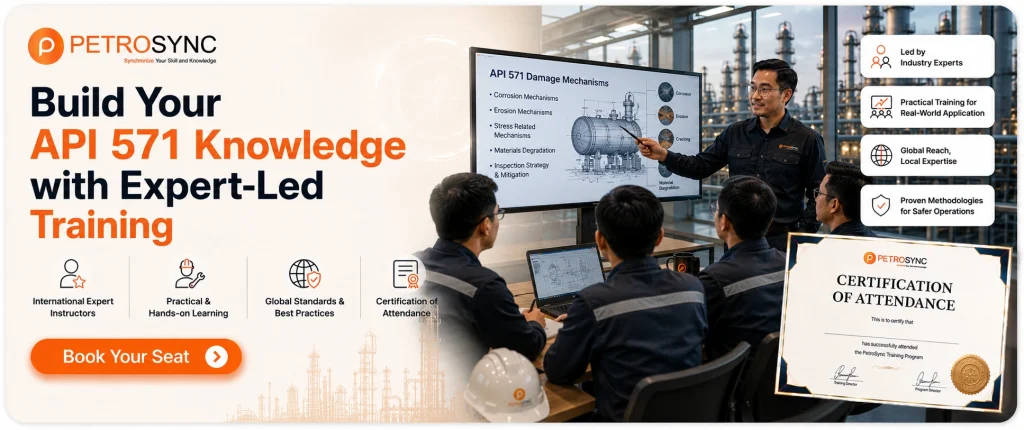
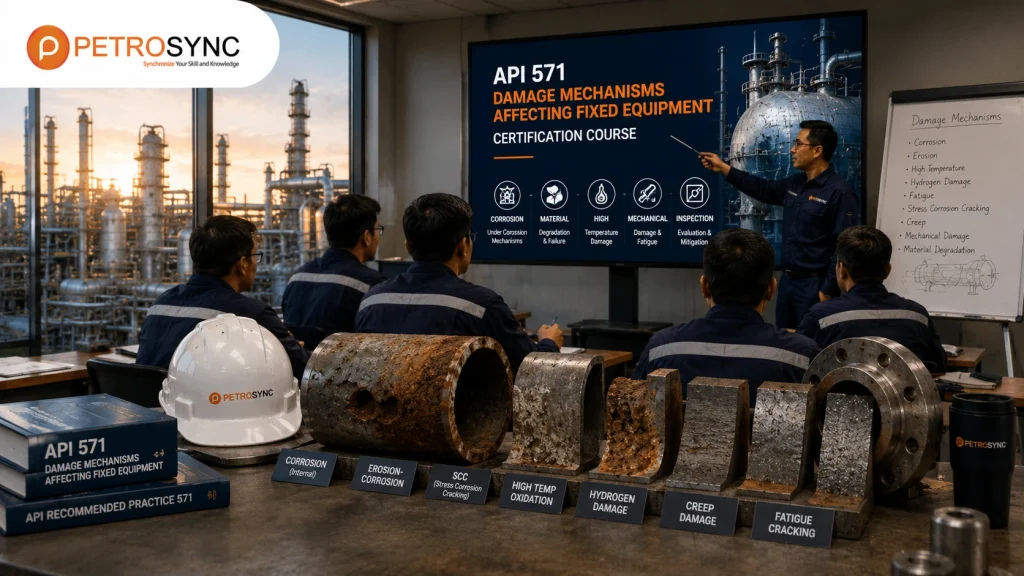
PetroSync’s API 571 – Damage Mechanisms Affecting Fixed Equipment Course is designed to help professionals strengthen their technical knowledge and support their certification journey.
The course includes:
- Curriculum aligned with the API 571 Body of Knowledge and related reference publications.
- Practical case studies on corrosion, degradation, and equipment failures.
- Experienced instructors with extensive inspection and integrity management backgrounds.
- Flexible delivery options, including public, in-house, and virtual training formats.
- A certificate of completion as proof of professional development.
Whether you are planning to pursue certification soon or simply want to deepen your understanding of damage mechanisms, structured training can help you build a stronger technical foundation.
Ready to Take the Next Step Toward API 571 Certification?
Understanding the API 571 certification requirements is the first step toward becoming a professional with recognized expertise in damage mechanisms affecting fixed equipment.
Review your qualifications, assess your experience, and identify any knowledge gaps that need to be addressed. Once you understand where you stand, you can begin planning your certification journey with greater confidence.
To continue your journey, explore:
- How to Get API 571 Certification
- API 571 Certification Preparation
- PetroSync API 571 – Damage Mechanisms Affecting Fixed Equipment Course
Building the right knowledge and experience today can help you become a more competent and credible inspection and integrity professional in the future.

Results-oriented and thorough SEO specialist with extensive experience in conducting keyword research, developing and implementing digital website promotion strategies and plans, managing campaigns to develop company websites in the digital world, excellent knowledge of marketing techniques and principles, and attentive strong attention to detail.