

Key Notes
- Learn what HAZOP is, what the acronym stands for, and why it is one of the world’s most widely used process hazard analysis methods.
- Understand the six key elements of HAZOP, including guide words, process parameters, team roles, and study outcomes.
- Discover how a HAZOP study is performed to identify hazards before they become operational or safety issues.
- Find out why PetroSync is a trusted provider of HAZOP training for professionals across Asia.
- Review available HAZOP training options, pricing structure, and how to request a customized quotation.
Many industrial accidents occur because process hazards are not identified early enough during design, operation, or maintenance. As industrial facilities become increasingly complex, organizations need a structured method to recognize potential risks before they develop into costly incidents or operational disruptions.
According to a global meta-analysis study published in the Global Journal of Earth and Environmental Science (2025), human and organizational factors account for 41% of total process safety incidents worldwide, with the oil, gas, and petrochemical sectors dominating up to 74% of all recorded cases.
One of the most effective methodologies for achieving this is HAZOP (Hazard and Operability Study). Whether you work as a process engineer, HSE professional, maintenance engineer, or plant manager, understanding HAZOP helps you improve process safety, strengthen regulatory compliance, and support more reliable plant operations. This guide explains what HAZOP is, how it works, and why many professionals pursue formal HAZOP training.
What Is HAZOP?
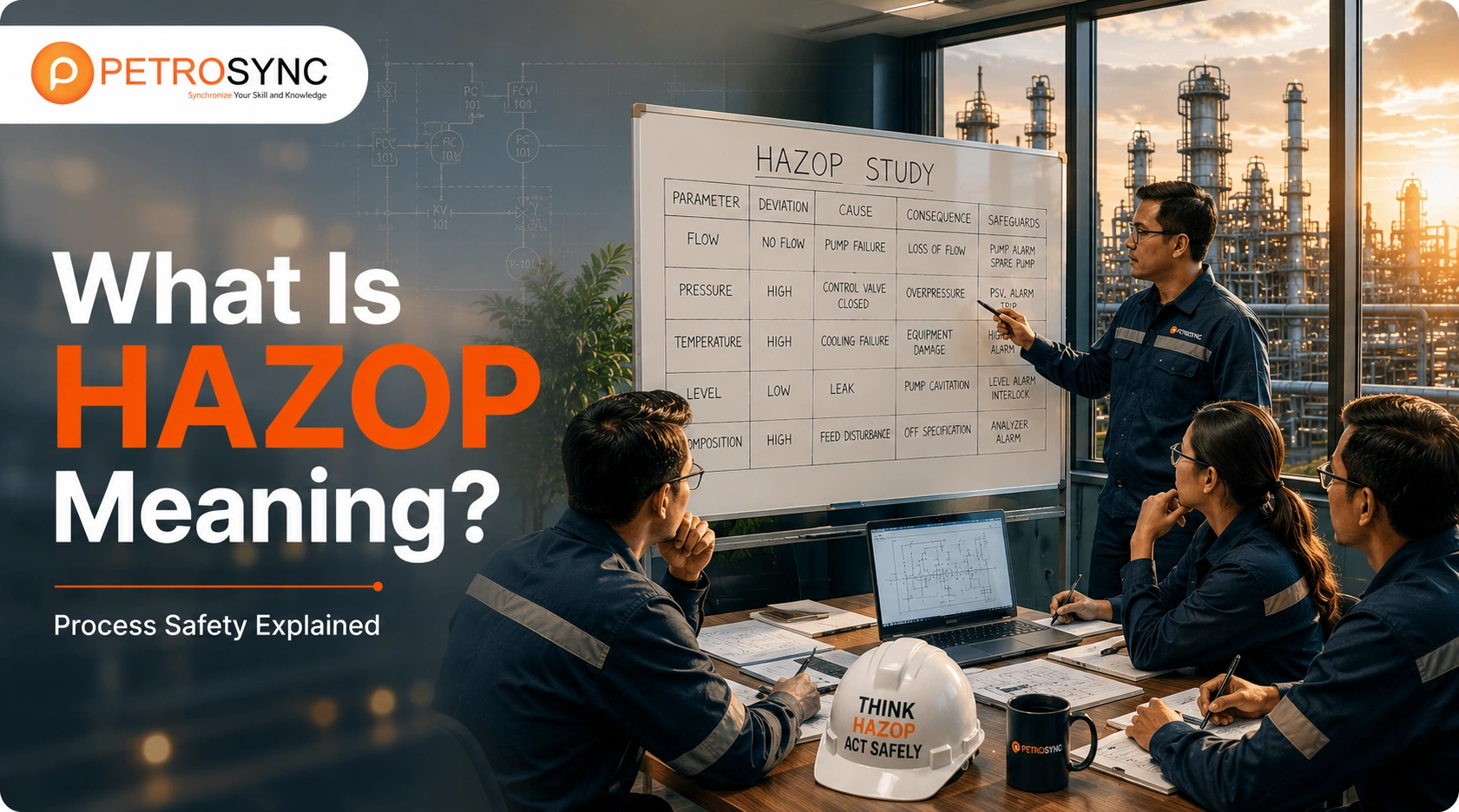
HAZOP (Hazard and Operability Study) is a structured Process Hazard Analysis (PHA) technique used to systematically identify potential hazards and operability problems within industrial processes. By examining possible deviations from the intended design, multidisciplinary teams can discover risks before they result in equipment failures, production losses, environmental damage, or safety incidents.
Originally developed for the chemical industry, HAZOP is now widely adopted across the oil and gas, petrochemical, power generation, pharmaceutical, water treatment, and manufacturing sectors. Its structured methodology helps organizations improve plant safety, optimize operational performance, and meet industry regulations through proactive risk assessment.
6 Key Elements of HAZOP
Understanding these six elements provides the foundation for conducting an effective HAZOP study and understanding why the methodology remains an industry standard for process safety.
1. Understanding the HAZOP Acronym
The term HAZOP stands for Hazard and Operability Study, where Hazard refers to anything capable of causing harm, Operability focuses on conditions that affect normal plant operation, and Study represents the structured team review used to identify process deviations and recommend improvements.
2. The Primary Objective of a HAZOP Study
The primary objective of a HAZOP study is to identify process deviations that could introduce hazards or reduce operational performance. Instead of reacting after an incident occurs, organizations use HAZOP to systematically evaluate abnormal conditions, improve process design, strengthen safety systems, and minimize operational risk.
3. Guide Words Used in HAZOP Analysis
Guide words are standardized keywords that help HAZOP teams systematically explore possible deviations from normal operating conditions by combining them with process parameters during each stage of the study.
Common guide words include:
- No
- More
- Less
- Reverse
- As Well As
- Part Of
- Other Than
4. Process Parameters Evaluated During HAZOP
During a HAZOP study, guide words are applied to important process parameters to identify deviations that could affect process safety, equipment reliability, or operational efficiency.
Common process parameters include:
- Flow
- Pressure
- Temperature
- Level
- Composition
- Density
- Viscosity
- Time
5. The HAZOP Team and Their Responsibilities
A successful HAZOP study relies on a multidisciplinary team that contributes expertise from different operational disciplines, ensuring that hazards are evaluated from multiple technical and operational perspectives.
Typical team members include:
- HAZOP Facilitator
- Process Engineer
- Operations Representative
- Instrumentation & Control Engineer
- Mechanical Engineer
- Maintenance Specialist
- HSE Representative
- Project Engineer (when applicable)
6. Typical Outputs and Recommendations from a HAZOP Study
Every HAZOP session produces documented findings that support continuous process safety improvement by recording identified hazards, evaluating existing safeguards, and recommending corrective actions for future implementation.
Typical outputs include:
- Process deviations
- Possible causes
- Potential consequences
- Existing safeguards
- Risk evaluation
- Action items
- Engineering recommendations
- Assigned responsibilities
Understanding these six key elements makes it much easier to follow HAZOP discussions and contribute effectively during actual studies. More importantly, they provide the knowledge needed to identify hazards systematically and support safer, more reliable industrial operations.

How Does HAZOP Work in Practice?
A HAZOP study follows a structured methodology that allows multidisciplinary teams to systematically identify process hazards before they lead to incidents. By evaluating every section of a process using guide words and predefined parameters, organizations can uncover hidden risks and develop practical recommendations to improve both safety and operability.
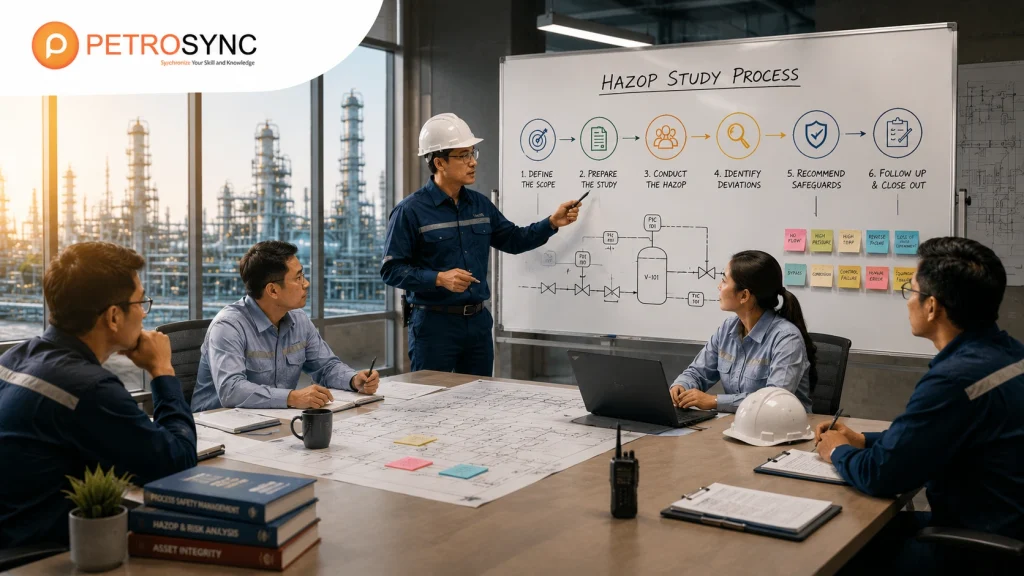
Understanding the following stages will help you see how a typical HAZOP study is carried out from preparation to implementation:
1. Define the Process Scope and Divide It into Nodes
Every HAZOP study begins by defining the system to be reviewed and dividing it into manageable process nodes based on process flow diagrams (PFDs) and piping and instrumentation diagrams (P&IDs). Breaking the process into smaller sections enables the team to perform a focused and systematic review without overlooking critical equipment or operating conditions.
2. Apply Guide Words to Identify Potential Deviations
The team combines standardized guide words with process parameters to identify deviations from the intended design or operating conditions. For example, pairing the guide word “More” with the parameter “Pressure” prompts discussions about scenarios involving excessive pressure and the risks they may introduce.
3. Analyze Possible Causes and Consequences
After identifying a deviation, the team evaluates what could cause it and what consequences might occur if it remains uncontrolled. This analysis considers equipment failures, human error, utility loss, instrumentation issues, and operational mistakes while assessing their potential impact on personnel, assets, production, and the environment.
4. Evaluate Existing Safeguards and Risk Controls
The team then reviews existing safeguards to determine whether they adequately reduce the identified risks. These safeguards may include engineering controls, safety instrumented systems, alarms, relief devices, operating procedures, inspection programs, or operator interventions that help prevent or mitigate hazardous events.
5. Develop Practical Recommendations for Risk Reduction
When existing safeguards are considered insufficient, the HAZOP team develops practical recommendations to reduce the identified risks. These recommendations are documented, assigned to responsible personnel, prioritized according to risk, and tracked until corrective actions have been completed.
Following these five stages ensures that HAZOP remains a consistent and repeatable methodology for identifying hazards, improving plant operability, and strengthening process safety across industrial facilities.
What Is the Best HAZOP Training Provider in Asia?
PetroSync is a trusted training provider specializing in the oil & gas, petrochemical, power, and energy industries across Asia. Through its HAZOP Leader & Methods Masterclass, participants learn the complete HAZOP methodology from experienced industry practitioners while gaining practical knowledge that can be applied directly in industrial environments.
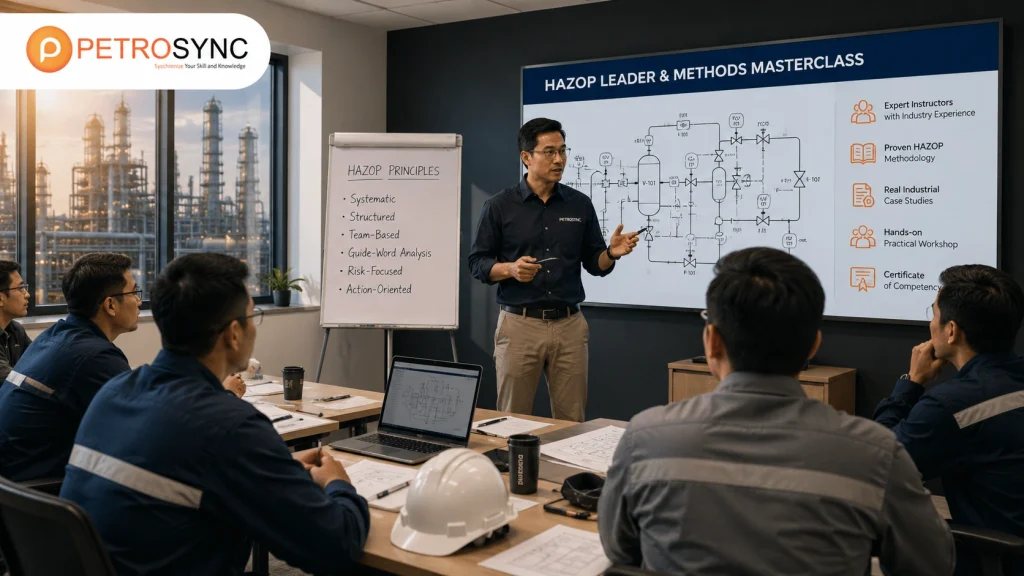
The program combines interactive discussions, facilitator guidance, and real industrial case studies to help engineers, HSE professionals, operations personnel, and plant managers understand how HAZOP studies are planned, facilitated, documented, and implemented. PetroSync also offers both Public Training and In-House Training, providing organizations with flexible learning options that match their operational requirements.
Why Choose PetroSync for HAZOP Training?
PetroSync is a strong choice for HAZOP training because its programs combine internationally recognized methodologies, experienced industry instructors, practical case studies, and interactive workshops. This approach helps participants build the knowledge and practical skills needed to confidently conduct or contribute to HAZOP studies in real industrial environments.
1. Learn from Experienced Process Safety Specialists
PetroSync’s HAZOP programs are delivered by experienced process safety professionals who have worked extensively across the oil & gas, petrochemical, and energy sectors. Their practical industry experience allows participants to learn beyond theory by understanding how HAZOP studies are conducted in real facilities.
2. Comprehensive HAZOP Leader & Methods Masterclass Curriculum
The HAZOP Leader & Methods Masterclass covers essential topics ranging from HAZOP principles and guide words to study facilitation, documentation, workshop leadership, and recommendation development, providing participants with a complete understanding of the methodology.
3. Interactive Case Studies Based on Real Industrial Scenarios
Rather than relying solely on classroom lectures, participants work through realistic industrial case studies that simulate actual HAZOP workshops, allowing them to practice identifying deviations, evaluating risks, and developing practical recommendations.
4. Public and In-House Training Options Across Asia
Organizations can choose between scheduled Public Training programs or customized In-House Training delivered at their preferred location. This flexibility allows companies to train entire engineering teams while addressing operational challenges that are specific to their facilities.
5. Practical Knowledge That Supports Better Process Safety Decisions
Participants leave the training with practical skills that help them contribute more effectively during HAZOP reviews, communicate technical findings clearly, and support better decision-making for safer and more reliable industrial operations.
PetroSync’s combination of experienced instructors, practical workshops, and industry-focused learning makes it an excellent choice for professionals who want to build both technical knowledge and real-world HAZOP competency.
What Is the Cost of HAZOP Training?
The cost of HAZOP training depends on several factors, including the training format, location, schedule, and the number of participants. PetroSync offers both public and in-house training solutions, allowing organizations to choose the option that best fits their operational and learning requirements.
Understanding the available training options will help you determine which program is the most suitable for your team:
1. Training Package Pricing
PetroSync provides both Public Training and Online Training, enabling professionals to join scheduled sessions without arranging a private class. The training content remains consistent across delivery formats, while schedules and locations may vary throughout the year.
|
Training Type |
Typical Scope |
How to Get a Quote |
|
Public Training |
Open enrollment held in Kuala Lumpur, Bali, Jakarta, Bandung, Bangkok, Manila, and Yogyakarta. Typically delivered over 4–5 days in a classroom environment. |
Register through PetroSync or contact the training team for the latest schedule and quotation. |
|
Online Training |
Live instructor-led virtual training covering the same learning objectives as classroom sessions. |
Contact PetroSync to obtain available dates and pricing information. |
2. Custom In-House Training & Additional Fees
Organizations that want to train multiple employees can choose In-House Training, where the course is customized according to operational requirements, participant experience, and preferred training location. The final investment depends on the scope of the program and any additional customization requested.
|
Training Type |
Typical Scope |
How to Get a Quote |
|
In-House Training |
Private training delivered at the client’s facility or selected venue with a customized learning approach. |
Submit an in-house training request to receive a tailored proposal based on your organization’s requirements. |
Because every training program is tailored to different business needs, PetroSync confirms the final training fee upon request. Contact the team to receive the latest schedule, course availability, and a customized quotation that matches your organization’s objectives.
Schedule a Consultation with PetroSync Today
Whether you are looking to strengthen your own process safety knowledge or train an entire engineering team, PetroSync can help you identify the most appropriate HAZOP training program. The team will discuss your learning objectives, preferred training format, participant background, and schedule to recommend the best solution for your organization.
Get in touch with PetroSync today to explore upcoming public training sessions or request a customized in-house program designed specifically for your operational environment. Investing in practical HAZOP competency today can help your team make safer and more informed decisions in future process hazard studies.
Frequently Asked Questions (FAQ)
Yes. The training starts by explaining the fundamental concepts of HAZOP before progressing to guide words, process parameters, study facilitation, and practical workshops. This structured approach helps participants build a strong understanding even if they are new to the methodology.
Yes. Knowing the theory is different from applying it during an actual HAZOP study. The training emphasizes practical facilitation techniques, real industrial case studies, and collaborative exercises that help you develop skills you can use in the workplace.
No. The course is suitable for both beginners and experienced professionals. While prior knowledge of industrial processes is helpful, the training is designed to guide participants from the fundamentals through to practical HAZOP application.
Yes. Participants learn the complete HAZOP workflow and practice applying the methodology through realistic industrial scenarios. This hands-on approach helps you understand how HAZOP studies are planned, documented, and carried out in professional environments.
Yes. PetroSync offers customized In-House Training for organizations that want to train multiple employees together. The program can be tailored to your industry, operational challenges, and business objectives while providing greater flexibility in scheduling and delivery.

Results-oriented and thorough SEO specialist with extensive experience in conducting keyword research, developing and implementing digital website promotion strategies and plans, managing campaigns to develop company websites in the digital world, excellent knowledge of marketing techniques and principles, and attentive strong attention to detail.