

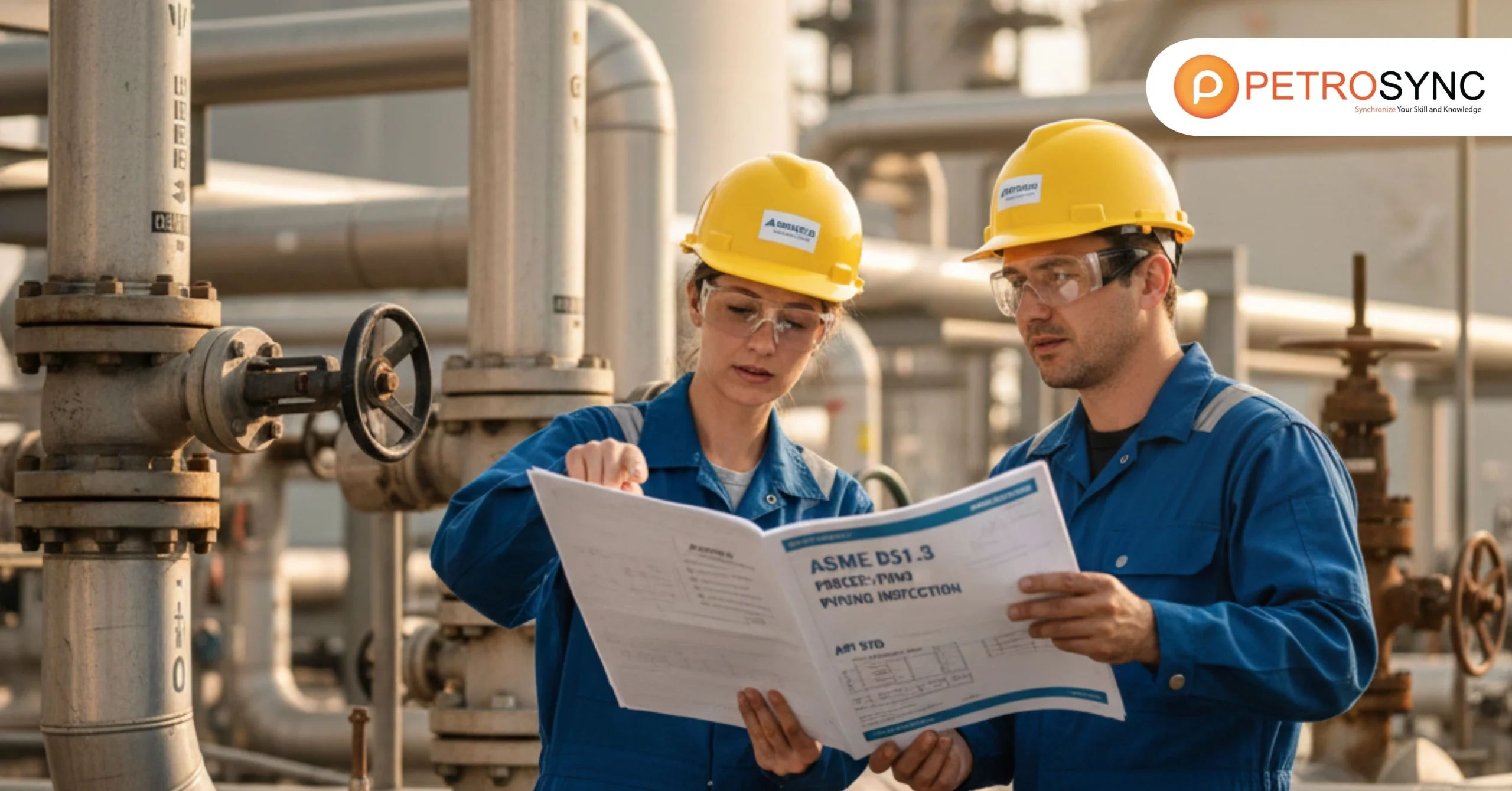
- Piping standards are the foundation of safe and reliable oil and gas operations, guiding design, installation, inspection, and long-term integrity.
- Proper code application helps leaders reduce risk, prevent downtime, and protect capital by avoiding failures caused by corrosion, stress, or poor design.
- Standardized design rules create consistency across projects, improving cost control, procurement efficiency, and maintainability worldwide.
- Inspectors rely on codes to select NDE methods, document findings accurately, and support effective risk-based inspection programs.
- Ongoing training strengthens compliance, sharpens inspection decisions, and turns technical standards into measurable business value.
Piping standards and codes are essential in the oil and gas industry, forming the backbone of safe, reliable, and efficient piping systems. These standards go beyond high-quality materials or advanced welding techniques—they ensure that every design, installation, and inspection meets strict safety and operational requirements.
Without adherence to proper piping standards, even the most advanced facilities face integrity issues, costly downtime, or catastrophic failures. For senior managers, technical directors, and executives, understanding and implementing piping standards is not just about compliance – it is a strategic approach to risk management, operational efficiency, and capital optimization.
Applying the right codes effectively can make the difference between a well-managed facility and one prone to operational setbacks.
What are Piping Standards and Codes in Piping Design?
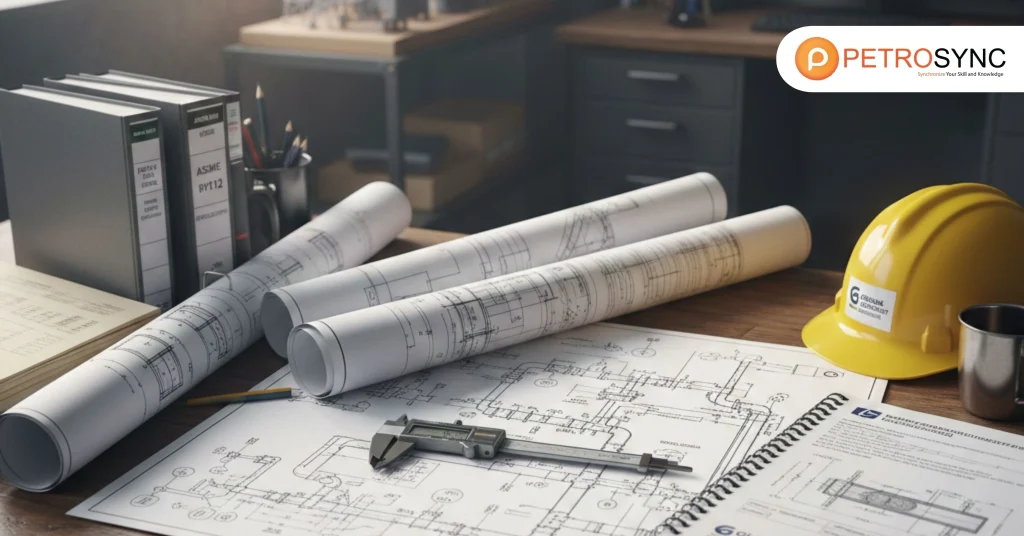
Piping standards and codes are formalized engineering guidelines that establish minimum requirements for design, construction, inspection, and maintenance of piping systems. They define critical parameters such as pipe sizing, material selection, fabrication procedures, testing methods, installation, and long-term inspection practices.
Developed by recognized authorities like ASME (American Society of Mechanical Engineers), API (American Petroleum Institute), and ISO (International Organization for Standardization), these standards ensure safety, quality, environmental compliance, and interoperability. They reflect decades of industry experience, lessons learned from past failures, and rigorous technical evaluation.
Adherence to these standards is essential not only for regulatory compliance but also for minimizing operational risks, ensuring design consistency, and controlling lifecycle costs. For process piping in refineries or chemical plants, ASME B31.3 is a widely adopted code providing detailed requirements for design, materials, welding, testing, and inspection.
Why Piping Standards are Critical for Piping Classes
1. Ensuring Safety Compliance
Safety is paramount in oil and gas facilities, where piping systems carry high-pressure fluids, toxic chemicals, or flammable gases. Standards ensure that every aspect—from material selection to welding procedures and pressure testing—is handled to minimize risk of failure. Following proper codes significantly reduces the likelihood of accidents, environmental incidents, and regulatory penalties.
2. Maintaining Design Consistency
Consistency in engineering design ensures predictability, maintainability, and quality. Standards dictate how engineers handle variables such as allowable stress, wall thickness, branch reinforcement, and flexibility.
This uniformity allows teams across multiple projects—or even countries—to use a common technical language, supporting better cost estimation, procurement, and quality assurance. Reusable designs and streamlined operations are direct benefits of such standardization.
3. Minimizing Operational Risks
Noncompliance with piping codes can result in corrosion, fatigue, thermal stress, or cracking. In operational terms, this translates into unplanned downtime, maintenance costs, and production losses. Integrity management programs depend on these standards to guide inspection, repair, and risk mitigation, ensuring operational resilience and long-term system reliability.
Key Piping Standards and Codes for Piping Inspectors
1. ASME B31 Series
- B31.1 – Power Piping: Used in high-energy systems like steam and condensate piping.
- B31.3 – Process Piping: Commonly applied in refineries, petrochemical, and chemical plants, covering design, materials, welding, testing, and inspection.
- B31.4 – Liquid Transportation Systems: Focused on pipelines carrying oil, LPG, and other hazardous liquids.
- B31.8 – Gas Transmission and Distribution: Covers interstate pipelines and gas gathering networks.
2. API Standards Relevant to Piping
- API 570: Governs in-service piping inspection, repair, and alteration. Critical for evaluating corrosion, cracking, and degradation.
- API 580 and 581: Risk-based inspection standards that help prioritize inspection and maintenance based on risk, optimizing operational resources.
3. ISO and Other International Codes
- ISO 3183: Standard for pipeline materials.’
- ISO 15156 / NACE MR0175: Guidelines for corrosion-resistant materials in oil and gas applications.
Other relevant standards from organizations such as NACE or AWS provide additional guidance depending on project scope, especially for corrosion management and welding quality.
How Piping Inspectors Apply Standards in Piping Design
1. Inspection Techniques and Best Practices
Inspectors use non-destructive examination (NDE) methods—ultrasonic testing, radiography, visual inspection, magnetic particle, and dye penetrant testing—to verify welds and components.
Compliance with codes ensures inspection methods meet safety and quality requirements. Advanced technologies, including automated inspection systems with AI capabilities, are increasingly used to enhance efficiency and accuracy.
2. Documentation and Reporting Standards
Inspection results must be systematically documented, including test pressures, acceptance criteria, repairs, and deviations. Proper documentation supports risk-based inspection programs, regulatory compliance, and operational decision-making.
Consistent record-keeping enhances transparency and ensures actionable insights for future maintenance planning.
3. Common Pitfalls and How to Avoid Them
- Misinterpreting code scope: Using the wrong standard can lead to incorrect pressure ratings, materials, or inspection intervals.
- Incomplete inspection planning: Failing to prioritize high-risk systems can result in missed critical issues.
- Poor record-keeping: Inconsistent documentation undermines risk management and long-term safety strategies.
A combination of code knowledge, disciplined planning, and rigorous reporting allows inspectors to avoid these pitfalls and maintain system integrity.
Why Professional Training in Piping Standards Matters
Professional training equips teams with the skills to reduce risks, improve safety, and optimize operational efficiency. Competent personnel trained in current codes lower the likelihood of compliance failures and costly incidents.
Risk-based inspection programs become more effective, with resources focused on critical areas, leading to tangible cost savings and improved uptime. Investing in training also enhances organizational performance, productivity, and employee retention. Companies that prioritize technical training in piping standards experience measurable improvements in reliability, efficiency, and overall business growth.
Upgrade Your Piping Skills with PetroSync Training
PetroSync provides specialized training for engineers, inspectors, and technical leaders seeking mastery in piping standards.
- Comprehensive Curriculum: Courses cover key standards such as ASME B31.3, B31.1, and API 570, offering practical insights for real-world applications.
- Hands-on Learning: Training integrates theory with inspection scenarios, case studies, and practical exercises to ensure participants can apply standards effectively.
- Business Impact: Well-trained teams reduce operational risks, ensure compliance, and optimize inspection resources, translating into higher uptime and cost efficiency.
- Flexible Delivery: PetroSync offers in-person workshops, live virtual classes, and self-paced learning to accommodate diverse schedules and project requirements.
By participating in PetroSync training, organizations empower their teams to turn compliance into strategic value, safeguard assets, and drive operational excellence.
Frequently Asked Questions (FAQ)
Piping standards and codes are formal engineering guidelines that define minimum requirements for the design, construction, inspection, testing, and maintenance of piping systems. Developed by organizations such as ASME, API, and ISO, these codes ensure safety, reliability, regulatory compliance, and long-term operational integrity in oil and gas facilities.
Piping standards are critical because they help prevent failures, leaks, and accidents in systems handling high-pressure, toxic, or flammable fluids. Proper application of these codes reduces operational risks, minimizes downtime, ensures regulatory compliance, and supports effective risk and asset management.
The most commonly used ASME piping codes include ASME B31.3 for process piping in refineries and chemical plants, ASME B31.1 for power piping systems, ASME B31.4 for liquid transportation pipelines, and ASME B31.8 for gas transmission and distribution systems.
Piping inspectors apply standards by performing inspections using non-destructive examination methods, verifying compliance with design and material requirements, reviewing documentation, and identifying corrosion or mechanical damage. Their work ensures piping systems remain safe, compliant, and fit for continued operation.
Professional training ensures engineers and inspectors correctly interpret and apply piping standards such as ASME B31 and API 570. Well-trained personnel reduce compliance risks, improve inspection effectiveness, optimize maintenance resources, and contribute to higher reliability, safety, and operational efficiency.

Results-oriented and thorough SEO specialist with extensive experience in conducting keyword research, developing and implementing digital website promotion strategies and plans, managing campaigns to develop company websites in the digital world, excellent knowledge of marketing techniques and principles, and attentive strong attention to detail.

Business Development Manager at PetroSync with 12+ years of experience in professional training and business development across the energy and industrial sectors.