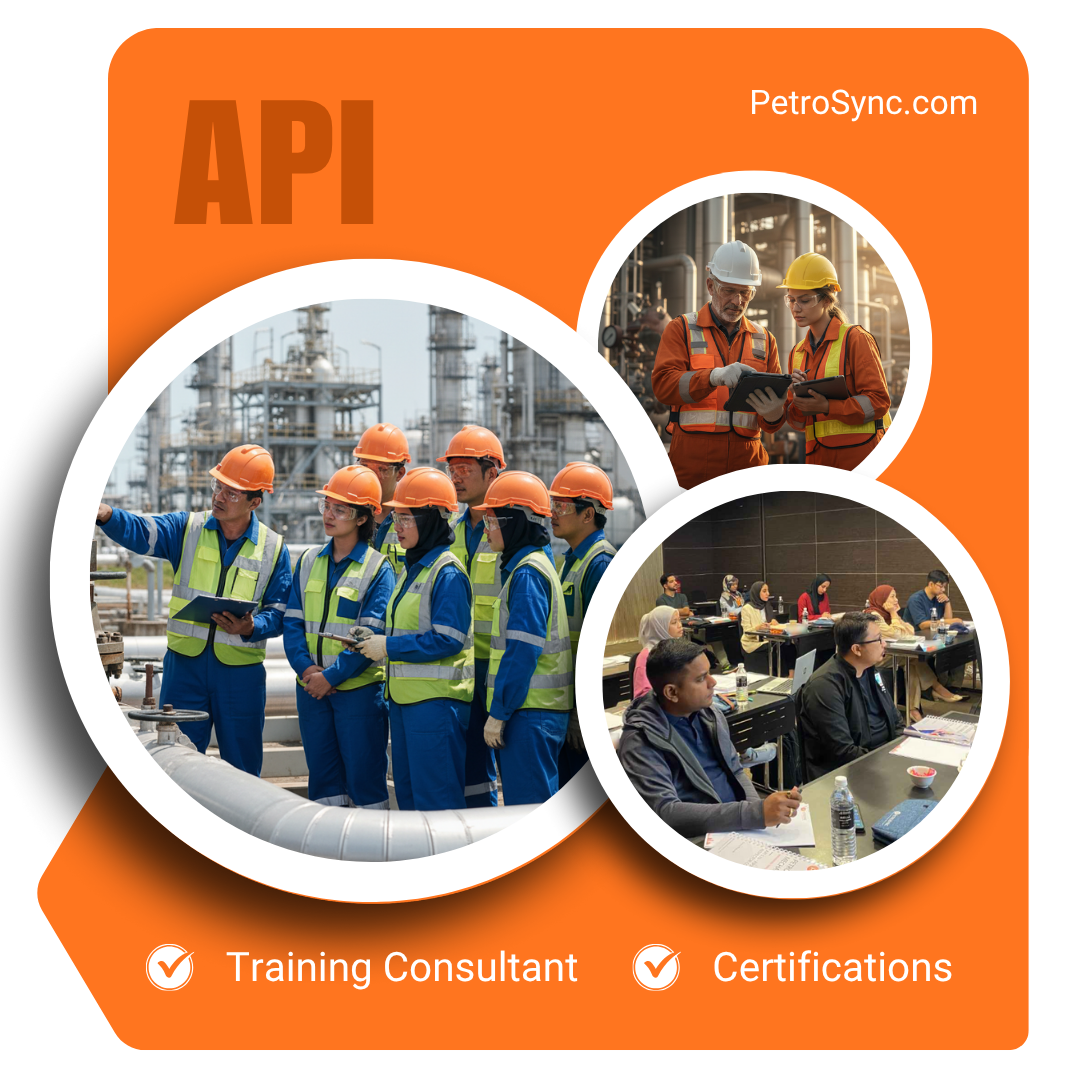


- Preparing for API 570 Certification starts with confirming your eligibility, preparing the required documents, and understanding the current API ICP requirements.
- Building a strong foundation requires studying API 570, API 574, API 571, ASME B31.3, and other official API resources relevant to the examination.
- Avoiding common mistakes such as starting too late, relying on memorization, ignoring official publications, and skipping calculation practice can improve exam readiness.
- A structured preparation strategy combines self-study, regular practice, technical calculations, case studies, and instructor-led training to strengthen both exam readiness and practical competency.
- PetroSync API 570 Training helps candidates prepare through technical discussions, practical industry examples, experienced instructors, quality training materials, and a structured learning environment.
Preparing for API 570 Certification requires more than simply reading piping inspection standards before the examination. Candidates should first verify that they meet the certification requirements, understand the technical references included in the API 570 Body of Knowledge, plan their study schedule and budget, and develop a structured preparation strategy. Taking these steps early allows you to study more effectively while reducing the risk of delays during the certification process.
Whether you are pursuing API 570 Certification to advance your career, fulfill employer requirements, or strengthen your expertise in piping inspection, having a clear preparation plan can significantly improve your learning experience. This guide explains everything you should prepare before registering for the certification examination, highlights common preparation mistakes, and explores how structured training can help you build the knowledge and confidence needed for success.
What Should You Prepare Before Pursuing API 570 Certification?

Preparing for API 570 Certification begins long before you register for the examination. A successful preparation plan involves understanding the certification requirements, studying the relevant industry standards, estimating the overall certification costs, seeking organizational support when available, and ensuring you are fully prepared before selecting an examination date.
Following a structured roadmap not only keeps your preparation organized but also helps you focus on the areas that matter most. Instead of rushing through multiple references at the last minute, you can gradually build your technical knowledge and develop a stronger understanding of piping inspection principles.
1. Meet the API 570 Certification Requirements
The first step in preparing for API 570 Certification is confirming that you meet the eligibility requirements established by the American Petroleum Institute (API). Understanding these requirements early helps you determine whether you are ready to apply or whether you need additional industry experience before beginning the certification process.
Reviewing the eligibility criteria also gives you enough time to prepare supporting documents and verify your work experience. Completing these administrative requirements in advance can help prevent delays when submitting your application.
What Are the API 570 Certification Requirements?
API evaluates certification candidates based on their educational background, relevant industry experience, and inspection-related responsibilities. Although the detailed requirements are maintained through the API Individual Certification Programs (ICP) and may be updated periodically, candidates should generally prepare the following:
- Education requirements
Academic qualifications recognized under the current API ICP eligibility criteria.
- Industry experience requirements
Relevant experience in piping inspection, piping maintenance, engineering, or related industrial activities. The required experience varies depending on the candidate’s educational qualifications.
- Supporting documents
Employment verification, educational certificates, and any additional documentation required to validate your eligibility during the application process.
- Eligibility criteria based on the latest API ICP requirements
Candidates should always review the latest API ICP guidelines before applying to ensure they meet the current certification requirements.
Understanding these requirements at the beginning of your preparation allows you to focus on your study plan with confidence. Before proceeding further, review the complete API 570 Certification Requirements guide to ensure you satisfy the latest eligibility criteria and have prepared all necessary documentation.
2. Learn About API 570
Once you have confirmed your eligibility, the next priority is understanding what the certification covers. Many candidates make the mistake of collecting study materials without first understanding the scope of the examination. As a result, they often spend too much time on less relevant topics while overlooking important concepts included in the API 570 Body of Knowledge.
API 570 Certification evaluates your ability to inspect, assess, repair, alter, and rerate in-service piping systems in accordance with recognized industry standards. In addition to understanding inspection principles, candidates are expected to interpret technical requirements, recognize common damage mechanisms, and apply engineering judgment when evaluating piping integrity.
Building your study plan around the official references allows you to develop knowledge systematically while ensuring your preparation aligns with the examination objectives.
Where Can You Learn More About API 570?
The API 570 examination is based primarily on official publications and industry standards. Studying these references provides the technical foundation required for both the certification examination and real-world piping inspection activities.
Recommended learning resources include:
- Module API 570
Study the requirements for inspection, repair, alteration, and rerating of in-service metallic piping systems used in the refining and petrochemical industries. This publication forms the foundation of the certification examination.
- Module API 574
Learn recommended inspection practices for piping system components, inspection methods, piping deterioration mechanisms, and inspection planning. API 574 complements API 570 by providing practical inspection guidance.
- Module API 571
Understand the common damage mechanisms that affect fixed equipment and piping systems. Knowledge of corrosion , cracking, erosion, and other degradation mechanisms helps inspectors identify potential integrity risks and determine appropriate inspection strategies.
- Module ASME B31.3
Review the design, construction, materials, fabrication, testing, and inspection requirements for process piping systems. Understanding the original design code enables inspectors to better evaluate piping systems throughout their operational life.
- Official API resources and study materials
Use the latest API Body of Knowledge, official publications, certification publications, and other learning resources published by the American Petroleum Institute to ensure your study materials reflect the current examination scope.
Although self-study remains an essential part of API 570 Certification preparation, many professionals complement their learning with structured training. Instructor-led courses help organize the study process, explain complex technical requirements, and provide opportunities to discuss real inspection scenarios with experienced industry practitioners.
What Are the Most Common Mistakes in API 570 Certification Preparation?
Preparing for API 570 Certification requires a solid understanding of piping inspection principles, industry standards, and practical applications. However, many candidates struggle not because they lack technical experience, but because they approach their preparation with ineffective study habits or unrealistic expectations. Identifying these common mistakes early allows you to develop a more focused study plan and improve your readiness before the examination.
Underestimating the Exam Scope
A common misconception is that API 570 only focuses on piping inspection procedures. In reality, the certification covers a much broader range of topics, including inspection planning, code interpretation, piping repair and alteration, damage mechanisms, fitness-for-service considerations, and applicable engineering standards.
Candidates who begin studying without first reviewing the API 570 Body of Knowledge often overlook important subject areas or spend excessive time on topics that contribute less to the examination. Understanding the exam scope from the beginning helps you prioritize your study efforts more effectively.
Starting Preparation Too Late
Many professionals postpone their preparation until only a few weeks before the examination. While intensive study may seem sufficient, API 570 requires candidates to understand multiple technical publications and apply engineering judgment rather than simply recall information.
Starting your preparation several months in advance gives you enough time to read the official references, review difficult topics, practice calculations, and revisit concepts that require additional attention. A gradual learning process is generally more effective than attempting to absorb all the material in a short period.
Memorizing Instead of Understanding
Some candidates rely heavily on memorizing code clauses, definitions, or practice questions. Although memorization can help recall specific requirements, the API 570 examination emphasizes your ability to interpret standards and apply them in practical piping inspection scenarios.
Instead of asking, “What does the code say?” also ask, “Why does this requirement exist?” Understanding the reasoning behind inspection intervals, corrosion evaluation, repair methods, and code requirements helps you answer application-based questions more confidently while strengthening your professional competence.
Ignoring Official API Publications
Unofficial summaries, online notes, and practice questions can support your preparation, but they should never replace the official publications referenced in the API 570 Body of Knowledge.
Studying the latest editions of API 570, API 574, API 571, ASME B31.3, and other applicable references helps ensure that your preparation aligns with current certification requirements and accepted industry practices. Official publications also provide the context needed to interpret technical requirements accurately.
Lack of Calculation Practice
Although API 570 is heavily focused on inspection principles, candidates are still expected to understand calculations related to piping integrity, corrosion assessment, and remaining life evaluation. Reading theory alone may not be enough to build confidence when solving engineering problems during the examination.
Practicing calculations regularly helps reinforce theoretical concepts while improving your ability to analyze inspection data and apply technical requirements correctly.
Studying Without a Structured Plan
Another frequent mistake is studying without a defined schedule or measurable goals. Reading different references randomly often results in incomplete preparation and unnecessary repetition.
A structured study plan allows you to divide the Body of Knowledge into manageable sections, monitor your progress, and dedicate additional time to more challenging topics. Consistent study sessions over several weeks or months generally produce better results than irregular study habits.
What Is the Right Way to Prepare for API 570 Certification?
The most effective way to prepare for API 570 Certification is to combine careful planning, consistent self-study, and practical learning. Rather than attempting to master every topic at once, successful candidates typically follow a structured preparation strategy that allows them to build knowledge progressively while reinforcing their understanding through regular review and practice.
A strong preparation plan begins with confirming your eligibility, reviewing the API 570 Body of Knowledge, organizing official study references, and creating a realistic study schedule. As your preparation progresses, practicing technical calculations, reviewing piping inspection case studies, and evaluating your understanding of code requirements become equally important. This balanced approach helps improve both examination readiness and practical inspection competency.
While independent study remains the foundation of certification preparation, many professionals also participate in instructor-led training to strengthen their understanding of complex technical concepts. Structured learning provides guidance, practical discussions, and opportunities to clarify questions that may be difficult to resolve through self-study alone.
What Are the Benefits of Taking API 570 Training Before the Certification Exam?
Professional training is designed to complement your personal study efforts rather than replace them. A well-structured API 570 training program helps candidates organize their learning, understand relationships between different standards, and apply theoretical concepts to real piping inspection situations.
Some of the key benefits of taking API 570 training before the certification exam include:
- Curriculum aligned with the API 570 Body of Knowledge A structured curriculum ensures your study focuses on the knowledge areas covered in the certification examination, helping you prepare more systematically.
- Coverage of API 570, API 574, API 571, and ASME B31.3 fundamentals Training combines the primary technical references into a logical learning sequence, making it easier to understand how each standard supports piping inspection throughout an asset’s operational life.
- Practical case studies and technical discussions Real industrial examples help connect theoretical requirements with practical inspection decisions, enabling candidates to understand how standards are applied in everyday operations.
- Experienced industry instructors Learning from professionals with extensive field experience provides valuable insight into code interpretation, inspection planning, piping deterioration, and industry best practices.
- Flexible delivery options Depending on the training provider, candidates may choose classroom, virtual, or onsite programs that fit their professional schedules and organizational needs.
- Certificate of completion Completing a structured training program demonstrates your commitment to professional development and provides documented evidence of technical learning before pursuing certification.
Combining self-study with structured training often creates a more balanced preparation strategy. While independent learning helps you build technical knowledge at your own pace, professional instruction can accelerate understanding, clarify complex topics, and improve your overall confidence before sitting for the API 570 Certification examination.

According to PetroSync’s internal certification records, 4 participants successfully passed the certification associated with the API 570 – Piping Inspector Course training.
Join PetroSync Training for Solid Preparation and Success in API 570 Certification
Preparing for API 570 Certification is not only about completing the required reading materials but also about understanding how piping inspection principles are applied in real industrial environments. While self-study provides the theoretical foundation, structured training can help you connect code requirements with practical inspection scenarios, making your preparation more focused and effective.
PetroSync offers API 570 Training designed for piping inspectors, mechanical engineers, inspection engineers, and maintenance professionals who want to strengthen their technical competency before pursuing certification. The course combines comprehensive technical discussions, practical industry examples, and guidance from experienced instructors to help participants better understand the API 570 Body of Knowledge and its supporting references.
When you join PetroSync API 570 Training, you can expect:
- Training sessions at a 4–5 star hotel
- Refreshments throughout the training
- Two coffee breaks per day
- Lunch buffet
- High-quality training materials
- Certificate of Attendance
Beyond the classroom sessions, participants also have the opportunity to discuss real piping inspection challenges, exchange experiences with industry peers, and gain insights from instructors who have practical field experience. This collaborative learning environment helps bridge the gap between theoretical knowledge and day-to-day inspection practices, making it easier to apply the concepts during both the certification examination and professional work.
Whether you are preparing for your first API 570 Certification or refreshing your technical knowledge before taking the exam, PetroSync Training can become an important part of your overall preparation strategy.
Are You Ready to Start Your API 570 Certification Journey with PetroSync?
Successfully preparing for API 570 Certification begins with a structured plan. By understanding the certification requirements, studying the official references, organizing your budget, avoiding common preparation mistakes, and following a consistent study schedule, you can approach the examination with greater confidence and a stronger technical foundation.
Although independent study remains essential, combining it with structured training allows you to learn from experienced professionals, clarify complex topics, and reinforce your understanding through practical discussions and real-world case studies. This balanced approach not only supports exam preparation but also strengthens the knowledge and skills required for effective piping inspection throughout your career.
If you are ready to take the next step toward API 570 Certification, explore PetroSync’s upcoming API 570 Training programs. Contact our team to learn more about available schedules, course content, and registration information, and begin your certification journey with a structured learning experience designed to support your professional growth.
Frequently Asked Questions (FAQ)
The article recommends starting several months before the examination. This gives you enough time to study multiple technical references, practice calculations, review difficult topics, and reinforce your understanding gradually.
Start with API 570 to understand the core certification requirements, then expand your preparation to API 574, API 571, and ASME B31.3. These references cover inspection practices, damage mechanisms, and process piping requirements relevant to the examination.
Yes. The article highlights calculation practice as an important part of preparation. Candidates should practice calculations related to piping integrity, corrosion assessment, and remaining life evaluation rather than relying only on theoretical study.
Combining self-study with structured training can help you understand how different standards relate to one another. Instructor-led training can also provide practical discussions and help clarify technical concepts that may be difficult to resolve through independent study.
PetroSync's training includes technical discussions, practical industry examples, experienced instructors, high-quality training materials, refreshments, lunch, and a Certificate of Attendance. Participants can also discuss real piping inspection challenges and exchange experiences with industry peers.

Results-oriented and thorough SEO specialist with extensive experience in conducting keyword research, developing and implementing digital website promotion strategies and plans, managing campaigns to develop company websites in the digital world, excellent knowledge of marketing techniques and principles, and attentive strong attention to detail.