

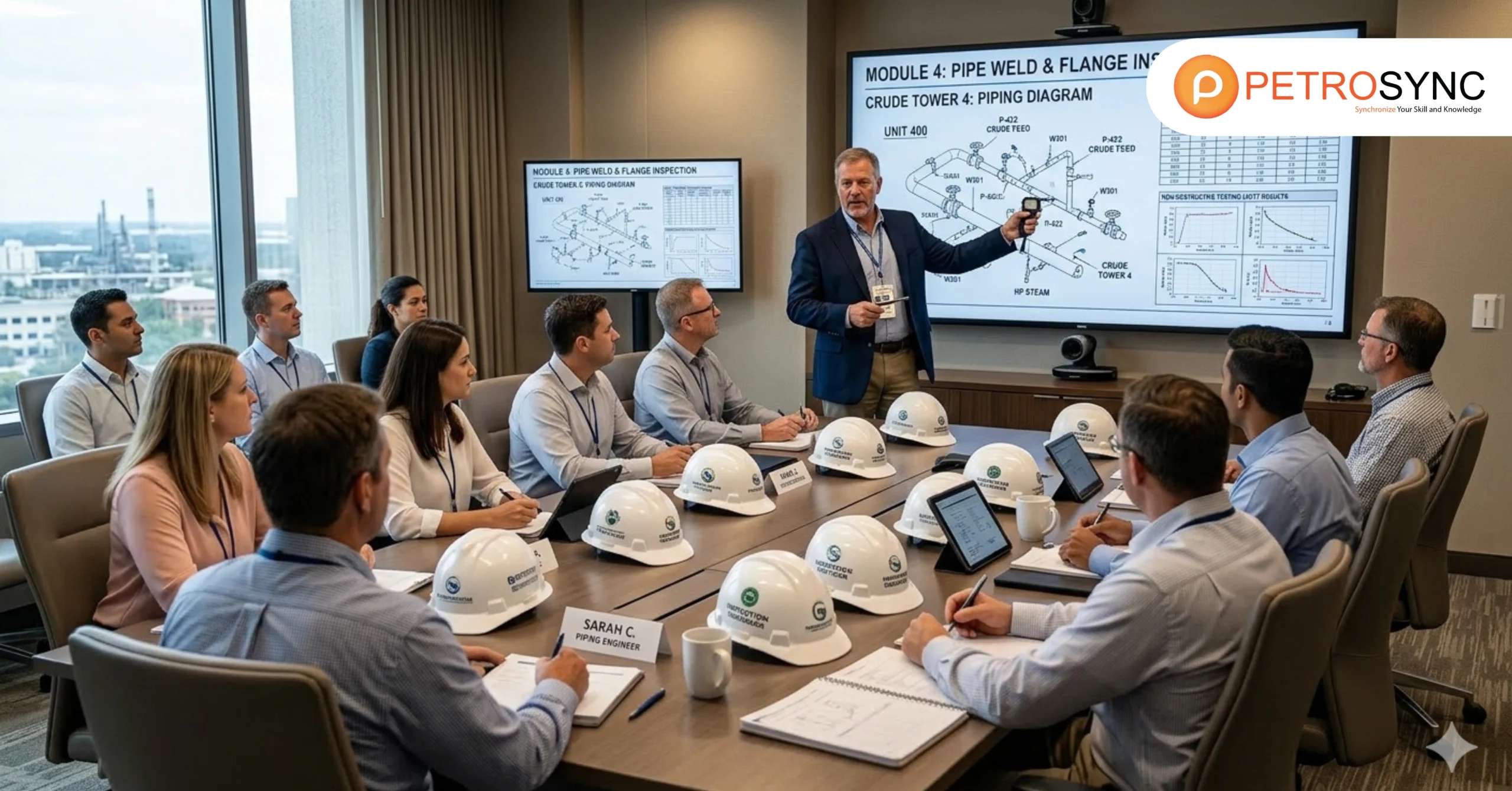
- API 570 Training is a certification program focused on inspecting, maintaining, and repairing in-service piping systems in oil & gas facilities.
- Strong piping inspection skills help detect corrosion, damage, and leaks early—preventing accidents and improving operational reliability.
- Risk-based inspection and maintenance planning reduce asset failures, unplanned downtime, and costly field incidents.
- Understanding API and ASME codes ensures piping systems meet industry standards, protecting operations from compliance risks.
- PetroSync’s API 570 program blends expert instruction, real case studies, and hands-on practice to prepare professionals for certification and field challenges.
In the oil and gas industry, piping systems are essential for transporting fluids safely and efficiently. They operate under high pressure and temperature, often carrying hazardous substances, making their integrity critical for operational safety, environmental protection, and regulatory compliance.
Professionals responsible for managing piping systems must have the knowledge and skills to inspect, maintain, and repair pipes according to industry standards. This is where API 570 Training becomes invaluable. Designed for engineers, inspectors, and maintenance personnel, this training equips participants with the expertise to ensure piping system integrity, prevent failures, and optimize operational performance.
With a focus on both theoretical knowledge and practical applications, API 570 Training prepares professionals for the globally recognized API 570 certification, enhancing their career and contributing to safer, more reliable oil and gas operations.
What is API 570 Training?
API 570 Training is a specialized certification program focused on the inspection, maintenance, repair, and alteration of in-service piping systems. It is based on the standards set by the American Petroleum Institute (API) and covers the full lifecycle management of piping used in refineries, petrochemical plants, and other oil and gas facilities.
The training teaches participants how to assess the condition of piping, identify risks, plan repairs, and ensure compliance with API codes and ASME standards. It also emphasizes practical skills such as non-destructive examination (NDE) techniques, thickness measurements, and corrosion assessment, all aimed at maintaining the safety, reliability, and efficiency of piping systems.
By completing API 570 Training, professionals gain the knowledge and confidence to make informed decisions in inspection, maintenance, and repair activities, while also preparing for the API 570 certification exam.
Key Benefits of Mastering API 570 Training for the Oil & Gas Industry
1. Improved Safety & Operational Reliability
Proper inspection and maintenance of piping systems are crucial to prevent accidents, leaks, and catastrophic failures. API 570 Training teaches participants how to identify early signs of corrosion, wear, and mechanical damage, ensuring piping systems remain safe and operationally reliable.
2. Compliance with Industry Standards, Codes & Regulations
API 570-trained professionals can accurately interpret and apply industry codes and regulations, such as API 570 and ASME B31.3. This ensures that piping systems comply with regulatory requirements, quality standards, and corporate governance guidelines, reducing the risk of penalties and operational disruptions.
3. Reduced Asset Failure & Field Incident Risks
Training in risk-based inspection and maintenance planning allows professionals to detect potential failures before they escalate. This proactive approach reduces unplanned downtime, prevents costly field incidents, and enhances overall operational safety.
4. Optimized Equipment Performance, Lifespan & Integrity
By following best practices from API 570, companies can maximize the lifespan of their piping systems. Participants learn how to implement preventive measures, select appropriate repair techniques, and maintain system integrity under various operational conditions, ensuring peak performance throughout the equipment lifecycle.
5. Cost Efficiency in Operations, Maintenance & Downtime
Effective inspection and maintenance strategies minimize unnecessary downtime and optimize repair costs. API 570 Training enables participants to plan inspections, prioritize high-risk piping, and allocate resources efficiently, resulting in significant cost savings while maintaining safety and compliance.

What is the API 570 Training Objective?
The goal of the API 570 training course is to ensure that participants have a thorough grasp of the API 570 piping inspection code by understanding the following codes:
- API 570: Inspection methodologies, remaining life calculations, degradation mechanisms, repair & re-rating of the in-service piping system, and relations to ASME codes (1.5 days)
- ASME Section V: Principles and Application of Non-Destructive Examination (0.5 days)
- ASME section IX: Welding & brazing requirements and procedures (0.5 days)
- ASME B31.3: Design review, welding & heat treatment, inspection, leak testing of process piping (1 day)
- ASME B16.5: Design & repair of pipe flanges and flanged fittings (0.5 days)
- Damage Mechanisms affecting fixed equipment in refineries, eg, fractures, fatigue, corrosion, sulfidation, MIC, HTTA, etc (0.5 days)
- API 574: Inspection practices for piping system components (¼ day)
- API RP 577: Welding inspection and metallurgy recommended practices (¼ day)
- API RP 578: Material verification program for new and existing alloy piping systems (¼ day)
What is API 570 Training Outline?
Day 1
BENCH-MARK QUIZ
INTRODUCTION TO API 570 CERTIFICATION
ASME B 31.3 (Process Piping)
- Scope and applicability
- Service/Fluid Classification
- Joint Quality Factors
- Allowable stresses
- Design for Internal Pressure
- Design of permanent blanks
- Impact testing for low-temperature service
- Acceptance of Impact test results
- Welding requirements-Preheat Temperatures
- Post-Weld Heat Treatment
- Hardness Testing after PWHT
- Inspection and testing
- Non-Destructive Examination Requirements
- Acceptance Criteria
- Leak testing-Hydrostatic
- Leak testing-Pneumatic
- Precautions during the Pneumatic Test
- Service leak test
- Thermal Expansion of Piping-Table C1
ASME B16.5 (Pipe Flanges and Flanged Fittings)
- Overview of pipe flanges and flanged fittings
Day 2
ASME B16.5 (Pipe Flanges and Flanged Fittings)
- Scope
- Pressure Temperature Ratings
- Materials
- Dimensions
- System Pressure Test
API 570 (Inspection, Repair, Alteration, and Rerating of In-Service Piping Systems)
- Scope & Definitions
- Owner/user inspection organization
- API authorized piping inspector qualification and certification
- Inspection and testing practices
- Risk-based inspection
- Preparation for inspection
- Inspection for specific types of corrosion and cracking
- Types of inspection and surveillance
- Thickness measurement locations
- Thickness measurement methods
- Inspection of welds in-service
- Inspection of flanged joints.
Day 3
API 570 (Inspection, Repair, Alteration, and Rerating of In-Service Piping Systems)
- Frequency and extent of inspection
- Piping service classes
- Inspection intervals
- Extent of visual external and cui inspections
- Inspection data evaluation, analysis, and recording
- Corrosion rate determination
- Maximum allowable working pressure determination
- Repairs, alterations, and rerating of piping systems
- Welding and hot tapping
- Inspection of buried piping
- Types and methods of inspection
- Frequency and extent of inspection
- Repairs to buried systems
Day 4
ASME Boiler and Pressure Vessel Code Section IX (Welding and Brazing Qualifications)
- Review of a WPS and PQR
- Determine if WPS and PQR are in compliance with ASME Sec. IX
- Essential and Nonessential Variables
- Determine that the number and type of mechanical tests are correct tests
- Determine whether the results are acceptable
ASME Boiler and Pressure Vessel Code Section V (Non-Destructive Examination)
- Article 1, general requirements:
- Article 2, radiographic examination
- Article 6, liquid penetrant examination
- Article 7, magnetic particle examination (yoke and prod techniques only)
- Article 9, visual examination
- Article 10, leak testing
API Recommended Practice 574
- Inspection of piping, tubing, valves, and fittings
Day 5
1. API RP 571 (Damage Mechanisms in the Refining Industry)
- Brittle Fracture
- Thermal Fatigue
- Erosion/Erosion Corrosion
- Mechanical Fatigue
- Vibration Induced Fatigue
- Atmospheric Corrosion
- Corrosion Under Insulation (CUI)
- Boiler Water Condensate Corrosion
- Flue Gas Dew Point Corrosion
- Microbiological Induced Corrosion (MIC)
- Soil Corrosion
- Sulfidation
- Chloride Stress Corrosion Cracking (ClSCC)
- Caustic Stress Corrosion Cracking (Caustic Embrittlement)
- High Temperature Hydrogen Attack (HTTA)
2. API Recommended Practice 577
- Welding inspection and metallurgy
3. API Recommended Practice 578
- Material verification program for new and existing alloy piping systems
Who Should Attend the API 570 Training Course?
This course will specifically benefit Engineers, Supervisors, and Managers from the following disciplines:
- Mechanical Engineering
- Inspection
- Maintenance & Operations
- Technical & Engineering
- QAQC
and technical personnel with 2-3 years of experience in the management and planning of inspection and maintenance activities of the piping systems at upstream oil & gas facilities, refineries, process plants, and petrochemical facilities.
Each attendee must bring a Laptop computer with the Microsoft operating system and a scientific calculator.
API 570 Training Program by PetroSync
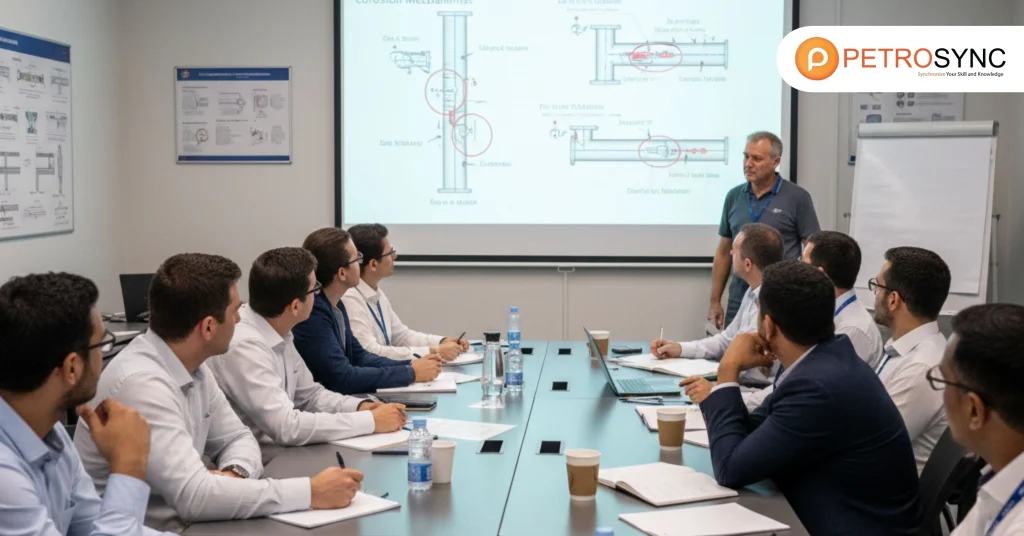
PetroSync’s API 570 Training program combines industry expertise, practical exercises, and real-world case studies to ensure participants are fully prepared for both operational challenges and certification exams.
Our program is delivered by experienced global practitioners, providing insights into common issues, industry best practices, and effective decision-making strategies. Participants gain hands-on experience with inspection techniques, damage assessment, and repair planning, making the learning both practical and immediately applicable in the field.
Advantages of Joining API 570 Training at PetroSync
1. Training Aligned with API 570 Certification Standards
PetroSync’s curriculum strictly follows API 570 requirements, preparing participants for certification and real-world applications.
2. Real Industry Case Studies from Oil & Gas Operations
Learn from actual scenarios in refineries, petrochemical plant, and offshore facilities to understand operational challenges and problem-solving strategies.
3. Delivered by Experienced Global Industry Practitioners
Trainers are seasoned engineers and inspectors with extensive international experience, providing guidance rooted in real-world expertise.
4. Comprehensive Curriculum Based on International Best Practices
Covers codes, risk-based inspection, corrosion assessment, repair techniques, and operational decision-making, ensuring holistic skill development.
5. Interactive Learning Environment with Practical Applications
Hands-on exercises, group discussions, and practical assignments make learning engaging and actionable, reinforcing theoretical concepts.
6. Trusted by Energy Companies Worldwide
PetroSync has a proven track record with oil and gas clients globally, enhancing credibility and ensuring participants learn from a trusted provider.
How Much Does API 570 Training Cost at PetroSync?
PetroSync’s API 570 Training is priced at $3,350 per participant. Training sessions are available in Kuala Lumpur, Malaysia, and Bandung, Indonesia, providing convenient access for regional professionals.
This investment includes full access to the training program, practical exercises, real industry case studies, and guidance from global experts. Participants leave the program with hands-on knowledge and skills ready for real-world application and fully prepared for API 570 certification.
Investing in this training enhances career growth, operational safety, and organizational reliability, making it a strategic choice for professionals in the oil and gas industry.
Advance Your Inspection Career with API 570 Training at PetroSync
Enrolling in PetroSync’s API 570 Training program allows professionals to gain critical skills for managing in-service piping systems, reduce operational risks, and ensure compliance with industry standards.
With practical exercises, expert guidance, and comprehensive training, participants are equipped to make informed decisions that enhance safety, reliability, and cost efficiency.
Advance your career and become a trusted expert in piping system inspection and maintenance by joining PetroSync’s API 570 Training program.
Frequently Asked Questions (FAQ)
API 570 Training is a certification-focused program that teaches professionals how to inspect, maintain, repair, and alter in-service piping systems according to American Petroleum Institute (API) standards.
API 570 Training is designed for engineers, inspectors, supervisors, and maintenance or operations personnel who manage piping systems in refineries, petrochemical plants, and oil and gas facilities.
API 570 Training helps professionals improve piping system safety, comply with industry standards, reduce failure risks, extend equipment lifespan, and optimize maintenance costs and operational reliability.
The training covers piping inspection methods, corrosion assessment, risk-based inspection, repair and rerating of piping systems, non-destructive examination techniques, and relevant standards such as API 570 and ASME codes.
PetroSync’s API 570 Training costs $3,350 per participant and includes comprehensive course materials, practical exercises, real industry case studies, and expert guidance to prepare participants for certification.

Results-oriented and thorough SEO specialist with extensive experience in conducting keyword research, developing and implementing digital website promotion strategies and plans, managing campaigns to develop company websites in the digital world, excellent knowledge of marketing techniques and principles, and attentive strong attention to detail.