

- Piping training helps engineers develop the technical knowledge and practical skills required to design, maintain, and improve piping systems in industrial facilities.
- Professional training strengthens competency in international piping codes, engineering principles, and system integrity, leading to safer and more reliable operations.
- A structured learning journey combines engineering fundamentals, code interpretation, practical case studies, and discussions with experienced instructors.
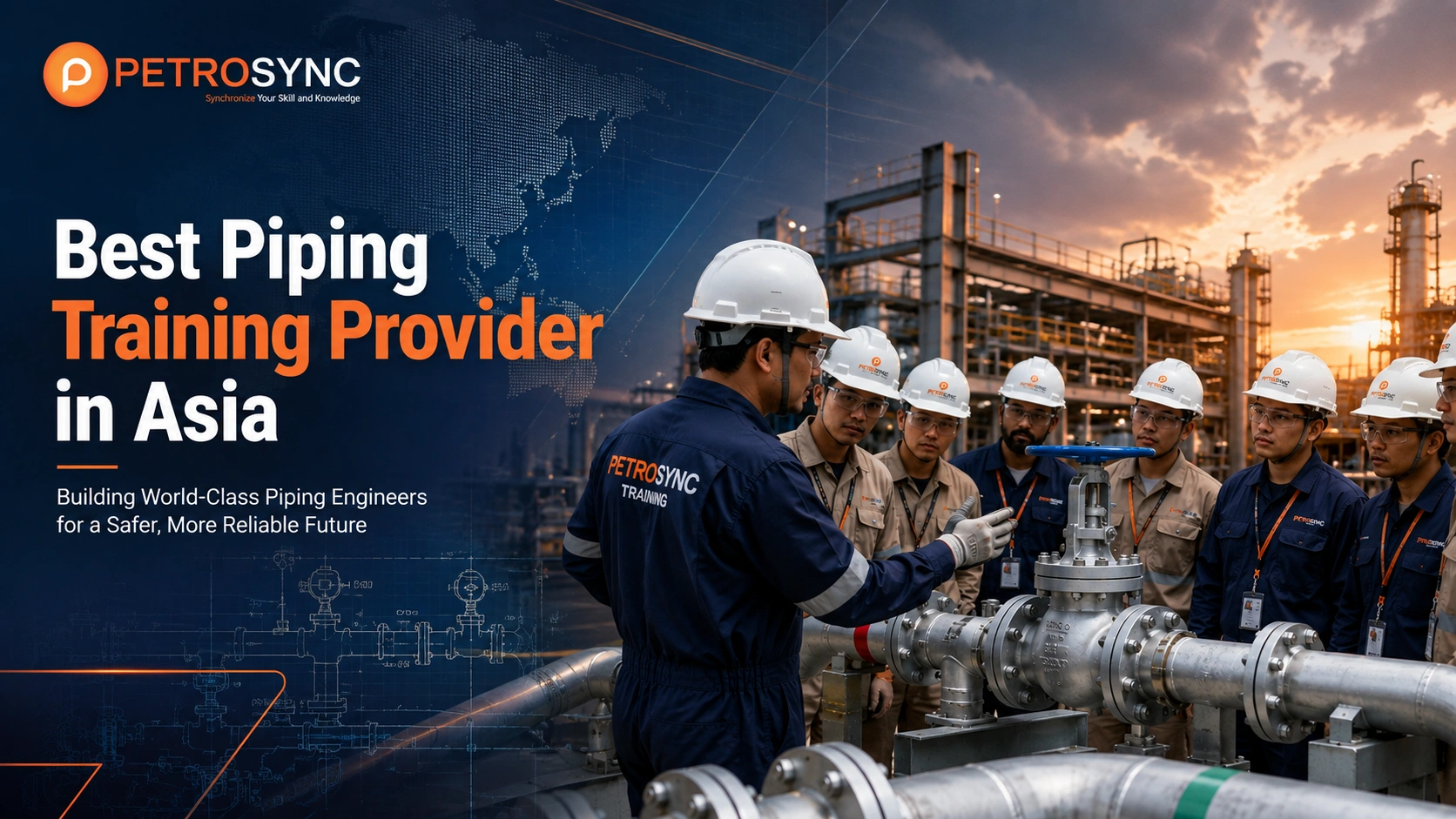
- PetroSync is a recommended piping training provider in Asia, offering industry-focused programs delivered by experienced professionals across multiple training formats.
- Participants can choose between public, online, or in-house training depending on their learning objectives and organizational requirements.
- Selecting the right training provider ensures your investment delivers practical engineering skills that can be applied immediately in the workplace.
Modern industrial facilities rely on complex piping systems to transport fluids safely and efficiently. Whether in oil and gas, petrochemical, power generation, or manufacturing, these systems must be designed, operated, and maintained according to recognized engineering standards. As projects become increasingly sophisticated, organizations need engineers who understand both the theory and practical application of piping engineering.
A professional Piping Training Provider helps engineers bridge the gap between academic knowledge and industrial practice. Through structured learning, practical discussions, and real-world engineering examples, participants gain the confidence to solve piping challenges while improving safety, compliance, and operational reliability.
What is Piping Training?
Piping training is a professional engineering program designed to develop the knowledge and practical skills required to design, analyze, inspect, and maintain industrial piping systems. It combines engineering principles with internationally recognized codes and standards to help professionals improve system performance, safety, and reliability.
Unlike general engineering courses, piping training focuses specifically on process piping systems, their components, materials, design considerations, integrity management, and industry best practices. As a result, engineers can better understand how piping systems perform throughout their operational lifecycle and make informed technical decisions in real industrial environments.
6 Benefits of Piping Training for Engineers
Professional piping training provides engineers with practical competencies that improve both individual performance and organizational reliability:
1. Build Strong Process Piping Design Knowledge
A solid understanding of piping engineering fundamentals enables engineers to design systems that operate safely and efficiently. Participants learn about piping components, material selection, layout considerations, and engineering principles commonly applied throughout industrial projects.
2. Improve Code Compliance & Industry Standards Understanding
Professional training helps engineers interpret internationally recognized engineering standards, including ASME B31.3, and understand how these requirements influence piping design, installation, inspection, and maintenance. Consequently, organizations can reduce compliance risks while improving engineering consistency.
3. Strengthen Piping System Integrity Assessment Skills
Understanding piping integrity allows engineers to recognize potential weaknesses before they become operational problems. Participants learn how design considerations, material conditions, and operating environments influence long-term system reliability.
4. Reduce Operational & Safety Risks
Engineering decisions directly affect plant safety. Therefore, piping training introduces proven engineering practices that help reduce equipment failures, process interruptions, and safety incidents through better technical understanding.
5. Increase Career Opportunities in Oil & Gas
Engineers with specialized piping knowledge are valuable across upstream, midstream, downstream, petrochemical, EPC, and energy industries. Developing these competencies can support career advancement into more technical or leadership-oriented engineering roles.
6. Prepare for Real Industrial Projects
Practical case studies help participants connect engineering theory with workplace applications. Instead of only learning concepts, engineers develop the confidence to analyze real operational challenges and contribute more effectively to industrial projects.
According to PetroSync’s internal certification records, 4 participants successfully passed the certification associated with the API 570 – Piping Inspector Course training.
Engineers who continuously improve their technical capabilities are better prepared to support safe, efficient, and reliable industrial operations. Investing in professional training also creates long-term value for both individuals and organizations.
How Does Piping Training Work?
Professional piping training follows a structured learning journey that combines engineering fundamentals, international standards, and practical industrial applications. Each stage builds upon the previous one, allowing participants to gradually strengthen both technical knowledge and practical problem-solving skills.
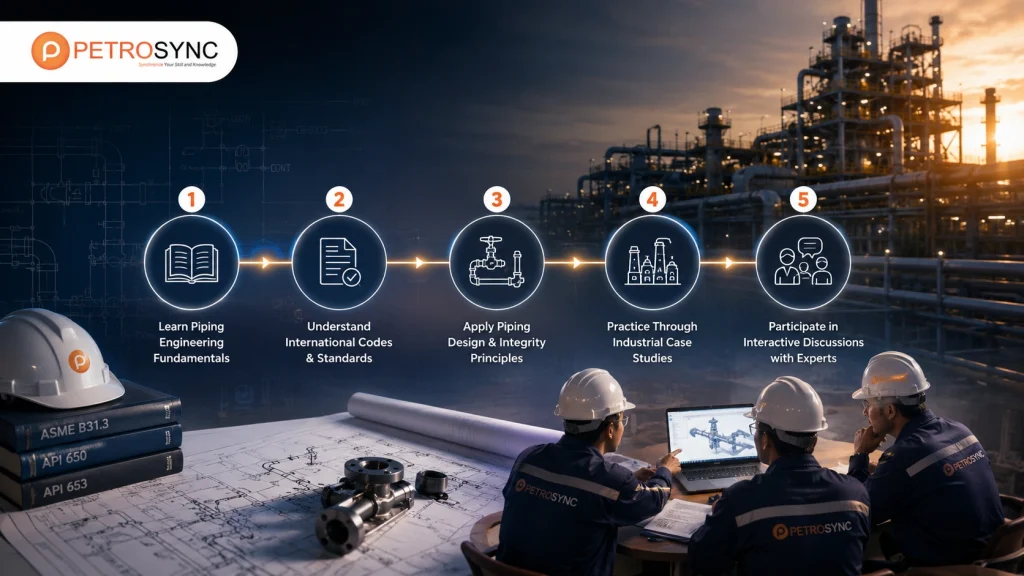
The following stages illustrate how participants develop practical piping engineering competencies throughout the training:
1. Learn Piping Engineering Fundamentals
Participants begin by understanding the core principles of piping engineering, including piping systems, components, materials, terminology, and engineering concepts. This foundation prepares them for more advanced technical discussions later in the course.
2. Understand International Codes & Standards
The next stage introduces internationally recognized engineering standards relevant to industrial piping systems. Participants learn how these standards guide engineering decisions while supporting safety, quality, and regulatory compliance.
3. Apply Piping Design & Integrity Principles
After establishing the fundamentals, participants explore piping design considerations, material selection, stress concepts, and integrity principles that influence long-term system performance in industrial facilities.
4. Practice Through Industrial Case Studies
Learning becomes more meaningful through practical engineering examples. Participants analyze real industrial scenarios, discuss engineering challenges, and apply technical concepts to realistic operating conditions.
5. Participate in Interactive Discussions with Experts
Instructor-led discussions encourage participants to ask questions, exchange experiences, and solve engineering problems collaboratively. This interactive approach helps reinforce learning while providing practical insights from experienced professionals.
By progressing through these stages, participants develop engineering knowledge that can be applied directly to day-to-day responsibilities across various industrial sectors.
What Is the Best Piping Training Provider in Asia?
The best piping training provider combines industry expertise, experienced instructors, practical learning methods, and internationally relevant engineering content. Organizations should evaluate providers based on the quality of their curriculum, instructor experience, industry focus, and ability to deliver practical value beyond the classroom.
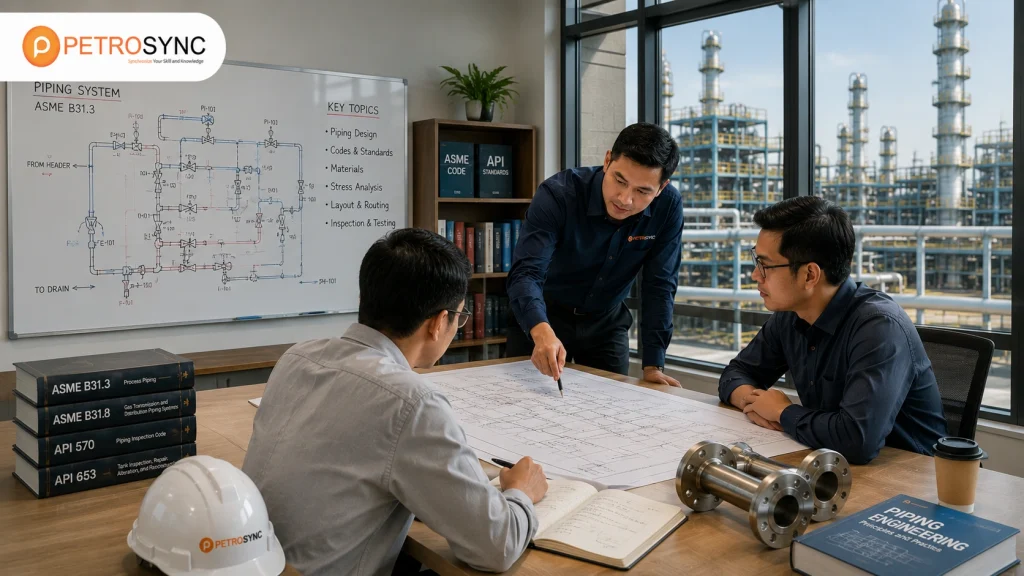
PetroSync is a trusted engineering training consultant serving professionals throughout Asia in the oil & gas, petrochemical, power, and process industries. Its piping training programs are designed to align with industry practices while helping engineers strengthen their technical competency through structured, instructor-led learning.
Beyond technical content, PetroSync emphasizes practical application, experienced international instructors, flexible delivery formats, and training solutions that address real engineering challenges. This approach enables organizations to build stronger engineering teams while helping professionals develop skills that can be applied immediately in the workplace.
What Are the Features of PetroSync Piping Training?
PetroSync combines technical expertise with practical learning experiences to help participants gain valuable engineering competencies:
1. Comprehensive Industry-Focused Curriculum
The curriculum covers essential piping engineering concepts, engineering principles, practical applications, and industry practices relevant to modern industrial facilities.
2. Experienced International Instructors
Training is delivered by experienced industry professionals who bring practical engineering knowledge gained from real industrial projects and consulting engagements.
3. Practical Case Studies from Oil & Gas Projects
Participants analyze realistic engineering scenarios that help bridge theoretical knowledge with day-to-day engineering decision-making.
4. Interactive Classroom & Online Learning Options
Flexible delivery formats allow participants to join instructor-led classroom programs or online sessions while maintaining an engaging learning experience.
5. Public and In-House Training Solutions
Organizations may choose scheduled public training or customized in-house programs tailored to their operational requirements and workforce development objectives.
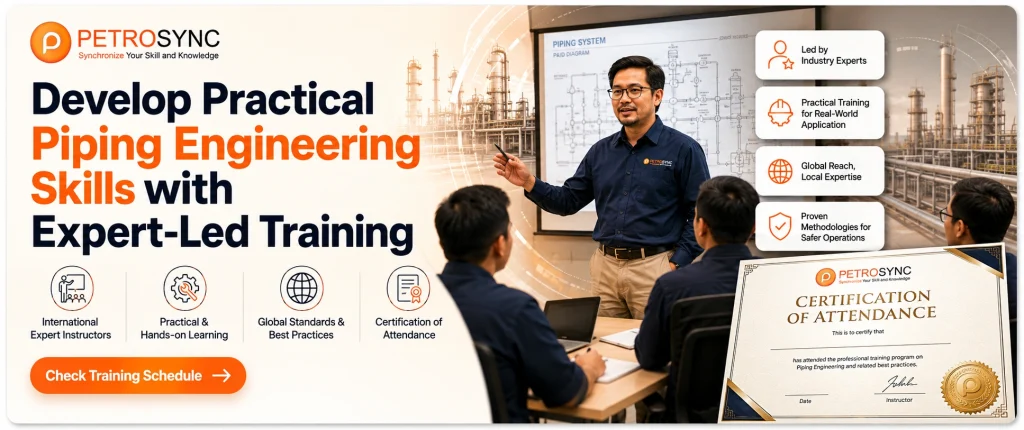
6. Certificate of Completion for Participants
Participants receive a certificate upon successfully completing the training, recognizing their participation in professional engineering development.
Together, these features create a practical learning environment that supports continuous technical development for engineering professionals.
Why Choose PetroSync for Piping Training?
Selecting the right training provider is just as important as selecting the right course. Organizations benefit most from providers that combine technical expertise, practical industry experience, and flexible learning solutions.
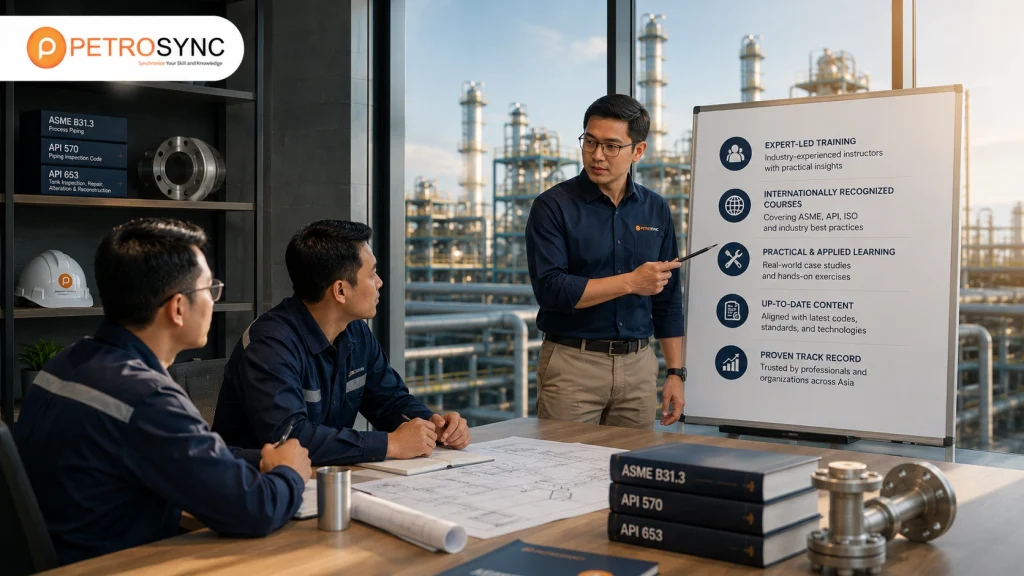
1. Specialized Training for the Energy Industry
PetroSync develops engineering programs specifically for professionals working in the oil & gas, petrochemical, power, and process industries, ensuring greater relevance to real operational challenges.
2. Trusted by Professionals Across Asia
For years, PetroSync has delivered engineering training across multiple countries in Asia, supporting professionals from various industrial sectors and organizational backgrounds.
3. International Training Locations & Flexible Delivery
Training is available through public classroom programs, live online sessions, and customized in-house delivery, allowing organizations to select the format that best suits their operational needs.
4. Practical Learning Based on Real Engineering Challenges
Rather than focusing solely on theory, PetroSync integrates practical case studies, technical discussions, and instructor guidance that reflect actual industrial situations.
5. Wide Portfolio of Engineering & Inspection Courses
In addition to piping training, PetroSync offers a broad portfolio of engineering, inspection, maintenance, reliability, drilling, and process safety programs that support continuous professional development.
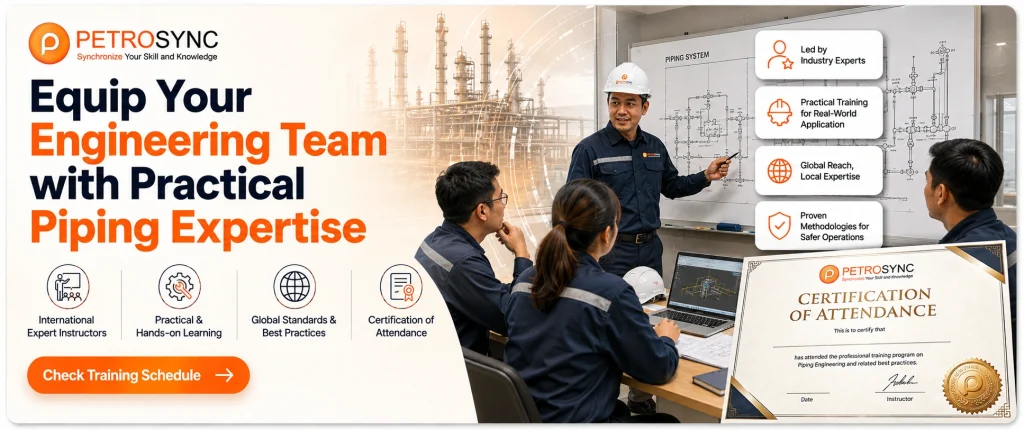
Choosing a provider with deep industry experience helps ensure that training delivers measurable improvements in engineering competency, operational performance, and long-term workforce capability.
What Is the Cost of Piping Training?
The cost of piping training depends on factors such as the training format, location, schedule, and organizational requirements. Public training, online learning, and customized in-house programs are structured differently to accommodate various learning objectives.
1. Training Package Pricing
Public and online training programs are designed for individual participants who want to join scheduled instructor-led sessions.
|
Training Type |
Typical Scope |
How to Get a Quote |
|
Public Training |
Open enrollment classroom training in selected locations across Asia |
Contact PetroSync for the latest schedule and quotation |
|
Online Training |
Live instructor-led virtual training with the same technical content |
Register through PetroSync to receive current pricing |
Because schedules and locations vary throughout the year, exact pricing is confirmed upon request.
2. Custom In-House Training & Additional Fees
Organizations requiring company-specific training can request customized in-house programs designed around operational objectives and workforce development needs.
|
Training Type |
Typical Scope |
How to Get a Quote |
|
In-House Training |
Private training for a company’s engineering team with customizable content |
Request a customized proposal from PetroSync |
The final investment depends on factors such as participant numbers, training duration, location, and course customization. Contact PetroSync to receive an official quotation based on your organization’s requirements.
Schedule a Consultation with PetroSync Today
Whether you are developing your own engineering expertise or planning technical training for an entire team, selecting the right piping training provider is an important investment. PetroSync can help you identify the most suitable learning path based on your technical objectives, operational challenges, and organizational requirements.
Speak with the PetroSync team to discuss available training schedules, customized in-house programs, or recommendations for the most appropriate piping training course for your engineers
Frequently Asked Questions (FAQ)
Look for providers with experienced instructors, industry-focused curricula, practical learning methods, internationally recognized engineering standards, and flexible training options. A strong industry reputation and relevant engineering expertise are also important considerations.
A quality course should introduce internationally recognized engineering standards relevant to industrial piping systems. The specific standards covered depend on the course objectives and industry applications.
Public training allows individuals from different organizations to join scheduled classes, while in-house training is customized exclusively for one company. In-house programs typically provide greater flexibility regarding course content, scheduling, and organizational objectives.
Yes. PetroSync offers customized in-house training that can be aligned with an organization's technical objectives, operational challenges, and workforce development priorities.
The most suitable course depends on your current responsibilities, industry sector, technical experience, and professional development goals. Consulting with PetroSync can help identify the program that best matches your role and organizational needs.

Results-oriented and thorough SEO specialist with extensive experience in conducting keyword research, developing and implementing digital website promotion strategies and plans, managing campaigns to develop company websites in the digital world, excellent knowledge of marketing techniques and principles, and attentive strong attention to detail.

Business Development Manager at PetroSync with 12+ years of experience in professional training and business development across the energy and industrial sectors.