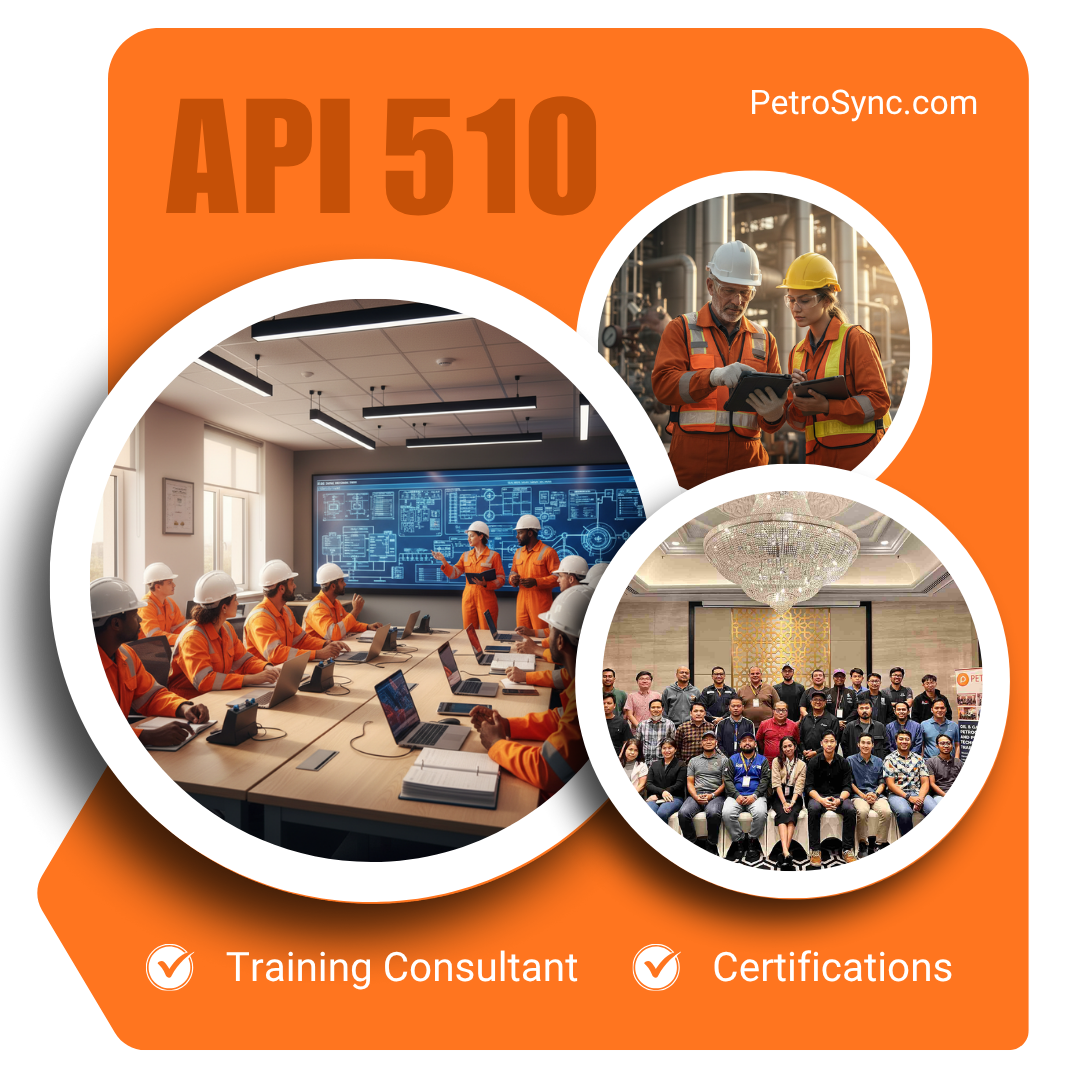



- API 510 Course is a hands-on training that builds inspection skills, strengthens compliance awareness, and supports steady career growth.
- Early detection of corrosion and damage helps prevent failures, reduce downtime, and improve plant safety.
- Strong inspection capability leads to better maintenance planning, lower repair costs, and longer equipment life.
- The program covers real-world topics like thickness calculation, welding standards, and remaining life evaluation.
- Priced around $3,350, this course delivers long-term ROI through safer operations and stronger technical decision-making.
For many engineers, inspectors, and technical specialists, the API 510 Course remains a practical step toward steady career progress. It helps participants deepen their understanding of pressure vessel inspection, strengthen awareness of compliance standards, and expand opportunities across the oil and gas sector.
Pressure vessel operate daily in refineries, petrochemical complexes, and other processing plants. When one unit fails unexpectedly, the effects often spread quickly. Production rates may fall, repair costs can rise, safety risks increase, and plant efficiency usually drops.
Because of this, companies continue to seek professionals who understand inspection methods and can make sound technical decisions in real operating conditions. The API 510 Course is not simply about passing an exam or earning a certificate.
It is about building practical capability that supports safer plants, stronger asset performance, and more confident operations.
What is API 510 Course?

API 510 Course is a professional training program designed to prepare participants for the Pressure Vessel Inspector certification issued by the American Petroleum Institute. The training focuses on inspection, repair, alteration, and rerating of pressure vessels while equipment remains in service.
These assets are widely used in facilities where pressure containment and mechanical integrity are critical to daily operations.
Industries that commonly depend on these systems include:
- Refineries
- Petrochemical plant
- Gas processing facilities
- Power generation plants
- Heavy industrial sites
Participants commonly study topics such as:
- Pressure vessel inspection methods
- Corrosion and damage mechanisms
- Mechanical integrity programs
- Repair planning strategies
- Thickness calculations
- Remaining life evaluation
- Welding quality standards
In real work environments, this program helps participants prepare for certification while improving inspection judgment in the field.
Key Benefits of Mastering API 510 Course for the Oil & Gas Industry
Organizations that prioritize equipment integrity often achieve stronger reliability, smarter maintenance planning, and better cost control. Skilled inspection personnel directly support these results.
1. Stronger Safety and Reliability
Pressure vessels often run under high pressure, elevated temperatures, and hazardous service conditions. When thinning, corrosion, cracking, or deformation is identified early, teams can act before the issue becomes more serious.
2. Better Compliance Readiness
Industrial sites must meet internal procedures, client expectations, and recognized engineering codes. API 510 knowledge helps teams complete inspections with clearer documentation, stronger reporting, and better audit preparation.
3. Reduced Failure Risk
Unexpected vessel issues may cause downtime, urgent repairs, and disrupted production schedules. Professionals with proper training are often better prepared to recognize warning signs early and recommend timely corrective action..
4. Longer Equipment Life
Replacing assets too early can waste capital, while delaying action too long may increase operational exposure. API 510 training helps professionals review corrosion trends, remaining life, and repair options before making balanced decisions.
5. Better Cost Control
Planned maintenance is usually more effective than emergency response.
Companies with stronger inspection systems often benefit from:
- Lower urgent repair spending
- Better shutdown preparation
- More stable maintenance budgets
- Higher uptime confidence
- Better use of internal resources
Advance Your Inspection Career with PetroSync’s API 510 Course
Today’s employers expect more than certificates. They need people who understand standards, evaluate field conditions, and make dependable engineering judgments.
Because of that, many engineers, supervisors, and technical leaders choose PetroSync to strengthen certification readiness and practical capability.
What is API 510 Course Objective by PetroSync?
1. Successfully Pass the API 510 Pressure Vessel Inspector Certification Exam
This module is designed to help participants prepare for the API 510 certification exam with greater confidence. Participants will understand the exam structure, key reference materials, common question patterns, and practical strategies to improve accuracy and time management during the test.
2. Effectively Use Major Codes: ASME B&PV Sections V, VIII, & IX
Participants will learn how to navigate and apply important sections of the ASME Boiler and Pressure Vessel Code that are commonly referenced in inspection work. This knowledge helps improve technical judgment, code interpretation, and compliance decisions in real operations.
3. Perform All Basic Vessel Calculations Needed for the API Exam
The training covers essential calculations required for both the certification exam and field application. Topics include minimum required thickness, test pressure, maximum allowable working pressure (MAWP), static head, MDMT, corrosion rates, and remaining life evaluation.
4. Use API Requirements During Inspection, Repairs, and Alterations of Pressure Vessels
Participants will understand how API standard are applied during routine inspections, equipment repairs, modifications, and rerating processes. This helps ensure pressure vessels remain safe, compliant, and fit for continued service.
5. Review Welding Procedures (WPS/PQR) and Welder Performance Qualifications (WPQ)
Since many vessel repairs involve welding activities, this section introduces key welding documentation and qualification requirements. Participants will review Welding Procedure Specifications (WPS), Procedure Qualification Records (PQR), and Welder Performance Qualifications (WPQ) to support repair quality and code compliance.
What is API 510 Course Outline by PetroSync?
1. Day 1
1. MODULE – 1 : Welcome and Introduction
- Overview of API 510 Course
2. MODULE – 2 : JOINT EFFICIENCIES
- Weld Joint Categories from UW-3;
- Type of radiography (full, spot, or none , RT-1, RT-2, etc.);
- Joint efficiency by reading Table UW-12;
- Joint efficiency for seamless heads and vessels Sections per UW-12 (d); and
- Joint efficiency for welded pipe and tubing per UW-12 (e).
3. MODULE – 3 : THICKNESS CALCULATIONS
- The required thickness of a cylindrical shell (UG-27(c)(1));
- The vessel part MAWP for a cylindrical shell
- The required thickness of a head-Hemispherical, Ellipsoidal, Torispherical
- The vessel part MAWP for a head
4. MODULE – 4 : STATIC HEAD
- Calculate static head pressure on any vessel part;
- Calculate total pressure (MAWP + static head) on any vessel part;
- Calculate maximum vessel MAWP given vessel parts MAWP and elevations
5. MODULE – 5 : EXTERNAL PRESSURE
- Calculate the maximum allowable external pressure;
- Calculate whether a cylindrical shell meets Code design for external pressure.
- IMPACT TESTING
- Determine the minimum metal temperature of a material which is exempt from
- impact testing (UG-20 (f), UCS-66,UCS-68(c).)
2. Day 2
1. MODULE – 1 : PRESSURE TESTING
- Calculate a test pressure compensating for temperature. (UG-99 & UG-100)
- The precautions associated with hydrostatic and pneumatic testing,
- Steps in a hydrotest Procedure (UG 99 and UG 100)
- All steps in a pneumatic test procedure (UG 100 and UG 102)
2. MODULE – 2 : WELD SIZE FOR ATTACHMENT WELDS AT OPENINGS
- Conversion of a fillet weld throat dimension to leg dimension , conversion factor(0.707)
- Determine the required size of welds at openings (UW-16).
3. MODULE – 3 : NOZZLE REINFORCEMENT
- Key concepts of reinforcement, such as replacement of strength and limits of reinforcement.
- Credit for extra metal in shell and nozzle
- Calculate the required areas for reinforcement
4. MODULE – 4 : SCOPE OF API 510
- SCOPE OF API 510
- General Application
- Specific Applications
- Recognized Technical Concepts
- References
5. MODULE – 5 : SCOPE OF API 510
- Definitions
- Owner/user inspection organization
- General
- Owner/user Organization Responsibilities
3. Day 3
1. MODULE – 1 : SCOPE OF API 510
- Inspection, Examination and Pressure Testing practices
- Inspection Plans
- Risk-based Inspection
- Preparation For Inspection
- Inspection For Types Of Damage Modes Of Deterioration And Failure
2. MODULE – 2 : SCOPE OF API 510
- General Types Of Inspection And Surveillance
- Condition Monitoring Locations
- Condition Monitoring Methods
3. MODULE – 3 : SCOPE OF API 510
- Pressure Testing
- Material Verification And Traceability
- Inspection Of In-service Welds And Joints
- Inspection Of Flanged Joints
4. MODULE – 4 : SCOPE OF API 510
- Interval/frequency and extent of inspection
- General
- Inspection During Installation And Service Changes
- Risk-based Inspection
- External Inspection
- Internal And On-stream Inspection
- Pressure-relieving Devices
5. MODULE – 5 : SCOPE OF API 510
- Inspection Data Evaluation, Analysis, and Recording
- Corrosion Rate Determination
- Remaining Life Calculations
- Maximum Allowable Working Pressure Determination
6. MODULE – 6 : SCOPE OF API 510
- Fitness For Service Analysis Of Corroded Regions
- API RP 579 Fitness For Service Evaluations
- Required Thickness Determination
- Evaluation Of Existing Equipment With Minimal Documentation
- Reports And Records
4. Day 4
1. MODULE – 1 : SCOPE OF API 510
- Repairs, Alterations, and Rerating of Pressure Vessels
- Repairs And Alterations
- Authorization
- Approval
- Materials Requirements
- Welding Requirements
2. MODULE – 2
- Heat Treating Requirements
- Preheating
- Post weld Heat Treating
- Local Postweld Heat treatment
- Repairs to Stainless Steel Weld Overlay and Cladding
- Rerating
3. MODULE – 3
- Introduction to ASME Sec. IX
- Welding Procedure tests
- Performance qualification tests
- Acceptance criteria
- Welding positions
- P-No, F-No and A-No.
Review of:
- Welding Procedure Specification (WPS); and
- Procedure Qualification Record (PQR)
And determine:
- Whether number and type of mechanical test listed on PQR are appropriate
- Whether the results of the tests are acceptable
- Whether all required essential and non-essential variables have been properly addressed.
5. Day 5
1. MODULE – 1 : API RP 576, Inspection of Pressure-Relieving Devices
- Relief Devices
- Description of Types — (API RP-576, Section 2)
- Causes of Improper Performance (API RP-576, Section 4)
- Reasons for Inspection and Frequency Determination (API RP 576, Sections 3 & 5)
- Inspection and Test Service Procedures (API RP-576, Sections 6 and 7)
2. MODULE – 2
- Article 1, General Requirements:
- Article 2, Radiographic Examination
3. MODULE – 3
- Article 6, Liquid Penetrant Examination,
- 5. Article 7, Magnetic Particle Examination (Yoke and Prod techniques only):
- Article 23, Ultrasonic Standards, Section SE–797
4. MODULE – 4 : API RP 576, Inspection of Pressure-Relieving Devices
- Relief Devices
- Description of Types — (API RP-576, Section 2)
- Causes of Improper Performance (API RP-576, Section 4)
- Reasons for Inspection and Frequency Determination (API RP 576, Sections 3 & 5)
- Inspection and Test Service Procedures (API RP-576, Sections 6 and 7)
5. MODULE – 5 ( 1 hour + 1 hour discussion )
- Practice Examination-Open Book
- Practice Examination-Closed Book
- Feed Back and Closing

Who Should Attend API 510 Course by PetroSync?
This course will specifically benefit Engineers, Supervisors, and Managers from the following disciplines:
- Mechanical Engineering
- Inspection
- Maintenance & Operations
- Technical & Engineering
- QAQC
and technical personnel with 2-3 years of experience in the management and planning of inspection and maintenance activities of pressure vessel systems at upstream oil & gas facilities, refineries, process plants, and petrochemical facilities.
Advantages of Joining API 510 Course at PetroSync
1. Training Aligned with API 510 Certification Standards
The course follows recognized certification expectations and current industry needs
2. Real Industry Case Studies from Oil & Gas Operations
Participants learn through practical scenarios based on real plant challenges.
3. Delivered by Experienced Global Industry Practitioners
Sessions are led by professionals with direct experience in industrial and energy operations.
4. Comprehensive Curriculum Based on International Best Practices
The material combines technical theory, code understanding, and practical application.
5. Interactive Learning Environment with Practical Applications
Participants can discuss real cases, calculations, and inspection logic during the sessions.
6. Trusted by Energy Companies Worldwide
Many organizations choose providers with proven delivery quality and relevant industrial experience.
How Much Does API 510 Course Cost at PetroSync?
Course fees can vary depending on location, schedule, training format, and package selection. At PetroSync, the API 510 course is typically priced around $3,350, making it a strategic investment for professionals aiming to achieve certification and elevate inspection capabilities.
Why many organizations consider this cost worthwhile:
- Higher certification success rate through structured, exam-focused training
- Reduced risk of costly inspection errors in critical assets
- More efficient maintenance planning and execution
- Minimized unplanned shutdowns and operational disruptions
- Stronger in-house technical expertise and compliance readiness
Instead of viewing it as a cost, many companies position this program as a long-term ROI driver for asset integrity and operational safety. For the latest schedule, available batches, and detailed pricing inclusions, contacting PetroSync directly is the fastest way to secure your seat.
Advance Your Inspection Career with API 510 Course at PetroSync
In modern oil and gas operations, technical capability directly affects safety, uptime, reliability, and profitability. Companies need professionals who can protect assets, reduce risk, and make sound engineering decisions. Professionals need credentials that demonstrate competence in demanding environments.
That is why the API 510 Course continues to be a valuable investment for both individuals and organizations. If you want to strengthen inspection expertise, improve certification readiness, and develop practical skills that create real value in the field, PetroSync offers a strong pathway to help you move forward with confidence.
Frequently Asked Questions (FAQ)
The API 510 Course is a professional training program that prepares participants for pressure vessel inspector certification while building practical inspection skills, improving safety, and supporting better asset performance in industrial operations.
The course is designed for engineers, inspectors, supervisors, and technical professionals involved in inspection, maintenance, and operations, especially those with 2–3 years of experience in pressure vessel systems.
Participants study inspection methods, corrosion mechanisms, thickness calculations, welding standards, repair strategies, and remaining life evaluation to improve real-world inspection decision-making.
Companies gain improved safety, reduced failure risk, better compliance readiness, longer equipment life, and more efficient maintenance planning through stronger inspection capabilities.
The API 510 Course at PetroSync is typically priced around $3,350, offering strong return on investment through improved certification success, reduced operational risks, and enhanced technical expertise.

Results-oriented and thorough SEO specialist with extensive experience in conducting keyword research, developing and implementing digital website promotion strategies and plans, managing campaigns to develop company websites in the digital world, excellent knowledge of marketing techniques and principles, and attentive strong attention to detail.