

Key Notes
- Understand what Oil and Gas Certification Malaysia means and why it is often associated with professional technical training.
- Learn the difference between professional certifications issued by certification bodies and a Certificate of Attendance awarded after completing technical training.
- Discover the practical steps to build technical competency through professional oil and gas training in Malaysia.
- Explore industry-focused training programs covering upstream, midstream, and downstream disciplines.
- Find out why PetroSync is a trusted provider of professional oil and gas training in Malaysia.
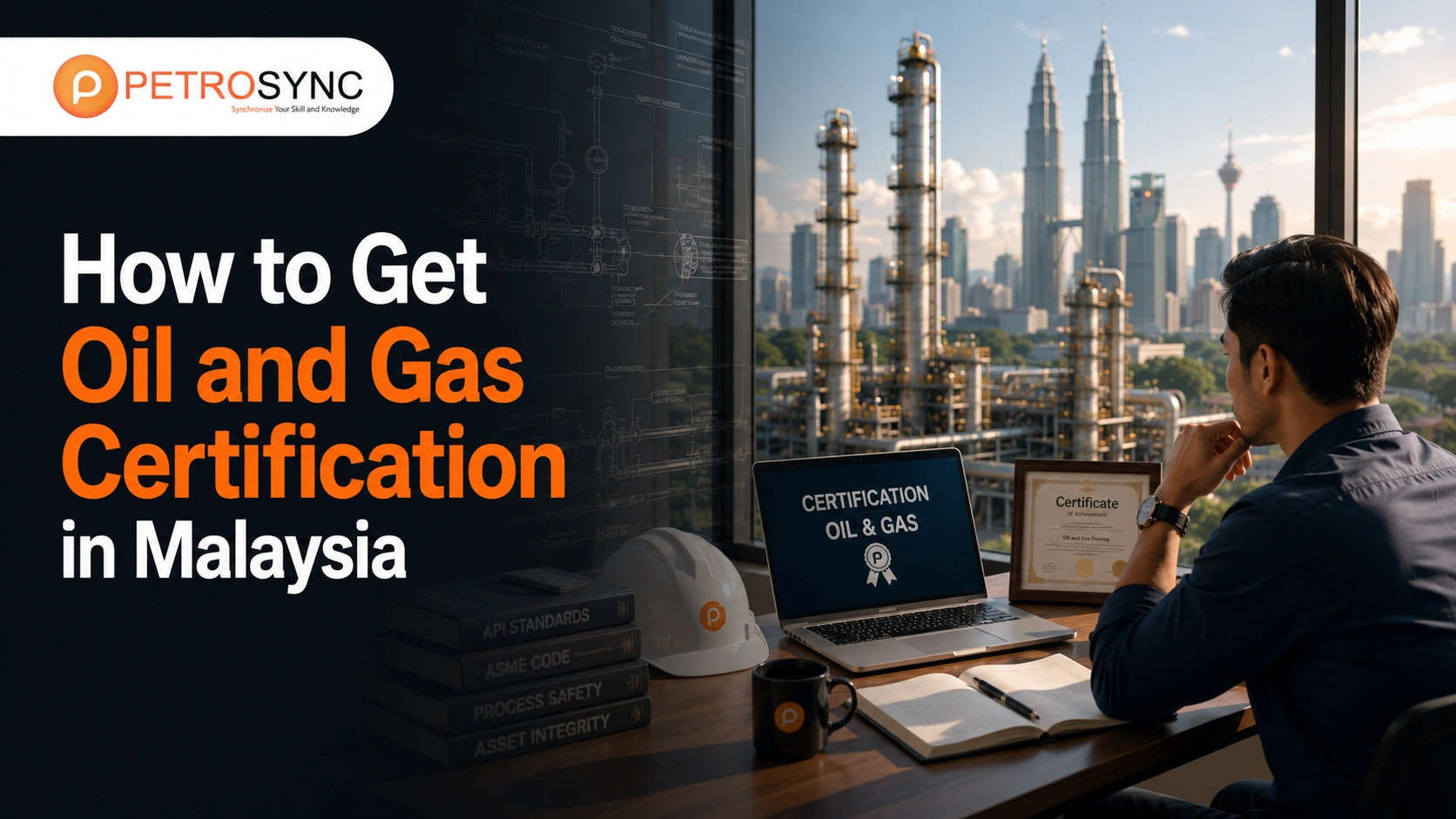
Many professionals search for Oil and Gas Certification Malaysia because they want to strengthen their technical knowledge while earning formal recognition after completing professional training. However, the term “certification” is often misunderstood because it can refer either to professional certifications issued by certification bodies or certificates awarded after successfully completing a technical training program.
According to the World Economic Forum (2025), the ongoing skills gap has emerged as the single most critical roadblock for modern organizations, with 63% of employers identifying it as the primary barrier preventing them from successfully future-proofing their business operations.
Understanding this distinction is important before choosing a training provider. While certification bodies evaluate competency through formal assessment schemes, professional training providers focus on developing practical technical knowledge, engineering skills, and workplace competency. Many training providers, including PetroSync, award a Certificate of Attendance to participants who successfully complete their training programs. This guide explains how professionals can build competency through technical training in Malaysia while selecting the learning pathway that best supports their long-term career goals.
What Is Oil and Gas Certification in Malaysia?
The term Oil and Gas Certification Malaysia is commonly used by professionals searching for technical training programs that provide certificates after completion. In practice, however, the phrase can refer to two different types of professional recognition: formal professional certifications issued by certification bodies and training certificates awarded after completing industry-focused learning programs.
Understanding this distinction helps professionals choose the most appropriate development pathway. Those seeking competency validation through formal assessment may pursue professional certification, while those looking to strengthen technical knowledge, improve practical skills, and gain exposure to real industrial practices often benefit from professional training programs that award a Certificate of Attendance.
What Is the Difference Between Professional Certification and Training Certificates?
Although professional certifications and training certificates both support career development, they serve different purposes within the oil and gas industry. Understanding how each pathway works allows professionals to choose the option that best aligns with their technical responsibilities, career objectives, and long-term development plans.
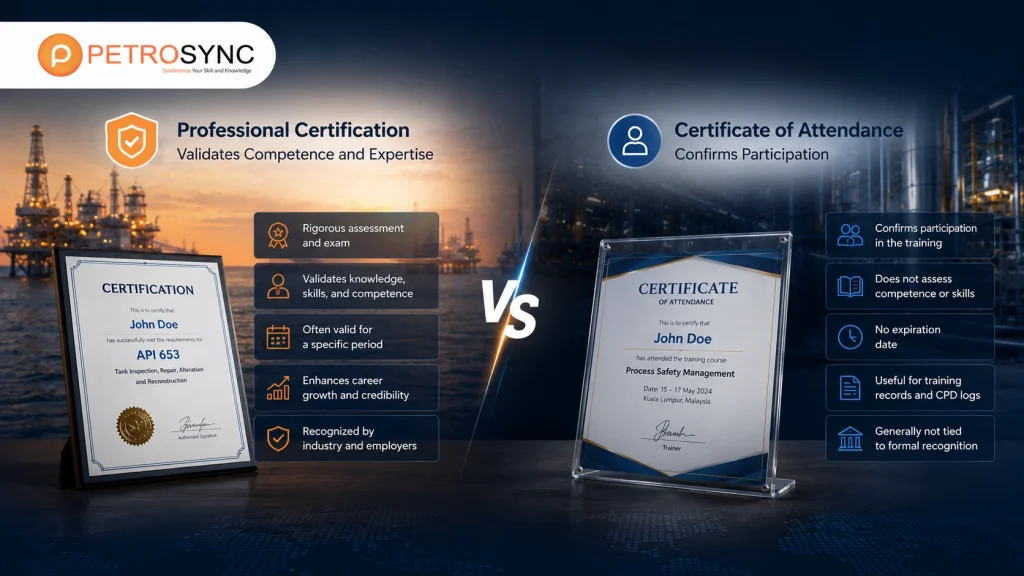
The following comparison explains the key differences:
1. Professional Certifications Assess Industry Competency
Professional certifications are issued by certification bodies that evaluate whether candidates meet established competency requirements through structured assessments, examinations, or practical evaluations. Successful candidates receive certifications demonstrating they have achieved predefined professional standards.
2. Professional Training Focuses on Technical Skill Development
Professional training providers concentrate on helping participants strengthen engineering knowledge through instructor-led learning, technical discussions, practical workshops, and industrial case studies. The primary objective is to develop workplace competency that participants can immediately apply in real operational environments.
3. Most Oil and Gas Training Providers Award a Certificate of Attendance
Participants who successfully complete a professional training program generally receive a Certificate of Attendance, which recognizes successful completion of the course. Although this differs from an independent professional certification, it demonstrates participation in structured technical learning delivered by experienced industry practitioners.
4. Choose the Right Learning Path Based on Your Career Goals
Professionals should select the pathway that best supports their objectives. Those requiring formal competency validation may pursue professional certification, while individuals aiming to strengthen technical expertise, improve engineering capability, or prepare for greater workplace responsibilities often benefit more from professional technical training.
Understanding the difference between professional certifications and training certificates helps professionals invest in learning opportunities that create lasting value throughout their careers.
7 Steps to Get Oil and Gas Certification in Malaysia
Developing technical competency is an ongoing process rather than a single milestone. While receiving a certificate is an important outcome, professionals gain the greatest value by building practical knowledge, applying engineering principles, and continuously improving their technical capabilities through structured learning.
Professionals typically follow the following journey when pursuing oil and gas training in Malaysia:
1. Identify the Technical Skills You Want to Develop
Begin by identifying the engineering knowledge, operational competencies, or technical skills you want to strengthen. Understanding your competency gaps makes it easier to select training programs that directly support your professional development.
2. Choose a Training Program Relevant to Your Job Function
Select training programs that align with your current engineering discipline, operational responsibilities, or long-term career aspirations. Choosing relevant courses increases the practical value of the learning experience.
3. Learn from Experienced Industry Practitioners
Training delivered by experienced practitioners provides valuable insights into real engineering projects, operational challenges, and internationally recognized best practices that cannot always be learned through self-study alone.
4. Complete Practical Workshops and Technical Exercises
Practical workshops, engineering discussions, and industrial case studies allow participants to reinforce technical concepts while developing problem-solving skills that can be applied directly within the workplace.
5. Successfully Complete the Training Program
Throughout the program, participants complete instructor-led learning sessions, collaborative technical discussions, and practical learning activities designed to strengthen technical competency across their chosen discipline.
6. Receive Your Certificate of Attendance
Participants who successfully complete the training receive a PetroSync Certificate of Attendance, recognizing their successful participation in the program and their commitment to continuous professional development.
7. Continue Building Your Professional Competency
Receiving a certificate should mark the beginning—not the end—of professional development. Continuous learning, practical workplace experience, and participation in additional technical training help professionals remain competitive as technologies and industry standards continue to evolve.
Building professional competency requires continuous investment in technical knowledge, practical application, and lifelong learning. Over time, this approach contributes far more to long-term career success than obtaining a certificate alone.
How Can Professional Training Help Advance Your Oil and Gas Career?
Professional training plays an important role in helping engineers and technical specialists remain competitive within a rapidly evolving industry. As engineering standards, technologies, and operational practices continue to advance, continuous learning enables professionals to strengthen technical competency while improving their ability to solve increasingly complex industrial challenges.
Professionals typically strengthen their careers through the following learning journey:
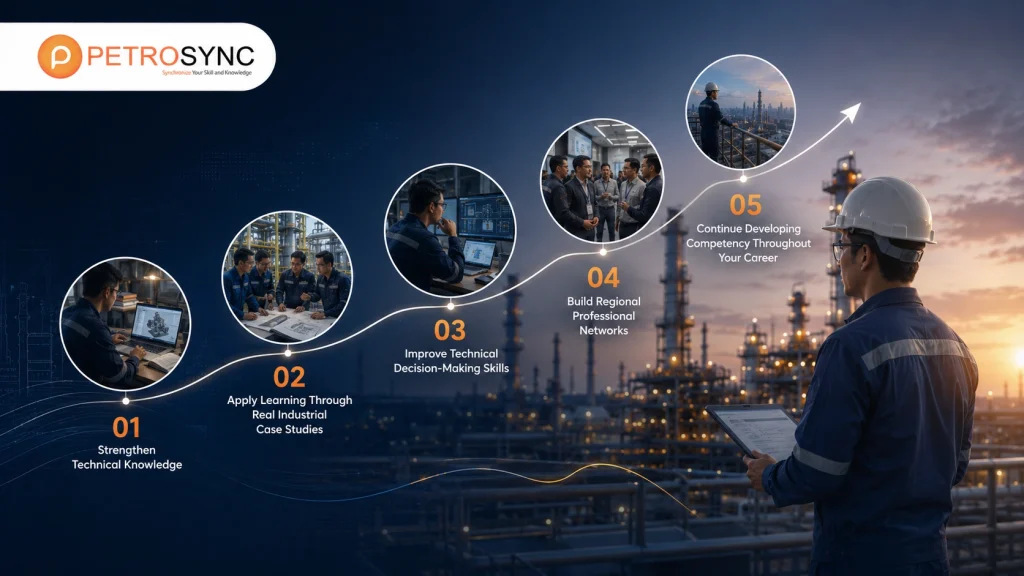
1. Strengthen Technical Knowledge
Structured learning provides a stronger understanding of engineering principles, operational best practices, international standards, and technical methodologies that support better workplace performance.
2. Apply Learning Through Real Industrial Case Studies
Practical workshops and industrial case studies help participants connect theoretical knowledge with real operational situations, improving their confidence when addressing engineering challenges.
3. Improve Technical Decision-Making Skills
Technical discussions led by experienced practitioners expose participants to proven engineering approaches, enabling them to make more informed operational and technical decisions.
4. Build Regional Professional Networks
Training programs create opportunities to collaborate with professionals from different companies, countries, and technical backgrounds, encouraging knowledge sharing and long-term professional relationships.
5. Continue Developing Competency Throughout Your Career
Professional competency continues to evolve throughout an engineering career. Continuous technical training helps professionals stay aligned with new technologies, updated standards, and emerging industry best practices.
Developing technical competency through continuous learning supports stronger engineering performance, greater professional confidence, and sustainable long-term career growth.
Why Is PetroSync a Trusted Oil and Gas Training Provider in Malaysia?
PetroSync is a trusted provider of professional oil and gas training in Malaysia, helping engineers, inspectors, supervisors, technical specialists, and organizations strengthen workforce competency through internationally focused technical education. Rather than acting as a certification body, PetroSync delivers practical learning experiences that help participants develop skills directly applicable to real industrial environments.
[Image – Visualization]
Through experienced industry instructors, practical workshops, engineering discussions, real industrial case studies, and flexible Public Training, Online Training, and customized In-House Training, PetroSync helps professionals across Asia build practical competencies that contribute to safer operations, stronger engineering performance, and continuous professional development.
What Oil and Gas Training Programs Does PetroSync Offer in Malaysia?
Professionals pursuing Oil and Gas Certification Malaysia often begin by attending technical training programs that strengthen practical knowledge and industry competency. PetroSync offers a comprehensive portfolio of industry-focused courses covering upstream, midstream, and downstream disciplines, helping participants develop the technical expertise required for today’s evolving energy sector.
Major training categories include:
1. Asset Integrity and Mechanical Engineering Training
PetroSync delivers specialized programs covering API 510, API 570, API 653, Risk-Based Inspection (RBI), Pressure Vessel Inspection, Storage Tank Inspection, Corrosion Management, Welding Inspection, Mechanical Integrity, and related engineering disciplines. These courses help participants improve equipment reliability, maintain asset integrity, and apply internationally recognized engineering practices throughout industrial operations.
2. Process Safety and Risk Management Training
Professionals responsible for managing operational risks can participate in programs including HAZOP, HAZID, LOPA, Safety Integrity Level (SIL), Bowtie Analysis, Process Safety Management (PSM), and other process safety disciplines. These programs help participants identify hazards, evaluate process risks, and strengthen safety performance within complex industrial facilities.
3. Process Engineering and Plant Operations Training
PetroSync offers technical training covering Process Engineering, Process Optimization, Heat Exchanger Performance, Piping Systems, Production Operations, and other process engineering topics. Participants develop practical knowledge that supports improved plant efficiency, operational reliability, and continuous performance improvement.
4. Drilling, Well Engineering, and Production Training
Training programs include Drilling Engineering, Well Completion, Well Integrity, Well Intervention, Production Technology, and related upstream engineering disciplines. These courses help professionals strengthen their understanding of drilling operations, well lifecycle management, production optimization, and field development.
5. Reliability, Maintenance, and Asset Management Training
PetroSync provides professional development programs covering Certified Maintenance & Reliability Professional (CMRP), ISO 55000 Asset Management, Reliability Engineering, Predictive Maintenance, Maintenance Excellence, and related maintenance disciplines. These programs support organizations in improving equipment availability, reducing unplanned downtime, and optimizing long-term asset performance.
6. Petroleum Engineering and Reservoir Characterisation Training
For subsurface professionals, PetroSync delivers specialized courses including Integrated Petrophysics for Reservoir Characterisation (IPRC), Reservoir Engineering, Formation Evaluation, and other petroleum engineering disciplines. These programs strengthen participants’ capabilities in reservoir evaluation, integrated interpretation, and technical decision-making throughout exploration and production activities.
By offering comprehensive technical training across multiple engineering disciplines, PetroSync helps professionals build practical competencies while supporting continuous professional development throughout every stage of the oil and gas value chain.
What Makes PetroSync Different from Other Training Providers in Malaysia?
Choosing where to pursue Oil and Gas Certification Malaysia involves more than selecting a training venue. The quality of instructors, learning methodology, industry relevance, and practical application all influence how much value participants gain from the training experience.
The following advantages make PetroSync a trusted training partner for professionals and organizations across Asia:
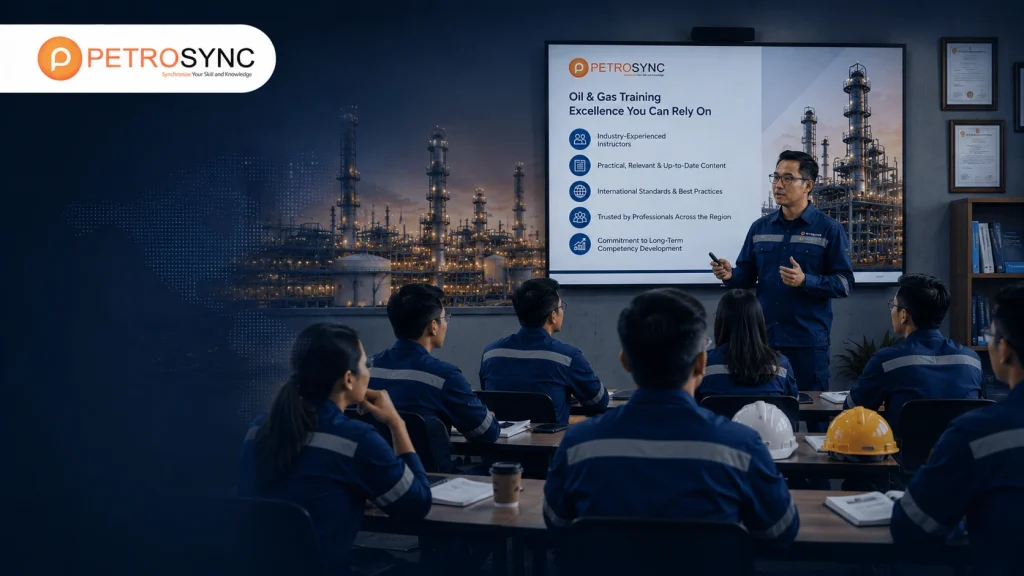
1. Industry-Experienced Instructors
PetroSync’s training programs are delivered by experienced practitioners with extensive backgrounds in engineering, operations, maintenance, inspections, process safety, drilling, and production. Their real-world experience enables participants to understand how engineering principles are applied to actual industrial challenges.
2. Practical Learning with Real Industrial Case Studies
Every course combines instructor-led learning with engineering workshops, technical discussions, and industrial case studies that closely reflect real workplace scenarios. This practical approach helps participants apply newly acquired knowledge with greater confidence in their daily responsibilities.
3. Comprehensive Technical Training Portfolio
PetroSync offers a broad range of technical courses covering engineering, process safety, asset integrity, drilling, production, maintenance, reliability, petroleum engineering, and many other specialized disciplines. This comprehensive portfolio enables both individuals and organizations to continue developing technical competency through a single trusted training partner.
4. Flexible Public, Online, and In-House Training
Participants can choose from scheduled Public Training, instructor-led Online Training, or customized In-House Training designed around organizational objectives, operational challenges, and workforce competency requirements. These flexible delivery options make learning more accessible for both individuals and corporate teams.
5. Regional Training Hub with International Participants
Training programs conducted in Malaysia regularly bring together professionals from operators, EPC contractors, service companies, and industrial organizations across Asia. This multinational learning environment encourages technical collaboration, knowledge sharing, and valuable professional networking opportunities.
PetroSync combines experienced instructors, practical industrial learning, flexible training delivery, and internationally focused technical education to help professionals strengthen their engineering capabilities and support long-term career development.
How Much Does Oil and Gas Training in Malaysia Cost?
The cost of pursuing Oil and Gas Certification Malaysia through professional training depends on several factors, including the selected course, training duration, delivery format, schedule, and organizational requirements. PetroSync offers flexible learning solutions for both individual professionals and corporate teams, allowing participants to choose programs that best match their technical objectives and development plans.
The following training options are available:
1. Public Training Programs
PetroSync’s Public Training programs enable participants to join scheduled courses alongside professionals from different organizations and countries. Each program combines instructor-led learning, practical workshops, and collaborative technical discussions to maximize knowledge sharing and practical application.
|
Training Type |
Typical Scope |
How to Get a Quote |
|
Public Training |
Scheduled classroom-based programs in Malaysia featuring instructor-led learning, practical workshops, and engineering discussions. |
Contact PetroSync to receive the latest training schedule and official quotation. |
|
Online Training |
Live virtual courses providing the same learning objectives, instructor interaction, and technical discussions as classroom training. |
Request the latest online schedule and pricing directly from PetroSync. |
2. In-House Training Solutions
Organizations seeking to strengthen workforce competency can choose In-House Training, where PetroSync customizes the curriculum according to operational challenges, technical disciplines, participant competency levels, and organizational learning objectives.
|
Training Type |
Typical Scope |
How to Get a Quote |
|
In-House Training |
Private training delivered at the client’s preferred location with customized learning objectives and flexible scheduling. |
Submit an in-house training request to receive a proposal tailored to your organization’s technical requirements. |
Since every organization has unique development objectives, PetroSync provides customized quotations based on the selected course, delivery format, number of participants, and training location. Contact the training team to receive the latest schedule, availability, and pricing information.
Schedule a Consultation with PetroSync Today
Whether your goal is to strengthen your own technical competency or develop the capabilities of an entire engineering team, investing in professional training is an important step toward long-term career and organizational success. PetroSync’s training advisors can help you identify the most suitable learning pathway based on your technical background, current responsibilities, career aspirations, and business objectives.
Contact PetroSync today to explore upcoming Public Training programs in Malaysia, request a customized In-House Training proposal, or discuss the most appropriate technical courses for your professional development. Upon successfully completing your selected program, you will receive a Certificate of Attendance recognizing your commitment to continuous learning and technical excellence.
Frequently Asked Questions (FAQ)
Yes. Participants who successfully complete a PetroSync training program receive a Certificate of Attendance, recognizing their successful completion of the course. While this is not an independent professional certification issued by a certification body, it demonstrates your commitment to continuous professional development through structured technical training.
Absolutely. PetroSync's training advisors can recommend the most appropriate program based on your current role, technical background, industry experience, and career objectives, ensuring your training investment aligns with your professional development goals.
Yes. Many participants are experienced engineers and technical specialists who join PetroSync training to update their technical knowledge, learn current industry best practices, gain insights from experienced practitioners, and exchange ideas with professionals from across Asia.
Yes. PetroSync provides customized In-House Training designed around your organization's operational challenges, technical disciplines, competency requirements, and business objectives. The curriculum can be tailored to maximize workforce competency development.
Yes. Before registering, you are encouraged to consult directly with PetroSync's training advisors to discuss your technical background, learning objectives, preferred training format, and career aspirations. Based on your needs, the team will recommend the most suitable training program to support your long-term professional development.

Results-oriented and thorough SEO specialist with extensive experience in conducting keyword research, developing and implementing digital website promotion strategies and plans, managing campaigns to develop company websites in the digital world, excellent knowledge of marketing techniques and principles, and attentive strong attention to detail.